Hyperscaling Responsibly: Data Center Design for Sustainability
Design techniques have given rise to effective strategies that aim to minimize operational cost, environmental impact and neighborhood disturbance.
By Julia Diaz, Contributing Writer
The expansion in data center development across the country has drawn scrutiny from local communities over the perceived impact of operations on local resources. Operators are equally concerned, and many are adopting modern design techniques that marry precision efficiency with sustainable operations to satisfy their own and their neighbors’ priorities. Power and water are typically the biggest challenges.
In 2024, U.S. data centers used 180 Terawatt-hours (TWh) of electricity, enough to power 16 million homes for an entire year. That number is projected to more than double to 420 TWh by 2030. The demand for water used to cool AI servers is expected to reach 300 billion gallons in the same time frame, which is equivalent to almost a year’s worth of water consumption for New York City’s 9 million residents.
With data center construction accelerating, building sustainably has become essential and a primary driver in the design process. Recognizing resource limitations, developers and hyperscalers — major cloud service providers, including Amazon, Google and Microsoft — have vested interests in maximizing resource efficiency and green energy adoption. That means reliability, durability, resource stewardship and community acceptance have become primary factors in the design and build process.
Current design techniques have given rise to effective strategies developers can use to minimize operational cost, environmental impact and neighborhood disturbance. Leading-edge developers, architects and engineering teams are addressing environmental impact of data center development and operations through sustainable, integrated design.
Solving the power problem
While data centers consume a large amount of power, they are extremely efficient. About 80 percent of the energy used by data centers powers the servers themselves, and equipment suppliers have responded by developing the most efficient chips and servers.
The average annual power usage effectiveness (PUE) — the ratio of total annual energy to run the data center relative to the total annual draw by the IT equipment — has dropped significantly. With 1.0 PUE being a 100 percent efficient system, the average is now 1.56, which is down from 2.50 at its peak. Beyond that, the design priority then shifts to minimizing non-compute power consumption across the facility.
In the pre-design phase, many utilities and local authorities require upfront municipal bonds to fund generation and transmission upgrades that serve the new data center load and provide much-needed grid modernization to accommodate increased electrical demand and the green energy transition. The aging grid has been a vulnerability long before the data center boom, so this approach serves the interests of data center operators and their neighbors.
Many hyperscalers also are tapping into renewable energy, especially solar, hydropower and geothermal. For example, Google, Meta and others have recently partnered with geothermal suppliers to underwrite the construction of new generation capacity to supply their data centers. This measure allows emerging technologies to reach commercial scale while delivering the always-on power that AI workloads require. These partnerships provide a guaranteed private-sector market for new renewable energy technology and are key to supporting the innovations that will eventually enrich all our lives.
The Bitcoin mining sector has been an early adopter of grid-responsive operations — a strategy colocation and hyperscale operators can also use to manage demand. By participating in utility demand-response programs, operators can modulate their consumption based on real-time demand to leverage financial incentives and avoid overtaxing the grid.
Because redundant power is essential for ensuring high reliability, sites commonly use backup generators, battery storage or a combination of both. Designing for ample on-site capacity allows operators to take themselves off the grid and become self-sustaining during periods of high demand or use battery storage to bank power when demand is low. Instead of being merely a consumer, operators become grid participants as part of a virtual power plant, absorbing or releasing power as demand dictates.
Managing water woes
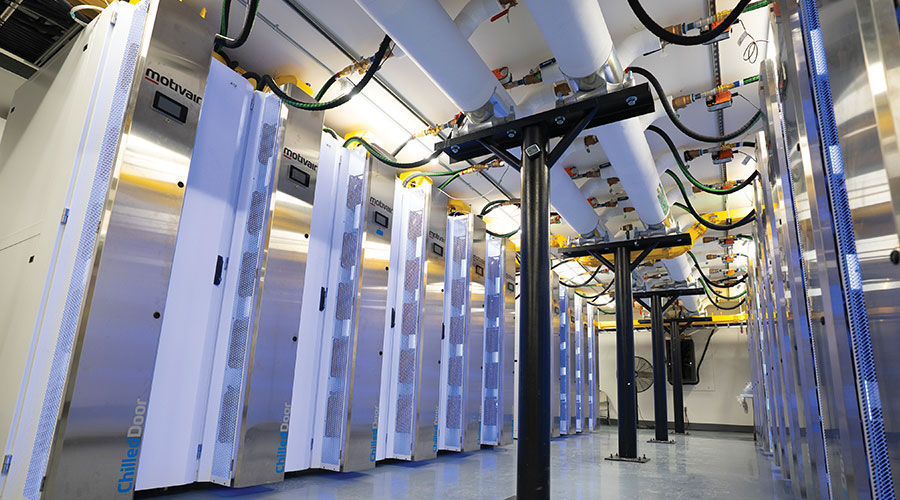
Equipment cooling is essential for optimal performance of data centers, and the water required often is a major sticking point in facility approval and community pushback. While some operators have tried to mitigate this issue by opting for waterless, air-cooled systems, this approach leads to added electricity demands.
Water has a higher heat capacity, and liquid-cooled servers can operate at higher temperatures, so they are inherently more efficient than their air-cooled predecessors. Combined with the higher operating temperatures made possible by innovations from hardware providers, facility designers can reduce or eliminate the most power-hungry cooling systems through liquid cooled loads.
Another design option is to capture heat output for use in other applications. This practice is common in the European Union, where district heating loops provide hot water heat to nearby neighborhoods. Because residential proximity is less common in the United States, many developers are exploring industrial applications for their excess heat, including food processing and manufacturing facilities that can be co-located near the data center. Greenhouses and other agricultural use cases are also viable options.
Mitigating acoustic impact
The continuous acoustic signature of data center operation is a critical issue for local communities. Because this signature is typically a low drone or hum, many people perceive it more as vibration or pressure than as an audible sound, which can make it harder to attenuate.
Most facilities are located in jurisdictions with maximum decibel tolerances at the property boundaries, so sound mitigation is routinely incorporated into facility design. Backup generators and cooling equipment typically are the biggest noise producers, which means mitigation typically starts with the manufacturer. Site developers and designers work with suppliers to build quieter, better insulated and less disruptive equipment.
Another strategy designers use to reduce noise is to deliberately oversize equipment. When the load is lighter than capacity, generators and cooling systems do not have to work as hard, which helps them run quieter and more efficiently.
Sound containment structures, baffles and noise screens are common acoustic design strategies, as is using the structure’s orientation to reduce disturbance. Building high soil berms and planting rows of trees also helps mitigate sound and aesthetic concealment, which helps the facility blend into its surroundings. All of these commonly utilized strategies for noise mitigation are likely to be more popular in the future.
Designing for Adaptability
Planning for an evolving future is one of the most important aspects of sustainable data center design. Not only is the hardware becoming smaller and increasingly dense with every iteration, but the buildings themselves are constantly being reconfigured and retrofit to meet tenant needs. With average expected lifespans of 30 years, data centers need to be agile to stay competitive with hardware refreshes on a three- to five-year cycle.
Adhering to industry standard specs for equipment and thoughtfully engineering power and cooling infrastructure for modular, adaptive reuse can drastically reduce waste from discarded hardware and lower reconfiguration costs.
The power of predictive modeling
Because of long lead times, most data center equipment must be ordered before designs are finalized. Designers use this as a strategic advantage. It is an opportunity to model, test and optimize potential designs during the concept phase.
Using energy, acoustic and construction modeling software, engineers can forecast the way a facility will operate throughout the year. Combined with an integrated design process that brings all disciplines to the table from the start, this modeling allows for deep collaboration early in the design process to test scenarios, predict obstacles and make more confident decisions faster.
For example, virtually testing scenarios like relocating steel columns, moving expansion joints and adjusting sound baffles helps design teams predict and achieve more efficient outcomes, reduce rework and provide empirical data to make better decisions earlier. Each choice can be thoughtfully considered and thoroughly vetted based on a broad perspective and various points of view to better understand the impact before it is put into place.
Proactive regulatory alignment
Planning for the future includes proactively adopting industry guidance and standards, even if they are not yet mandated. Getting ahead of compliance is much easier and more efficient than playing catch-up. The American Society of Heating, Refrigerating and Air-Conditioning Engineers (ASHRAE) plays a major role in setting standards and best practices for energy-efficient HVAC, thermal and humidity management.
More broadly, the Open Compute Project has multiple working groups of global industry leaders who collaborate to share strategies and standardize data center design. This includes everything from small details like establishing standard rack dimensions to networking best practices.
Working with a design team that participates in these communities and stays current on emerging guidance streamlines project development and compliance for years to come.
Designing for co-habitation
Data centers increasingly underpin so much of people’s daily lives, from facilitating streaming entertainment, social media, video calls and online shopping to medical records, weather modeling and 911 dispatch and emergency response. High-performance computing is a utility in the modern world that people rely on in the same way they rely on electricity, natural gas and phone service.
Just as other industries have evolved to become better cohabitants of the land, data center operators are consciously working to improve their footprint by adopting new sustainable technologies and innovations in response.
Having a design team that has helped steer the sustainability evolution in other industries is a competitive advantage. An integrated, collaborative team can apply the knowledge and innovations they have developed for other mission-critical and commercial design projects to accelerate the path to sustainable data center coexistence by delivering economic and lifestyle advantages. Working together, designers, engineers and developers can build a better future for people, the technology they rely on and the planet.
Julia Diaz, P.E., is a mechanical engineer for the mission critical sector at HED, an architecture, engineering and design firm.
Related Topics: