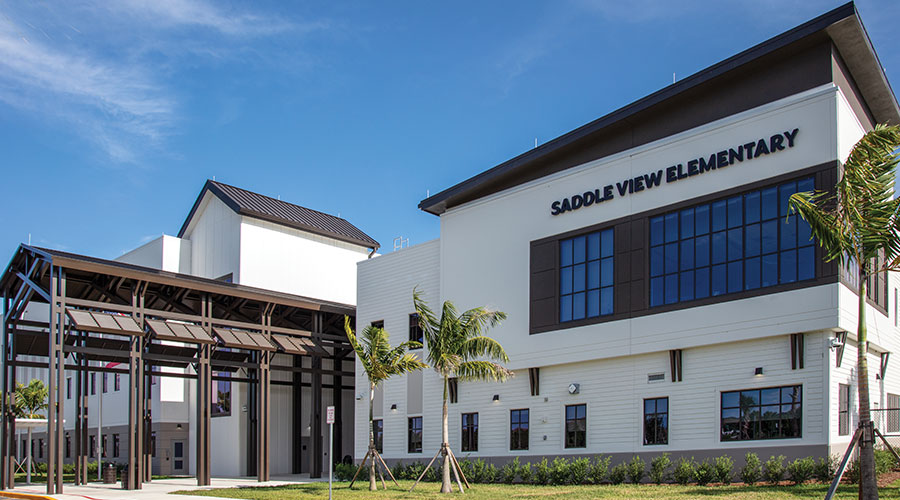
 Photo credit: The School District of Palm Beach County
How the School District of Palm Beach County Designs for Storms
Owners and executives can lean on proactive, resilience-driven design to help their facilities weather the storm.
By Jeff Wardon, Jr., Assistant Editor
Severe weather events have become increasingly common and destructive nationwide. These storms can rip and tear through building infrastructure within minutes, often leaving them devastated. Facility owners and executives can take measures beforehand to make their buildings more resilient to disaster.
Owners and executives can lean on proactive, resilience-driven design to help their facilities weather the storm. The School District of Palm Beach County, which is situated in the high-risk climate of Southern Florida, where hurricanes, flooding and extreme heat are common. This district’s practices demonstrate the way resilience can work as a system-wide strategy that spans design, maintenance and long-term planning.
Designing beyond code
Designing for resilience starts with code compliance, but it goes well beyond it. Many times, complying with building codes often is treated as the maximum amount of thought and consideration when designing facilities.
In reality, codes serve as a baseline rather than a ceiling. The School District of Palm Beach County follows this tenet in their designs.
The main code they use is the Florida Building Code, which references American Society of Civil Engineers standard 7-22 for Minimum Design Loads and Associated Criteria for Buildings and Other Structures, and it also draws on International Code Council 500 Standard for the Design and Construction of Storm Shelters, according to Marisa-Ann Gedeon, director of building code services for the district.
However, just following code is not the limit of what can be done.
“The codes are the minimum, and we try to exceed that so we can do our best for resiliency in our schools,” says Michael Tubiolo, director of facilities construction for the district.
For example, the district builds a bit higher than the minimum level of the floodplain to bake in more flood redundancies for their facilities. They also tighten their building envelope design and incorporate other redundant systems to improve reliability during storms, Tubiolo says. Overall, resilience is layered into design decisions from the start.
Those decisions are critical in a region where schools are expected to do more than educate students. Many campuses are designed to act as community shelters during hurricanes, which requires coordination with local agencies to make sure there is enough capacity and strategic placement.
Emergency generators are standard, Tubiolo says, allowing facilities to maintain operations and reopen quickly after an event. In some cases, other infrastructure components, such as on-site water storage equipment, helps ensure continuity even if municipal systems are disrupted.
The building envelope in practice
Resilience is not just about compliance. It also is about the way buildings function during and after a storm. The building envelope plays a central role in resilience. Materials and construction strategies are chosen not only for durability, but also for their ability to minimize vulnerabilities.
“We do a lot of tilt-wall construction, which creates a fairly rigid envelope and has fewer penetration or weak points,” Gedeon says.
Exterior components such as wall and window systems must meet strict testing requirements for wind pressure and impact resistance. This reflects the realities of a high-velocity hurricane zone, where airborne debris is a frequent threat.
“Everything on the outside has to be independently tested to withstand those high force winds, as well as small and large missile impact,” Tubiolo says.
Even seemingly small decisions can end up having a greater impact. The district places critical equipment inside buildings rather than on rooftops or exposed exteriors to reduce the risk of storm-related damage. At the same time, efforts to create tighter building envelopes help limit air and water infiltration, improving resilience and energy performance.
A preventive approach
Design on its own is not enough to guarantee resilience. Preventive maintenance is an equally important aspect of the district’s resilience strategy.
“We have a preventive maintenance program for our roofing systems where they're inspected annually,” says Stacey Marshall, the district’s director of maintenance and plant operations. “So we do any kind of minor repairs before they blossom into a glorious eruption.”
Marshall says exterior maintenance programs, including painting and sealing, help prevent moisture intrusion and long-term degradation.
As hurricane season draws near each year, those efforts intensify. Maintenance teams conduct comprehensive system checks across campuses, testing generators, verifying valve operations and making sure that emergency systems are fully functional, says David Dolan, chief of facilities management for the district. Any potential hazards such as lightweight exterior structures also are identified and addressed in advance to reduce the risk of damage during a storm.
“Stacey’s team does a kind of a heavy-duty test in the late spring to make sure that all of our schools, particularly our shelters, are in good shape and ready for the storms,” Dolan says. “But that also goes to the preventive maintenance of validating that there are not areas where we have potential flying debris.”
That fusion of design and maintenance has delivered measurable, tangible results. In recent storms, district facilities have experienced minimal structural damage, with most issues tied to external factors such as debris or electrical surges rather than building envelope failures.
Those experiences have also shed light on new challenges. More energy-efficient systems, while beneficial during normal conditions, can be more sensitive to power fluctuations during extreme circumstances.
Balancing these considerations necessitates a long-term perspective on cost and performance. While more resilient materials and systems often come with higher upfront costs, the facilities department evaluates those investments in terms of life-cycle value.
“Some of the equipment has a slightly higher upfront cost, but it is usually a really short turnaround because of our energy savings,” Tubiolo says.
For example, longer-lasting roof systems reduce the frequency of replacements, while energy-efficient designs lower operating expenses over time.
“If it is a million-dollar roof replacement, and you are replacing it every 20 years, that is $50,000 a year in deferred costs,” Dolan says.
A sustained commitment to capital renewal across the district’s portfolio has further reinforced this approach, ensuring older facilities are upgraded to meet performance expectations.
Looking ahead
The School District of Palm Beach County continues to refine its strategy, with new construction projects serving as testing grounds for emerging ideas.
An upcoming elementary school is being designed with an emphasis on resilience and energy efficiency, incorporating tighter envelope detailing, enhanced commissioning processes and systems optimized for long-term performance. The project is also being evaluated for net-zero energy operations, with early projections forecasting a relatively short payback period of seven to eight years, Tubiolo says.
“We do not want to be on the leading edge, but we do want to make sure that we lead the industry as far as products that are successful,” he says.
Instead of chasing unproven technologies, the district focuses on adopting strategies that have demonstrated success while using data from existing facilities to inform future decisions. This feedback loop allows the district to gradually improve performance without taking on unnecessary risk.
Ultimately, even for facilities owners and executives in regions where the specific challenges differ, the core theme of resilience is widely applicable. Resilience is no longer a single design feature or a one-time investment, but an ongoing process that encompasses planning, construction, maintenance and operations. Through a commitment to continuous evaluation and improvement organizations can better position their buildings to weather whatever storms lie ahead.
Jeff Wardon, Jr., is the assistant editor of the facilities market.
Related Topics: