Avoiding Portable Cooling Failures: A Technical Guide for Facilities
From accurate sizing and electrical planning to airflow design and ongoing maintenance, performance depends less on the unit itself and more on how well the system is engineered and supported in real-world conditions.
One common recommendation among MEP consultants is to stop treating nameplate capacity as the answer. Real-world, delivered cooling depends on the way the unit is deployed and the conditions it faces once it is in the building.
“A unit’s BTU rating is only a starting point because placement, ducting length, airflow restrictions and heat-rejection routing can reduce the actual delivered cooling performance,” says Kaye Scheurer, senior director of engineering operations, workplace management, at JLL.
Nick Angerosa, executive vice president, national customer solutions at Limbach, says many performance claims are based on idealized test conditions that are often eroded by real-world conditions, such as higher ambient temperatures, elevated humidity, long or restrictive duct runs and electrical constraints that limit stable operation.
“We recommend that facilities apply a 10 percent to 25 percent derate factor in harsh conditions, verify static pressure tolerance, confirm sensible vs. total capacity matches the load profile— many spaces are sensible-heavy — and request performance curves, not just nameplate BTU,” Angerosa says.
By subtracting the application’s environmental derates and installation losses from the unit’s rated capacity, managers can more accurately estimate a unit’s delivered cooling performance.
Some best practices include gathering peak and average load, understanding the sensible-versus-latent split, confirming room dimensions and ambient conditions, identifying heat-generating equipment and determining a supply and exhaust path that realistically can be built in the field. Trade professionals often recommend treating the air path as part of the sizing exercise, not something to figure out after the unit is selected.
Electrical planning and reliability
If sizing is the first major decision, electrical planning is often the first operational test. Many temporary cooling projects run into trouble not because the unit is defective but because the power plan is incomplete. Common problems include underestimated startup inrush current, shared circuits, voltage drop across long feeder runs, undersized extension cabling and breaker setups that do not align with the equipment’s startup profile.
Angerosa says managers need to use dedicated circuits whenever possible, verification of conductor sizing and startup testing under load before the space is fully occupied.
“Electrical planning needs to be part of the decision early,” Scheurer says. “Breaker sizing, outlet type, amp rating, and lock rotor amperage all have to be matched correctly to avoid nuisance trips and startup issues.”
This potential problem means managers should commission portable cooling with the same discipline as other temporary building systems. A quick visual check of outlet availability is not enough if the circuit cannot support startup behavior without nuisance trips or voltage instability.
Airflow and heat rejection
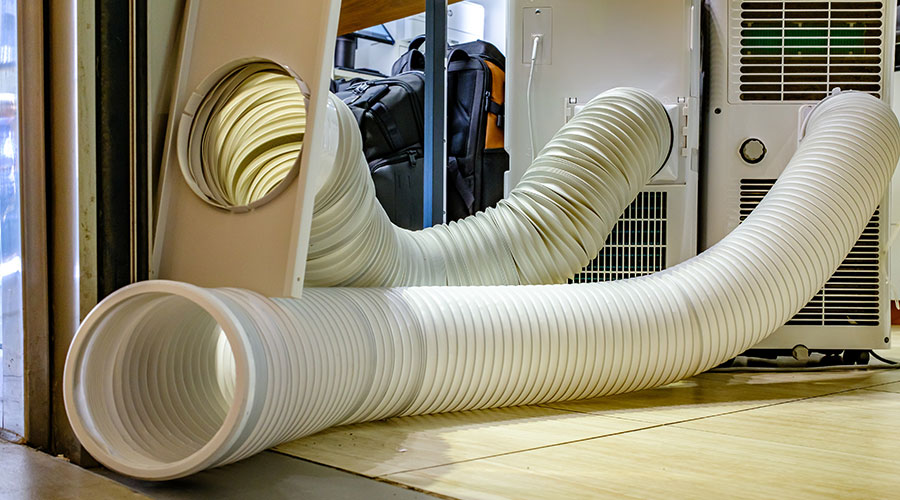
Airflow is often the least visible problem in portable cooling, but it might be the biggest reason a deployment underperforms. In other words, airflow is the most common so-called soft failure. The unit runs, but the room temperatures do not improve.
Some best practices to address this issue include designing the supply path so cooled air actually reaches the heat source, minimizing duct length and bends and ensuring rejected heat is routed far enough away that it does not migrate back into the same space.
Experts say the issue has several common causes, including short-circuiting supply air, long or kinked exhaust runs, blocked airflow and return conditions that are hotter than anticipated. They add that exhausting air can affect building pressurization, infiltration, doors, adjacent spaces and ventilation balance.
As a result, portable cooling deployment cannot be judged only by whether the unit powers on. It has to be evaluated by whether the air path is engineered well enough to deliver stable cooling where the building actually needs it.
“Airflow is where many portable cooling projects quietly lose performance,” Angerosa says. “Every added bend, restriction or poorly placed exhaust path reduces what the unit can actually deliver to the space.”
Monitoring, maintenance and total cost
Trade professionals often recommend evaluating portable cooling as a full temporary deployment cost, not just the rental or purchase price plus electricity. But electrical work, ducting, connectors, condensate pumps, service visits, filter changes, labor, space disruption, and monitoring requirements are all parts of the true cost.
Once units are deployed, one common recommendation among MEP consultants is to maintain regular inspection routines that check airflow, condensate handling, heat rejection, adjacent-space temperatures and overall unit operation. In occupied spaces, outside air, air quality and noise also need attention.
The broader takeaway is that portable cooling is becoming part of resilience planning, especially in facilities facing aging infrastructure, deferred upgrades and growing continuity-of-operations demands. Organizations that get the best results plan temporary cooling connections and procedures before an emergency makes every decision reactive.
“Portable cooling can be a valuable part of a facility response plan, but it performs best when the planning is done in advance, and the operating impacts on both equipment and occupants are clearly understood,” Scheurer says.
Portable cooling delivers the most value when managers treat it as an engineered solution rather than a quick fix. Though the unit appears simple, it functions more like a small on-site HVAC system, with real-world performance shaped by proper sizing, sound electrical planning and effective airflow and heat-rejection management. Success depends less on the unit than on the planning behind it. That planning turns portable cooling from a temporary convenience into a reliable performance strategy.
Joel Williams is a freelance writer based in Frankfort, Illinois.
Related Topics: