How Technology Is Reshaping Landscape Maintenance
From autonomous mowers to GPS tracking and hybrid equipment, grounds managers are blending traditional tools with emerging technologies to boost efficiency, precision and sustainability across large-scale landscapes.
As sustainability goals grow more ambitious and technology more complex, grounds and landscape managers have discovered there is truth in this phrase: It isn’t easy being green.
Maintaining landscapes around institutional and commercial buildings in sports facilities and in parks has become increasingly complex. Grounds managers must deliver pristine fields and landscapes while navigating labor shortages, budget constraints, sustainability goals and rapid technological change.
As a result, they are reshaping large-scale landscape maintenance. Their operations blend traditional equipment with data-driven technology, robotics and automation to create smarter, more efficient grounds programs.
The foundation of grounds management
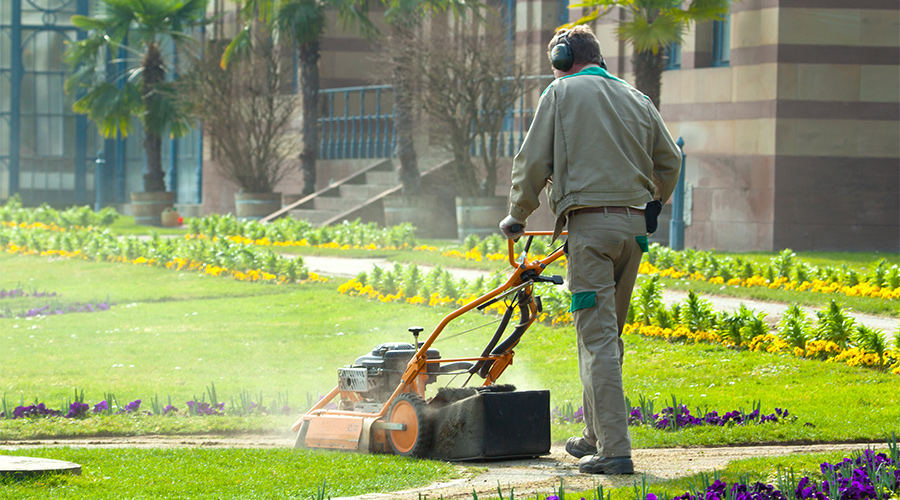
Even at institutions that experiment with innovative technology, traditional mower fleets are still the backbone of day-to-day operations.
Nick McKenna, Texas A&M’s assistant athletics director for sports fields, describes his mower setup as reasonably traditional, adding it features large, commercial-grade triplex units designed for sports turf and landscape areas, as well as zero-turn mowers and traditional push mowers.
“We have added a couple of hybrid units,” he says. “The engines are still diesel-powered, but the cutting units are electric. This has allowed us to eliminate some of the hydraulics, which reduces the risk of a blown hydraulic line on the field killing the grass.”
Reliability and precision guide Texas A&M’s mower selections.
“Reel mowers are necessary for that ultra-low cut and smooth playing surface,” McKenna says. “We can’t compromise quality, and that means traditional equipment stays front and center.”
Lance Johnson, who oversees parks, golf and open spaces for the city of Westminster, Colorado, also underscores the importance of proven equipment.
“We still use ride-on and zero-turn mowers for most sizeable areas,” he says. “These mowers are reliable, efficient and able to handle the grass types and frequent use in parks and athletic fields.”
In municipal spaces with variable terrain and unpredictable public interaction, dependable machinery often outweighs the promise of new technology.
Matt Bailey, landscape services manager at Michigan State University, says diesel-powered mowers remain the standard for demanding applications at the university, despite the growing availability of electric tools. Armed with diesel mower technology, his 100-person crew manages 400 acres of turf using around 40 mowers.
“We are constantly trying out new technologies as they become more and more available,” he says. “However, you can’t beat the consistency of traditional gas-powered equipment for high-use athletic fields.”
Bailey says warranty, operating costs, reliability and blade speed are top priorities when choosing mowers, adding that he replaces his mowers every three years.
Robotics on the grounds
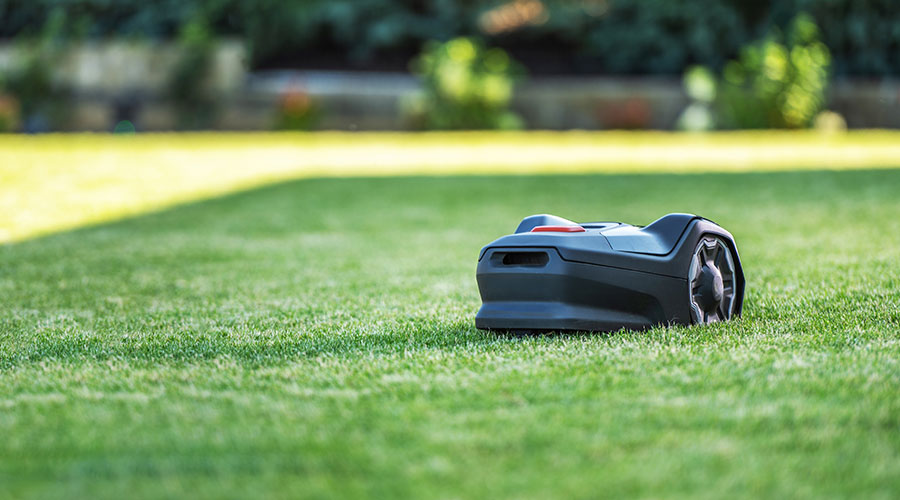
Alongside traditional mower fleets, autonomous and robotic mowers are making waves in landscape management, in part because they tackle repetitive tasks and tricky schedules to free teams to focus on the work that truly matters.
McKenna has incorporated several autonomous mowers at Texas A&M over the last three years, assigning them to fields with unpredictable use patterns, such as a track facility and a football practice area.
“The mowers are not perfect,” he says. “Sometimes, they get stuck on obstacles or lose satellite signals, but they free our staff to focus on higher-priority work. A robot mowing overnight lets our staff handle high-traffic areas during the day. We are not doing less work. We’re reallocating it.”
For example, the robot assigned to the university’s track facility cannot cut right up to the edge, so the staff perform edging and cleanup while the mower handles most of the mowing.
Johnson says he is experimenting with small and medium robotic mowers on athletic fields and landscape areas at Westminster Parks. He started small with testing and observation. Over time, Johnson says he found that the machines adapted to environments, learning paths and avoiding obstacles more effectively.
“Our experiments show that these robots can handle routine mowing and reduce labor intensity without sacrificing quality,” he says.
Bailey says he also sees the value in autonomous units. Though not a perfect solution, he says their use can lead to significant time and cost savings.
“It costs us about $1,000 an acre each year to mow,” he says. “We have nine autonomous mowers doing some of our larger field areas. They save us around $10,000 a year. We have integrated robotic units for select sports fields, and they help maintain consistent turf quality and allow staff to focus on tasks that require more nuanced human judgment.”
All three managers say autonomous technology can come with challenges.
For example, McKenna says the robotic mower repeatedly becomes stuck in one field when mowing in a particular direction. If the problem is not detected, the mower will repeatedly pass over the area until its battery dies.
Turning data into action
Landscape modernization has received a high-tech makeover at Michigan State University, where Bailey’s team uses GPS and data insights to optimize activities and redefine efficiency and precision.
“We have GPS on almost every piece of equipment that we own,” Bailey says. “We also have asset trackers on high-use implements and bigger tools.”
In addition to equipment location tracking, the department’s system monitors equipment behavior and use in real time, allowing supervisors to make data-driven decisions.
Tracking provides insights into multiple operational metrics, Bailey says. For example, the system tracks power takeoff on/off time so supervisors can see how long a mower was cutting turf versus traveling between locations.
“It also helps managers make better decisions on which type of mower they want to use, whether it’s the 70-inch or the 105-inch batwing, or you only need the 28-inch standard” mower, he says.
Data also has boosted accountability across the department by giving staff and supervisors access to the same performance metrics. For example, the ability to recognize hard stops or hits allows them to work jointly toward safer equipment operation.
“It has also spurred a lot of accountability and efficiency conversations with our team,” Bailey adds. “If an operator ran a mower for nine hours today but only mowed for four, I’m going to have a conversation with him.”
GPS tracking also enhances equipment maintenance.
“Our timelines for preventive maintenance have vastly improved,” he says. “We are no longer relying on the operator to bring a mower in when the sticker says maintenance is needed. We now look at our mowers every 100 hours to make sure we catch any issues.”
These systems also use geofencing, which alerts managers if equipment leaves designated boundaries. This information is vital on a large campus with a $7 million fleet spread across 16 locations.
Bailey also uses tracking to optimize resource allocation. If a mower breaks down, he can see whether another is sitting idle and redirect it accordingly. This visibility reduces downtime and maximizes fleet utilization.
Ronnie Wendt is a freelance writer based in Minocqua, Wisconsin.
Related Topics: