Safer, Smarter and More Efficient: Mowing Strategies for Today’s Lean Crews
Mower manufacturers discuss how safety-focused design, ergonomics and productivity-enhancing features help crews work smarter—and safer—with fewer people.
Safety and productivity are increasingly intertwined in grounds operations. Training, scheduling and maintenance practices still form the foundation of safe operations, but manufacturers are also placing greater emphasis on ergonomics, operator comfort and technologies that reduce fatigue and distractions.
In this manufacturer roundtable, Facility Maintenance Decisions asked mower manufacturers how evolving safety expectations and ongoing labor constraints are shaping equipment design and operational strategies, and what features can help grounds teams maintain quality results with smaller crews.
FMD: Safety requirements for grounds crews continue to evolve. What broader safety features, standards or ergonomic improvements are becoming more important in today’s mowing environments?
“The importance of safety comes down to four main points – education, smart scheduling, proper maintenance and operator fatigue. Education starts with reading and understanding the operator’s manual and following the manufacturer’s instructions. Landscape owners should hold regular training with each employee/operator and monitor their daily operations to ensure that the mower operators are adhering to safe operations.
It is tempting to squeeze another job or two into a crew’s schedule to increase revenue. Accidents are more likely to happen when operators are rushing to get from one job to the next. Do not cut corners on maintenance! In addition to regular or periodic maintenance, each crew member should inspect their mower each day to check fluid levels, blades, tire pressures, etc., before heading out for the day as well as between jobs. Faulty equipment leads to problems that could otherwise be avoided.
Another safety concern is operator fatigue. When a mower operator becomes fatigued reaction times and decision making can present safety concerns. Grasshopper engineers its mowers to help operators stay focused, alert and comfortable throughout the day. Ergonomics are built into each mower to deliver a smooth vibration-free ride. Premium seats reduce fatigue and dissipate jolts and jostles on uneven ground. Landscape operators see a dramatic reduction in productivity and employee turnover absenteeism and workers’ compensation claims as a result.”
— Brian Schoenthaler, marketing specialist, Grasshopper
FMD: With many facilities facing labor constraints, what operational strategies or equipment characteristics can help grounds teams maintain efficiency and quality with smaller crews?
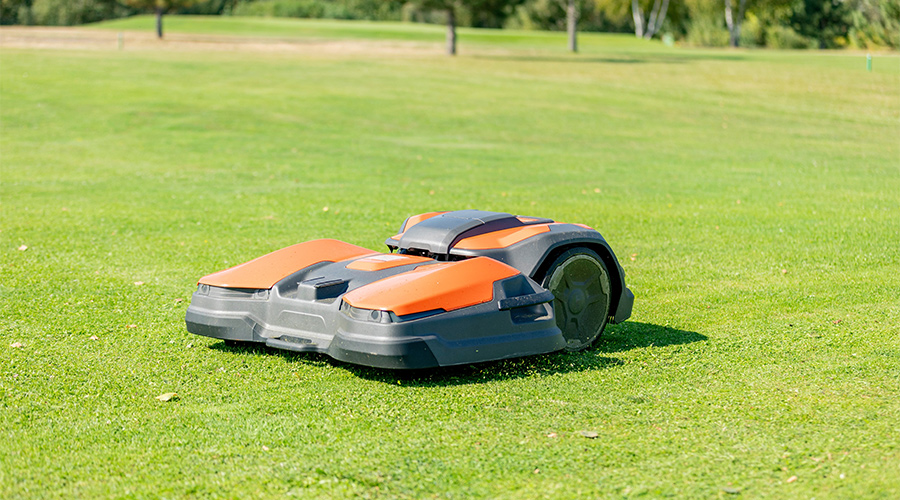
“Helping smaller crews do more is a matter of helping them work more efficiently. Autonomous mowers, for example, are great for enhancing the efficiency of small crews. By letting the crew handle other tasks while the autonomous mower takes care of the bulk of the mowing work; they increase overall productivity considerably.
Larger, more powerful zero-turn and stand-on mowers also help crews that need to mow vast expanses of turf, such as parks or sports complexes.
Ultimately, one of the best things crews can do to maximize efficiency is to choose the equipment mix that best meets their needs. In some situations, a smaller mower might be more efficient than a larger one. Because of the wide range of needs, the right mix of equipment will look different for virtually every crew.”
— Lenny Mangnall, marketing manager, Exmark
“Maximizing productivity is key. Downtime is lost time. With ride-on mower product it is about keeping product well maintained, taking advantage of items like flat-free tires to reduce nuisance down time and in some cases going with more powerful options or larger cutting decks to maximize the operator’s time.
There is also something to be said for rotating equipment out or keeping it in premium condition to attract the best operators. In a limited work pool, having the best, cleanest, most comfortable product helps attract the best workers.”
— Sean Dwyer, senior product manager – commercial wheeled products, Husqvarna
“Take care of your crew. They are the face of your business. High turnover will prevent your company from providing a consistent, quality product for your clients. Schedule your employees to mow the same job sites. A properly trained employee using the right equipment is the best advertisement you can buy. It is called word of mouth!”
— Brian Schoenthaler, marketing specialist, Grasshopper
Jeff Wardon, Jr., is the assistant editor of the facilities market.
Related Topics: