 Photo credit: Wold Architects & Engineers
 City Reimagines its Town Hall as a Modern Civic Center
Colorado city’s renovated 1906 Town Hall blends historic preservation with modern, energy-efficient design to create a centralized space for its community.
By Howard Riell, Contributing Writer
Renovating a much-loved facility from the distant past in order to meet the needs of the present — with an eye at all times toward the future — is a tall order.
Not an impossible one.
After years of strategic planning, Erie, Colorado, has finally reopened its 1906 town hall as a preservation-forward, all-in-one civic center that demonstrates how long-range facility planning can guide municipal growth.
Erie is experiencing increasing population growth. A long-range facility master plan looked at all of its projected needs to help provide useful information and aid in decision-making regarding funding to address those needs in a more organized and coherent manner.
The long-range planning study — which gathered input from residents, community stakeholders and staff to identify priorities and objectives — revealed that an expansion of the current town hall should be the first priority in order to enhance services to residents, retain staff and modernize a valued facility asset.
The historic one-time school building, located at 645 Holbrook Street in downtown Erie, had been gifted to the municipality in 1981. A significant renovation occurred shortly afterward to turn it into the city’s town hall. The project followed the Secretary of Interior Standards for the Treatment of Historic Properties, and modifications to the exterior of the historic building were minimized.
Community identity and civic ownership were central to the project’s vision. Artwork donated by residents and mosaic tiles created during a community beautification event are displayed throughout the building, reinforcing the town hall as a shared space that belongs to the people it serves.
Respectfully expand
Designed by Minneapolis-based Wold Architects & Engineers, the 39,000-square-foot renovation and addition consolidates various departments into a high-performance civic hub, improving public access to services.
Wold, which was engaged in 2019 to draw up a comprehensive, town-wide facility strategic plan, evaluated long-term operational, departmental and infrastructure needs through 2050. In 2022, the firm was re-engaged to design the first major project identified in the plan: the expansion and renovation of the Town Hall.
In keeping with the 1981 goals for preservation and rehabilitation, the expansion project’s priorities were to adapt and reuse all the building’s interior space; respectfully expand the historical structure without sacrificing architectural assets; meet building and fire safety codes and structural requirements; and increase energy efficiency.
This commitment even extended to materials selection, with stone for the new addition mined from the same quarry used for the original 120-year-old building, creating a seamless visual and historical connection between old and new. In homage to the building’s identity through the mid-1960s as the Lincoln School, the town will install new windows in the bell tower later this year to display the original school bell as a visible reminder of the building’s layered history.
The project addresses longstanding space constraints that previously required staff to be dispersed across multiple locations. The design paired National Register — compliant historic materials with modern systems, energy upgrades and phased flexibility — through 2050 and community-driven elements like donated artwork and a time capsule ceremony.
The renovated and expanded Erie Town Hall combines a 20,000-square-foot historic building with a 19,000-square-foot addition, consolidating public services into a welcoming, accessible civic hub. Designed to improve resident navigation, staff efficiency and energy performance, the facility also enhances access to key services, including Planning & Building, Utilities and Municipal Court, while providing long-term flexibility to support continued community growth.
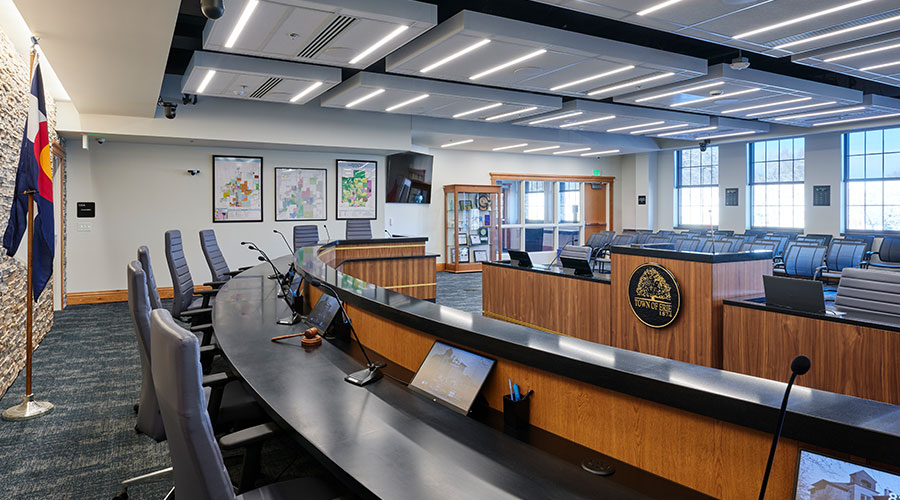
The boardroom and community room are located on the lower level. The edifice also includes a fitness room and a bike storage facility, promoting fitness and bicycle commuting.
Construction was completed in collaboration with Fransen Pittman Construction, along with project partners JVA Consulting Engineers, Martin/Martin Consulting Engineers, BCER Engineering and SWAP Integration. The project was ultimately delivered on schedule and on budget.
Stakeholder-driven
The design process was inclusive, stakeholder-driven and phased to ensure that user voices were heard from planning through occupancy, according to Wold’s government practice leader, Aimee LaLone.
“Throughout design, the team worked continually to clarify needs, validate scope, confirm priorities and align the project with budget and schedule expectations,” she says.
Schematic design was a “big picture” phase, she adds. “A core planning group was formed to determine building adjacencies, functionality and project criteria. The emphasis was on overall organization and relationships, not detailed finishes or technical refinement.”
At the design-development phase, a construction manager was selected by the town to participate in the design cost and construction feasibility process. The design team met with end users to build ownership in decisions, and with greater involvement from all engineering disciplines (civil, structural, mechanical, electrical), the design was developed further to accommodate budget, schedule and the realities of renovation of a historic structure, and its physical connection to a new addition.
The construction-documents phase brought the full team — including a contractor, a core planning group and end users — together to solidify design decisions into a formal, coordinated set of documents for pricing, permitting and construction. The goal was to create clarity, ownership and consensus on all design decisions while keeping the project’s scope, schedule and budget aligned.
100 percent net-zero
According to Facilities Manager Chad Alexander, the project aligns with the town’s adopted Beneficial Electrification Plan — specifically, the goal for the municipal energy-use sector to achieve 100 percent net-zero greenhouse emissions by 2030.
“Town Hall is now the first major municipal building to be fully electric,” Alexander says. “The project design also incorporated a strategy from the Town Sustainability Master Plan that all new government buildings and major renovations be designed to meet Energy Star certification. It also goes far beyond minimum design criteria for electric vehicle infrastructure, adding seven EV charging ports to the parking lots.”
According to LaLone, the Town Hall expansion project had a number of goals that rendered it unique. “It has created a more welcoming hub for town residents to access services. The energy efficiency of this existing facility asset was improved with new mechanical and electrical systems, and the project also brought a fresh celebration of the respected historic Town Hall architecture. More critically, the project has improved the work environment so that the town can continue to attract and retain great staff.”
There had been discussion about constructing a totally new facility away from the historic Old Town area.
“Before forming the town’s Historic Preservation Board, historic buildings were not consistently preserved,” Alexander says. “The decision was made by town leadership to continue to honor the town’s history and renovate and expand the current facility, and to keep municipal services in Old Town, retaining the connection to the historic center.”
The renovated building does, indeed, retain a great deal of character and meaning for the community, Alexander continues, having been a school for generations of residents as well as its connection to town government.
“One of the elements giving the building character is the original 1906 bell tower and bell,” he explains. “The bell was covered up by louvers during a previous renovation but was discovered during the current renovation to be in relatively good shape. Town staff worked with the town’s Historic Preservation Board to approve a renovation of the bell tower so that the bell can be prominently seen and heard as it would have been in 1906, connecting current residents to the history of the Town of Erie.”
Prior to the renovation and expansion, staff from multiple divisions such as Human Resources, Economic Development, Environmental Services and Parks & Recreation had to be housed at other locations, including leased space.
“All those divisions and new staff like the Town Attorney’s office can now be housed at Town Hall because of this project,” Alexander says.
Ultimately, of course, the goal was to help secure Erie’s future.
The project, Alexander concludes, “expanded the facility to account for the future staffing needs required to continue to serve town residents at a high level, dramatically improved energy efficiency and occupant comfort, and preserved the old town connection between residents and their municipal government.”
Howard Riell is a freelance writer based in Henderson, Nevada.
Related Topics: