 Successful renovations to increase facility resilience need to include a range of interested parties who can help building owners identify threats to facilities, operations and occupants.
Planning Renovations to Ensure Facilities Maximize Resilience
By focusing on communication, risk assessment and team building, owners can ensure facilities can return to operation as soon as possible after an emergency.
By Dan Hounsell, Senior Editor
Improving the resilience of institutional and commercial facilities is an increasingly complex challenge for building owners and facility executives. Why? The threats against facilities are becoming stronger, more frequent and more destructive each year. In addition, the many stakeholders in the process can run the gamut from in-house facilities managers and technicians to outside entities that include engineering consultants and code officials.
But perhaps the toughest challenge for executives intent on ensuring their facilities can effectively prepare for, respond to and recover from emergencies is fully understanding the goals of resilience in order to make smart decisions on upgrades and renovations to achieve those goals.
Outlining the process
The process of renovating facilities to enhance resilience often needs to start not with launching projects but with starting conversations.
“The first step is defining what resilience means to the owner and then to all of the stakeholders,” says Karl Fippinger, vice president of fire and disaster mitigation with the International Code Council (ICC), which provides model codes and standards for building safety, sustainability and resilience. “There are many different views and opinions on what resilience means, but I think ultimately what drives it is the prioritization and the funding for any of these initiatives. So sit down and have that conversation about what resilience means.”
Unfortunately, owners too often do not have that discussion.
“I don’t really hear them asking about that a lot, or at least not using that word,” says Joe Demers, civil engineer with Alpha Structural, a design build firm specializing in foundation repairs and other structural projects. “Everyone just always asks me, ‘Is this safe enough?’ On the idea of resilience, they’re not really thinking that way, but they should. That’s the main goal is to get everything back up and running as quickly as possible. A lot of them don’t really think that way, though.”
Fippinger says the conversation can start with establishing baseline expectations of where the owner and the other stakeholders believe the facility is today and where they want to evolve in the future, whether that involves servicing occupants, being more energy efficient or combating crises resulting from climate adaptation.
“In one regard, resilience for an owner could be, ‘I’m trying to reduce my bottom line, so I want to increase my energy efficiency and be able to reduce my cooling and heating costs and other things associated with the building,’” he says. “For others, resilience could be, ‘I’m in Florida, or I’m in Texas, or I’m somewhere in the middle of the country where there are high winds. I’ve had roof material blown off and siding blown off, and I’m getting sick of repairing it. What’s it going to take to be able to be resilient?’”
Risks and roles
Armed with a better understanding of the meaning of resilience for the organization and the involved stakeholders, owners then can identify specific events that threaten the resilience of their facilities.
“The first step obviously is to identify the specific risk to the facility after the hazard,” Fippinger says. “What does that recurrence interval look like? Prioritize the risk and the hazards, and incorporate all of that again into what would be more of a comprehensive and strategic facility maintenance and renovation plan.”
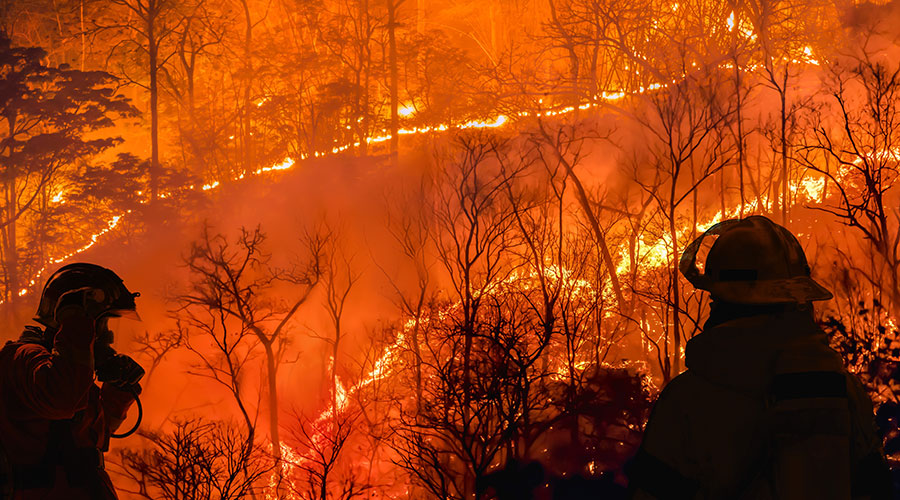
He cites two resources owners can tap into for guidance in identifying risks and protecting those facilities seeking improved resilience against wildfires:
Demers says one example of an overlooked threat to facilities is a common element in such natural disasters as hurricanes, floods and tornadoes.
“The sneaky thing that destroys buildings is water,” he says. “A lot of people don’t think of water as being that dangerous, but over time, water can deteriorate concrete underground, and that’s not something people see.
“Obviously, you don’t see underground, and if it’s in the crawl space under a building, people don’t go down there. Water can really slowly deteriorate foundations, so a lot of maintenance has to do with keeping water away from the building, keeping the drainage going, and then just checking it once in a while to make sure that’s not happening.”
Successful discussions of threats to facilities should include parties who have experience with and insights into emergency preparedness.
“Set aside some time to sit down with your emergency manager,” Fippinger says. “Schedule that meeting, and maybe even include the building official, too. Sit down and say, ‘What hazards and risks do we have here, whether that be wind, rain, flood or seismic (activity). What is the risk of that particular hazard occurring, or what’s the recurrence interval of that hazard happening? Having a base understanding and a common operating nomenclature for hazard and risk would be really important to that conversation.”
The process of identifying resilience risks can involve a host of interested parties, but Fippinger says one participant is essential for success.
“You’ve got a great resource in terms of the facility managers and the building engineers, particularly for larger buildings,” he says. “The buildings live and breathe to a certain degree just like we do. They’re the closest to that. They know where the things are that are performing really well, and they also know where things are not performing so well and what’s going to need attention.”
He says owners also can benefit by bringing code officials into the discussion early: “In addition to the building engineers, the maintainers, architects, engineers and construction pros, have a member of the code official’s office at the table early on to talk and say, ‘Here’s what our plan review process looks like. Here’s what our inspection process looks like during construction. Here’s what it takes to essentially achieve success.’”
Avoiding trouble
Given the complexity of upgrading and renovating facilities to bolster resilience, it is not surprising that the process can present unforeseen challenges. For example, Demers says, owners too often fail to combine resilience renovations in ways that would improve the efficiency of the process.
“They plan different things separately when they should do them all at the same time,” he says. “If you need to get a new roof every 20 years or something and you have a bunch of damage from water or other things, do those two things at the same time. Don’t make that two different projects.
“We see a lot of cases where we’re replacing a foundation that has been damaged due to water, and that’s a lot of work. We’re going to tear up a lot of area around the building to do that, so we tell them if there’s any other upgrade you need to do with the drainage, with the slopes of the sidewalks, you don’t want us to fix all this now and then come back and do that a year later. Do that all at once, and that will definitely maximize the efficiency.’”
Fippinger says that unfortunately, owners too often do not seek input from the full range of interested parties who can provide valuable insights to the process.
“The number one mistake is a lack of early planning and collaboration — getting a team and making sure that you’ve got a variety of voices to be able to inform ownership about how to approach a project,” he says, adding that owners can benefit from “spending a little bit of time with peers in the community who have similar facilities and may have done projects previously. Sit down with them and say, ‘How did you plan this? How did it go for you? What were some of the challenges as you went through this process? Now that you’re occupying that after your renovation, maybe even an addition, what are you seeing now that you wish you had done in the process that you didn’t do?’”
Perhaps the most challenging aspect of upgrading facilities to improve resilience is that owners do not prioritize the process until they are forced to.
“With earthquakes particularly, big ones are so rare that it’s easy to not think about them,” Demers says. “Then when they happen, it’s too late. When there’s a very small earthquake, one that people can just barely feel it, we get a lot of calls. That’s when people get reminded to look at that. Obviously with fires, it’s the same thing. You don’t really think about it until there’s a big one. But those happen every year. The goal is to plan for them before they happen.”
Resilience is a forward-looking challenge for managers, and the most successful efforts are those that prepare facilities for imminent threats and look ahead for what threats may come later.
Says Fippinger, “Where you are today in terms of what your hazards and risk isn’t necessarily where you’re going to be three or five years from now or even 10 years from now or if you’re looking over the 30-year or 50-year life of a building.”
Dan Hounsell is senior editor for the facilities market. He has more than 30 years of experience writing about facilities maintenance, engineering and management.
Related Topics: