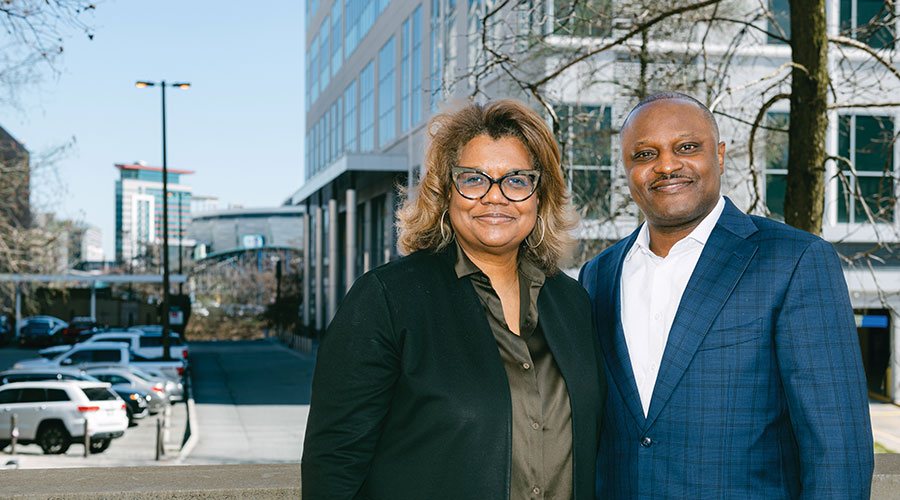
 Photo credit: Muse Event Photography
Charlotte Hornets Facility Executives Lead NBA Team Through Renovation
Charlotte Hornets facility executives Donna Julian and Ronnie Bryant are in the memory making business.
By Dave Lubach, Chief Editor
In October 2005, a new Charlotte, North Carolina, arena was about to open its doors with a bang. Built to welcome the NBA back to the city, the multi-purpose arena’s first public event was a concert by rock and roll legends The Rolling Stones.
While local patrons were fired up to see the new arena and celebrate its opening, facilities executives Donna Julian and Ronnie Bryant were an equal mix of excitement and nerves.
“I was excited when people walked in and the tickets actually scanned because I was worried about the internet not working or something like that,” recalls Bryant, now the senior vice president and chief information officer for the Charlotte Hornets, the building’s primary tenant. “But once we got past the stress of credit cards not working and not processing and seeing everything that was planned for years to make this happen. ... I started dancing and realized I was at work. It was an amazing feeling, and at that point, I knew that I was making an impact on everyone’s life when they came here.”
Bryant and Julian, the team’s executive vice president and chief venues officer, are in the memory-making business. While performers and athletes are the reason 25 million people have passed through the doors at Spectrum Center since it opened, it is the behind-the-scenes players like the facilities teams that keep the lights on, the arena clean and the venue comfortable so that fans and performers keep returning.
Twenty years later, Bryant and Julian are still leading facilities teams at Spectrum Center and they’re still opening venues. They recently worked together on Spectrum Center’s $245 million renovation that includes the construction of a state-of-the-art practice facility that will position the Hornets among the top practice venues in the NBA upon completion.
Going pro
Julian and Bryant always seemed destined for careers in professional sports, even though they took different paths to get there.
Julian grew up in Baltimore going to Colts and Orioles games with her father. After taking an internship with the NBA’s Washington, D.C., team, she thought that working for a pro franchise would be her ultimate career goal.
Around the same time, Bryant grew up in Alabama wanting to be an NBA player, like the legendary Michael Jordan, who ironically enough was Bryant’s boss when he owned the Hornets from 2010-2023.
“I made it to the NBA, but not the way I initially thought I would,” Bryant told the NFMT East crowd.
They arrived in Charlotte within a year of each other – Bryant in April of 2004 and Donna in February 2005 – before the arena opened and have worked together for more than two decades.
While they don’t claim to finish each other’s sentences and do have occasional disagreements, they agree that their long working relationship is a net positive.
“It’s extremely rare to get two leaders to an organization and be together for an extended period of time,” Bryant says. “She and I have an amazing relationship. We come from two different backgrounds. She’s been in facility management all her career, and I’ve been a few other places before landing here. We spend a lot of time together. The one thing about working in facilities is oftentimes, if your facility is busy enough, you spend more time at the facility then you spend with your families.”
Two decades of working together have resulted in a level of confidence in each other that can’t be manufactured.
“Part of any good working relationship is there is a trust factor,” Julian says. “You have to have a relationship with someone who you feel like their intentions are in the right place, which ultimately for me is what’s best for this business.
“I don’t have to worry about that with Ronnie, and I don’t think he has to worry about that with me. Of course, there are going to be situations where we can maybe do A instead of B and how do we figure that out? ... You don’t want everybody to have the same opinion. That would be boring and you’re not going to elevate your experience or the work you’re doing.”
The renovation
Arena renovation projects involve planning years in advance, and Spectrum Center was no exception. While the work was done in 2024 and 2025, the process started back in 2019 as part of a capital plan that included working with the city. The city of Charlotte owns Spectrum Center, which is managed by Hornets Sports Entertainment.
“We did go and look at several different NBA arenas across the country,” Julian said. “But ultimately, it had to fit Charlotte and what the market needed. The focus was on the customer facing areas. We wanted to enhance the guest experience on every level. We wanted to be sure that everybody that came into the building was impacted by the renovations. And I’m very proud to say we accomplished that.”
The renovations included adding 1,400 new lower-level bowl seats; designing new concourses that included better sightlines to the court; upgrading dining options; expanding contactless technology to help better manage patrons’ entering the arena and speeding up the time that fans spend at concession stands.
Bryant said the utilization of AI played a significant role in the renovation from a customer experience standpoint, from influencing climate control and other aspects of facility management like beverage selections and crowd control.
“In every area of the business today, it is a must that you adopt AI,” he said. “AI is going to make life extremely easy for everyone to manage in our business and the management of facilities to create that customizable experience for every person that comes in the building.”
In the ultra-competitive world of sports and entertainment, when ownership groups compete to attract the hottest concert tours and keep their arenas at NBA levels of service, upgrades to services and facilities evolve on a 24/7/365 basis. But during the Hornets’ recent renovation, facilities leaders took the unprecedented step of closing the arena during the Hornets’ summer offseasons in 2024 and 2025.
Shutting the doors cost the arena concert tour opportunities, but the Hornets group was determined closing for a period was the best option for long-term success.
“Most buildings do not like to shut down at any point to do renovations, but we felt like we needed those two summer shutdowns because of the work that was being done in the facility,” Julian said. “The first summer, we decided we were going to end the NBA season, do a little construction, then try to have a few events and do the preseason, this back and forth, and I almost lost my mind.
“The second summer, we made the decision we were going to shut down and let the construction be uninterrupted.”
When Spectrum Arena reopened in October 2025, it did so with both feet in the pool. It hosted seven events in eight days, including the Hornets’ home opening game for the 2025-2026 season.
It also brought back memories from 20 years ago, when Bryant and Julian, during the early stages of their careers with the Hornets, first welcomed guests into the arena to show off the fruits of their labor.
“When I’m at the building, I do love being in our lobby when we open the doors,” Julian said. “It’s just a great feeling when the doors are open and people come in the building. ... If they’re leaving and they’re just talking about an incredible event and a great experience, they’re going to remember that.
“We have a role to play in that, and we take that really, really seriously.”
Dave Lubach is the chief editor for the facilities market and moderated the general session with Bryant and Julian at NFMT East. He has more than 10 years of experience writing about facility management issues.
Related Topics: