How Diversion Stewardship Is Reshaping Office Renovations
Reverse procurement is the practice of identifying the reuse potential of existing construction materials and integrating their reuse into a new space.
By Gabi Dwyer, Contributing Writer
Key Takeaways:
- Diversion stewardship relies on reverse procurement, which is the process of identifying the reuse potential for existing construction materials and integrating their reuse into the new space.
- Reuse not only reduces construction and demolition waste. It also significantly reduces cost.
- Office spaces are an asset in their entirety. Inherited space can be shopped in for the new office design, and existing products can be donated for a new life elsewhere.
Commercial office buildings are built to last for at least 50 years, but commercial office interiors often undergo major renovations every 5-10 years. With each major renovation, an office expends significant waste, cost and impact on the environment in order to reshape a space to fit the identity of a new or existing tenant.
In 2018 alone, the United States produced 600 million tons of construction and demolition debris, with 90 percent of this coming from demolition and 10 percent from construction processes.
How can building owners and facility managers reduce waste, cost and environmental impact in such cases? They can strategically consider the reuse potential of existing furniture, finishes and equipment and incorporate landfill diversion strategies that include reuse, donation and upcycling in early design.
Known as diversion stewardship, prioritizing material diversion from landfills at a project’s onset allows owners and managers to view pre-demolition spaces as material banks rather than debris and breathe life into new spaces with existing materials.
What is reverse procurement?
Diversion stewardship relies on reverse procurement, which is the process of identifying the reuse potential for existing construction materials and integrating their reuse into the new space. Reverse procurement involves a four-step process from design through construction to prioritize reuse.
First, all assets are cataloged and tagged to understand existing material quantity. The more information managers have on existing finishes — ideally, from architectural plans for the existing space — the easier this step and the next one will be. Photographs also are useful as visual representations of the material and its condition.
Second, materials are evaluated based on:
- cost — buy new or reuse
- carbon — embodied carbon of new material vs. keeping the existing material
- feasibility — material condition.
Common, high-value items are also typically high-quantity items, and they offer cost and carbon savings for materials in good condition. They include furniture, raised access flooring, lighting, partition systems, ductwork, terrazzo and stone. Their evaluation and ultimate reuse are critical to realizing the greatest savings on major commercial office renovations.
Third, existing inventory and evaluation are shared with the design and construction teams for implementation. These teams determine the best way to integrate reusable products into the design and coordinate plans for preserving reusable finishes during construction.
Finally, project teams coordinate with diversion stewards and construction teams during demolition and construction to ensure reusable materials are reused, donated or diverted from landfill through manufacturer takeback programs or material stream-specific recycling. On-site, reusable materials are properly uninstalled, stored and re-installed to fit the new space design.
Through reverse procurement, project teams can leverage existing materials to create a beautiful space, tell a sustainability story, and reduce demolition and construction waste.
Cost, carbon and value
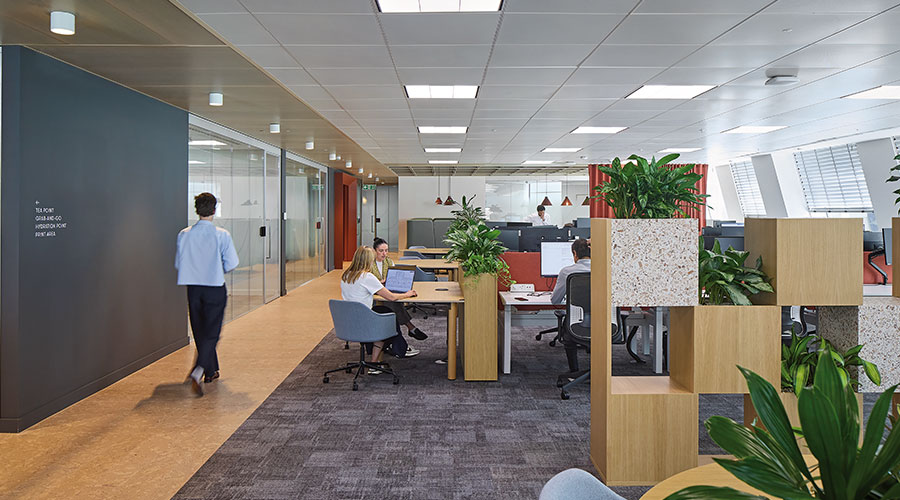
Reuse not only reduces construction and demolition waste. It also significantly reduces cost. For instance, the Grant Thornton headquarters in London used diversion stewardship and reverse procurement strategies to align the design intent with low embodied carbon, resulting in lower costs.
With a goal of reducing embodied carbon by 78 percent from baseline, the project team began with the intent to reuse as much as possible. On-site photographs, existing drawings detailing existing material specification, existing finishes evaluation and accurate material differentiation allowed HLW to consider and implement reused materials in the final design. Even furniture from the existing office was evaluated, and re-usable pieces were re-upholstered to fit the new design aesthetic.
These strategies resulted in 63 percent reuse of finishes and furnishings for the site, and they reduced construction costs by approximately one-third. Significant savings came from a deep appreciation for embodied carbon and reuse paired with careful on-site storage coordination.
Operational realities
Logistics can be a barrier to achieving high reuse. Take carpet tiles as an example. The tiles must be correctly and carefully uninstalled, then stored on pallets for the duration of construction until reinstallation occurs.
This challenge is compounded with a phased construction approach, where these pallets might need to be moved to different floors for storage as construction progresses. Further coordination also must take place when the space is in operation to avoid pallets being stored in occupied spaces. In a 1-million-square-foot, multi-phase renovation in New York City, coordination with the contractor and facilities team began during design development to ensure raised access flooring remained protected during construction to ensure reuse was successful.
Early coordination is critical for successful reuse. Before demolition, construction, design and facilities teams must meet to discuss strategies to ensure reused materials can be stored safely to maintain material integrity.
What to reuse, what not to
It is up to project teams to determine which products can be re-used in design. Non-aesthetic materials are the easiest to consider. If they are in good condition, there is no reason to discard them. Partition systems for parts of the floor plan remain the same, and raised access flooring and mechanical systems can be reused without impacting the design intent of the new space.
Aesthetic materials determined to be reusable during inventory should be placed into one of three categories: reuse, upcycle or resell/donate. For example, new furniture that will fit with the new office space can be reused. If furniture is older but still in good condition, is it possible to reupholster the piece to refresh it and use it in the space? If so, it should be upcycled. If the furniture style does not match the design intent and upcycling will be too expensive, the item should be resold or donated.
How should facilities teams prioritize what to evaluate first? Quantity. Office spaces typically feature large quantities of carpets, acoustic ceiling tile systems, partition systems and furniture, which can be evaluated first. Prioritizing high-volume materials will result in a greater reduction in environmental impact.
Used furniture and materials can vary by project. Some clients, like Grant Thornton, are heavily interested in reuse on site and seek to reuse and upcycle as much as possible.
Another large banking client refreshing 1 million square feet of office space decided to donate furniture and finishes that did not meet the design intent for the new space. A non-profit client decided to reuse furniture from its previous office space in a new space. The only right answer is to ensure the products are diverted from landfills. The way they are diverted is up to the project team.
Reuse resistance
Reuse has many financial and environmental benefits, so why does the practice face resistance? The short answer is perception.
High-end, brand-driven environments prefer new, expensive products to meet their aesthetic goals. Leadership changes in such firms trigger unnecessary renovations with requests for new, different materials. In addition, commercial office lease turnover every 5-10 years often comes with an entirely new design intent and a time constraint, reinforcing purchasing new as the easier and more common pathway.
What can shift client perception? Education. Presenting the proven benefits of strategic reuse — reduced cost, reduced embodied carbon, reduced waste and the creation of a sustainability story — can help clients conceptualize the benefits of reuse. Project examples also can help clients understand that high-end spaces can be created with reuse at the center.
What owners and managers need to do
Facility leaders can take away several key points for future projects:
- Incorporate material audits early in the design process to understand what materials can be reused on the project. Owners and managers can inventory their entire space today to prepare for the next time their space is refreshed, which will expedite the existing material evaluation process.
- Ensure coordination up front with all project stakeholders — sustainability, design and construction teams — to ensure reuse goals are prioritized throughout the project lifecycle.
- Consider the full project lifecycle, not just cost. Reuse can reduce embodied carbon impact, construction and demolition waste, and total project cost.
Office spaces are an asset in their entirety. Inherited space can be shopped in for the new office design, and existing products can be donated for a new life elsewhere. Diversion stewardship is the future, and these cost-saving, environmentally friendly practices already are becoming standard for commercial offices concerned about their triple bottom line. As building owners and managers divert as many materials as possible from landfills, offices will continue to be vibrant spaces with sustainability stories and reduced environmental impact.
Gabi Dwyer, MBA, WELL AP, LEED Green Associate, is associate, sustainability analyst at BEYOND, a part of HLW, a global architecture, design and planning firm.
Related Topics: