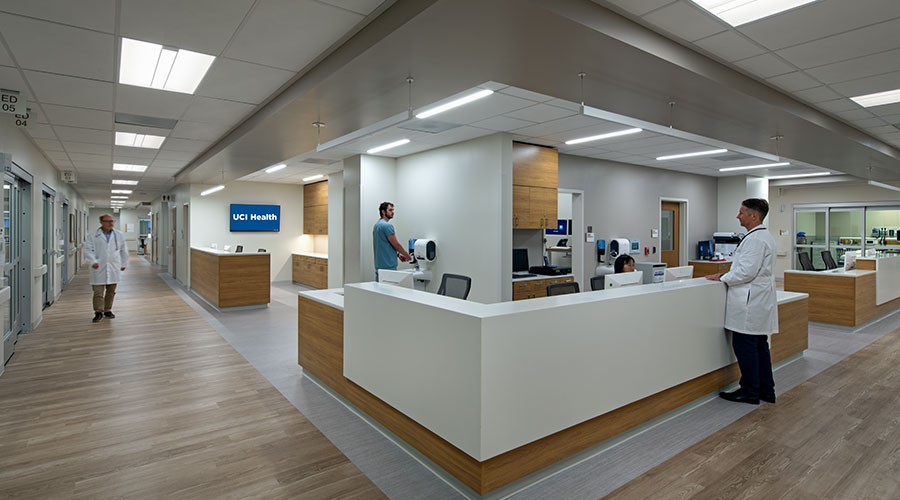
 Photo credits: UCI Health and CO Architects
Teamwork Delivers Efficiency for New All-Electric Hospital
Early involvement of facilities team ensures hospital includes systems and components accessible for technicians performing inspection and maintenance.
The involvement of an organization’s facilities team in the planning and design process of modern facilities is essential for producing a new building that meets long-term reliability, safety and sustainability goals. In the case of UCI Health-Irvine in California, Joe Brothman, director of facilities and general services, and his team were involved early and were able to address several critical priorities for the all-electric hospital, one of which was working with designers to ensure the facility’s ease of operations and maintenance.
“They came up with the concepts, the ideas, and through our construction partners who were really the leads for the project, our team was elicited to make sure the design looks sufficient and reliable,” he says. “We were assisting with the selection of equipment, how the equipment was to be installed. (My priority) really was to push to get us to be an all-electric facility. We also were working with our culinary and nutrition services leads to push them toward that decision, as well as with our plant ops team to get them the necessary tools and training needed to operate this new type of plant.”
Facilities — especially those designed and constructed decades ago — are notorious for featuring HVAC, plumbing and electrical system components that are all but impossible to access, much less properly inspect and maintain. The early involvement of Brothman and his team helped ensure the finished facility includes systems and components that are accessible for technicians to perform inspection and maintenance.
“We were there from inception, from the initial programming of what the space might need all the way through construction and then through commissioning,” Brothman says. “Facilities management and all of my areas under General Services were involved. We provided a lot of input as to how this space should be conceptualized, programmed and later on constructed in order to maximize efficiency, and make the safest place for both our patients and co-workers.”
The team’s involvement in the design process resulted in a finished product that is a rarity — an ergonomically maintainable facility.
“When we were programming the central utility plant, we made a point with the engineering team to make it as ergonomic and human centric as possible,” he says. “The primary area where our team is working in and providing services is the central utility plant.
“Putting all of those services that we oversee in that dedicated space makes it a lot easier for us to maintain the equipment without getting into the clinical environment. Not only does it save square footage for the clinical teams, but it also allows our teams to perform maintenance activities and repair work without impacting operations significantly to the clinicians.
“We’ve learned through our other sites that anytime you can have an off-site or a dedicated central utility plant, that’s going to minimize disruptions and increase the efficiency of the work for the maintenance staff.”
The planning for ease of maintenance filtered down into the location and orientation of specific system components.
“Inside that building, we located all valves, control panels, flow switches, everything that we could,” Brothman says. “We made it so you don’t have to get on a ladder for a lot of things. We installed pulley chains for valves that might be in the ceiling and relocated valves to a human level so it’s a safer place to work. It’s more ergonomic.
With things like our chillers and our recirculation pumps, we have designed in hoist beams. We’re going to have to eventually replace that equipment. We have that ready to go, and we put moveable walls in place so you wouldn’t have to take the chiller out through the main door. You’re able to just move it right outside. It’s placed easily so that work can be completed as minimally invasive as possible.
“All the major equipment at some point is going to have to be serviced, replaced, major work done, and the plant has the space to do it. We’re able to stage our replacement parts, our tools nearby each equipment and either perform that work or eventually replace it in a manner that can minimize operations and downtime.”
Changes and challenges
While Brothman and his team have helped create a new facility that delivers sustainability, ergonomics and safety goals, the new space does present challenges related to workload and the required skillsets for technicians.
“All of my team that I get the pleasure of working with are now overseeing both campuses,” Brothman says. “They have expanded their scope, as well as mine. In many cases, we enlarged the team, duplicated them, and we have cohesive policies, procedures, workflows and platforms to make it as uniform as possible at both sites. We didn’t want to do things exactly the same as we had been doing, so existing plans, policies and workflows had to be edited a little bit. But with that process, given the new site, everything was assessed and edited to ensure that there was a cohesive environment for both locations.”
The advanced technology involved in the UCI Health-Irvine hospital means an expansion of knowledge and skills technicians must bring to a task.
“The biggest challenge in my opinion was educating our team on this new equipment that they were managing,” he says. “We were working very closely with the construction team, the manufacturers of the equipment and spinning up the team and educating them to be competent to manage and maintain this site. That was a challenge, but it really was a great partnership with the contractors, the manufacturers, the vendors that we have working with us.”
Brothman says the evolving skillsets required of technicians also has impacted the department’s hiring and training practices.
“We didn’t have everybody onboarded by the time that the site opened,” Brothman says. “We’re still onboarding people. As you can imagine, we have a normal cadence of bringing new people on and people leaving, so we took the time to record those sessions and actually have a library of onboarding sessions so that when new technicians come in and new plant operators come in, we’re able to quickly spin them up and educate them to this site.
“Everything from equipment maintenance to a tour of the site we’ve made that available digitally so that they’re able to get a ton of information initially and then follow up with our manufacturers or the service vendors so if there are any questions about anything, our teams have those resources available.”
Brothman says helping design a new facility and then taking over its operations and management has been a rewarding learning experience for his department.
“Even though it’s been a challenge, the team has done an exceptional job of taking it on," he says. “We’ve been open almost two months fully operational. We went live with the two other buildings a couple years ago, so we’ve had some time to ramp up. We’ve had over two years of operating our central plant, and we’ve gotten to know the space. We’ve gotten to know the unique operating characteristics.”
Dan Hounsell is senior editor for the facilities market. He has more than 30 years of experience writing about facilities maintenance, engineering and management.
Related Topics: