 Photo credit: Harvard Business School
Lessons in Top-Level Sustainability from Harvard Business School
Facilities and sustainability teams at Harvard Business School team up to ensure green roof benefits to occupants, the university and the community.
Green roofs have become central elements of many institutional and commercial organizations’ sustainability efforts. The idea of replacing a traditional roof with a system that features vegetation and irrigation systems once seemed cutting edge and even risky.
But advances in system materials, design and maintenance — along with greater acceptance among engineering and maintenance managers responsible for their long-term performance — have enabled green roofs to deliver a range of critical benefits for organizations looking to minimize the impact of their facilities on the environment.
The facilities and sustainability teams at Harvard Business School understand this dynamic better than most. The school installed its first green roof in 2009 and now has a total of nine in pace. The lessons they have learned about designing and managing green roofs offer a roadmap for embracing top-level sustainability.
The right stuff
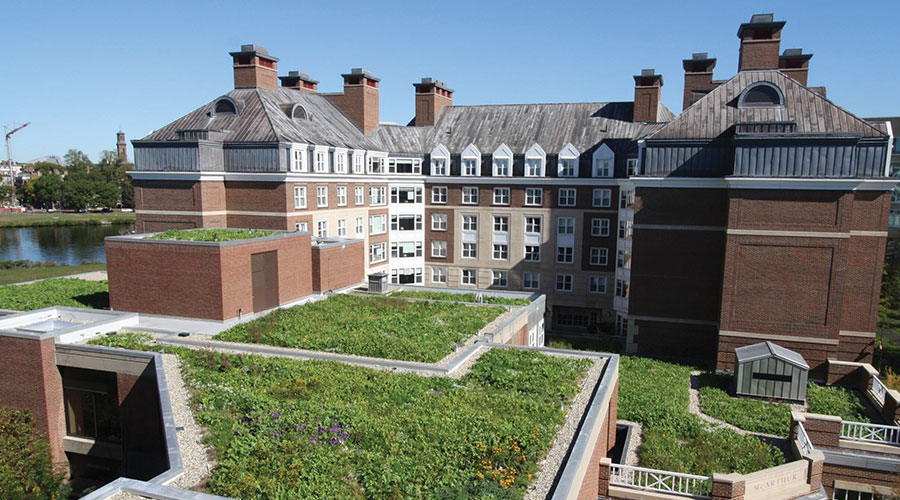
The green roof on Harvard Business School’s McCollum/MacArthur Hall has a total of 11,058 square feet, with 8,604 square feet of green roof, 1,704 square feet that are vegetation free and 740 square feet of pavers. The building was a candidate to host a green roof in part because of its location.
“Part of the reasons why the building was a good host is its visibility perspective on campus,” says Julia Musso, Harvard Business School’s assistant director of buildings, facilities and grounds. “All of the executive education dormitory rooms also look down onto it. It was an unused section of the campus where we could highlight some of our sustainability features in a very prominent way.”
One early hurdle for those involved in the green roof’s design was ensuring the facility could support it safely and effectively.
“From a structural perspective, there were load restrictions based on how the building had been built,” Musso says. “We had to work collaboratively with the design team and the engineer and the structural engineers on exactly which sections of the green roof had different depths of the green roof media.
“The green roof media that we had selected is a very lightweight material instead of a typical green roof media that would be more weight per square foot.” The light growing media made it viable to grow tall plants on the roof without compromising structural integrity.
“The challenge was that the meadow-style green roof is what we wanted from an aesthetic standpoint,” says Leah Ricci, the school’s associate director for sustainability and energy management. “But from a load standpoint, we typically would have gone for a sedum green roof — a low-lying, lighter-weight-style green roof. The slight compromise is that we did need to have a continuous irrigation system to keep the media weighted and everything watered on the green roof.
“Some of our other meadow-style roofs that are traditional may require some initial watering but then typically don’t require irrigation. The same thing for the sedum roofs. They usually don't require ongoing irrigation. It was the one compromise we had to make, but it was exciting to be able to get a beautiful meadow-style roof, given the structural limitations.”
Maximizing benefits and performance
Green roofs can deliver a host of benefits to institutional and commercial facilities, and the Harvard Business School was interested in the full range of potential benefits from the roof on McCollum/MacArthur Hall, including stormwater management on campus.
“Green roofs can absorb up to 70 percent of rain that falls onto them, and it’s part of a broader storm water master plan that we have for the campus, which is important since we're so close to the Charles River,” Ricci says. “We want to reduce the amount of runoff and the water quality because the Charles River does suffer from toxic algae blooms when it's really hot and the water levels decline from different stormwater pulling off phosphorus and other pollutants into the river.”
Aesthetics also drove the decision to install the green roof.
“Within the building, the McCollum Lounge for executive education participants also looks out onto the green roof of MacArthur,” Ricci says. “When you look at this combination of McCallum MacArthur, which is a combo building, this green roof is visible from four other buildings. One of our newer buildings, (the Ruth Mulan Chu) Chao (Center), has a nice view over onto it. We wanted the view to be aesthetically pleasing. We're looking for that big wow factor when you're coming out onto that terrace.”
The business school also was interested in the benefits for occupants of introducing natural elements into the environment.
“The research shows that there's all these cognitive improvements and health improvements when you incorporate nature into the design of your building,” Ricci says. “By having this view from (executive education) lounge and from other locations on campus and people can look down on a beautiful green roof, it has all these additional health benefits, which is part of the big broad umbrella under sustainability.”
The roof also enabled the sustainability and facilities teams to introduce honeybee hives. Honeybees are crucial for environmental sustainability, biodiversity, food security and the overall health of ecosystems.
“Not only are you looking out to a beautiful green roof, but now we have these honeybee hives and a pollinator hotel, as well,” Ricci says, adding that the presence of bees on the green roof increases the engagement between building occupants and the roof.
“Not only can they look down on it, but there’s a My Hive page, so people get to hear and learn a lot about (honeybees),” she says, adding that the roof “really is a great combination of all of these aspects in terms of stormwater, biophilic design and insulating the roof better — all these wonderful benefits that the green roof can provide the community.”
Musso says the roof’s overall success benefited from close interaction between a range of interested parties during design, installation and management, including the involvement of the facilities team through the installation and continued maintenance.
“We were involved throughout the whole project so we could quickly make decisions,” Musso says. “The roofers were almost like part of the design process.
“Once we got the structural load requirements, they worked on the design. They were involved inside the larger project, but they weren't dictating any of the plant species. It was really a good collaboration between operations and our internal teams with the project manager, as well as the facilities.”
Dan Hounsell is senior editor for the facilities market. He has more than 30 years of experience writing about facilities maintenance, engineering and management.
Related Topics: