Tankless Water Heaters: Where Efficiency, Reliability and Reality Meet
Once considered a niche technology, new-generation tankless systems are going mainstream.
As maintenance and engineering managers work to reduce energy use, improve system reliability and meet sustainability goals for institutional and commercial facilities, tankless water heaters are drawing increased attention.
Once considered a niche technology, they are increasingly viewed as a mainstream option, prompting closer examination of where they deliver value, where they face challenges and how they fit into modern building efficiency strategies.
Tankless systems are often associated with reduced standby losses, smaller footprints and the ability to scale capacity through modular design. But these benefits are not automatic. Successful applications depend on managers understanding the building’s hot water demand, available utilities and long-term operational needs.
“Tankless water heaters are a great option, but they’re not a universal solution,” says Amy Brummet, senior mechanical designer for Henderson Engineers. “Success comes down to matching the system to how the building actually uses hot water.”
Steven Kleinschmidt, a mechanical engineer and owner and project manager with Smith Seckman Reid, agrees.
“In the commercial world, there are many ways to provide domestic hot water,” Kleinschmidt says. “Tankless systems have higher instantaneous energy usage, but they also offer strong long-term benefits when applied in the right situations.”
Advanced technology
Earlier generations of commercial tankless water heaters presented design challenges. Limited turndown ratios, inconsistent temperature control and sensitivity to hard water conditions frequently forced engineers to supplement tankless systems with storage tanks, reducing efficiency and adding complexity.
New-generation equipment has advanced. Manufacturers now offer stainless steel heat exchangers, improved controls and higher turndown ratios — the range between minimum and maximum output — which allows systems to respond more effectively to variable demand. The units can even be manifolded together to provide even greater turndown ratios.
“In commercial buildings, hot water demand can swing dramatically throughout the day,” Brummet says. “You might have one sink running early in the morning and dozens of fixtures operating at once in the afternoon. High turndown ratios let tankless systems handle both conditions without instability.”
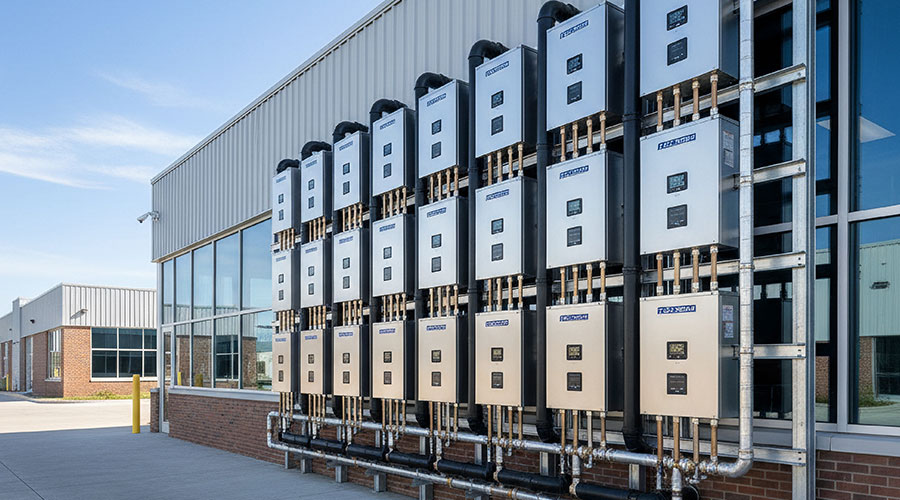
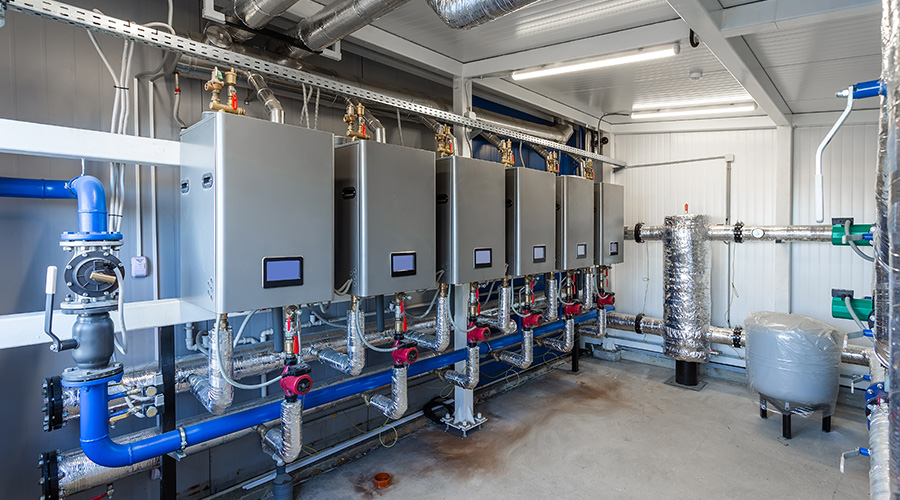
Kleinschmidt says larger facilities frequently achieve flexibility by combining multiple units.
“If you have big peaks, your equipment has to be larger to handle that,” he says. “When you use three or more units working together, you can meet that demand and still modulate down during low-use periods.”
Savings with caveats
When evaluating tankless versus traditional storage tank water heaters, most managers start with cost.
“Cost is always the first consideration,” Kleinschmidt says. “What does it cost for a tanked system versus a tankless option? Sometimes they’re comparable. Sometimes one is more or less expensive than the other, and that often depends on facility type and expected peak and low usage.”
Energy performance, particularly standby losses, also plays a significant role in long-term operating costs. Hot water in tank systems lose heat, leading to standby losses, and causing the system to cycle on to maintain water temperature.
“With the tankless style, there aren’t nearly as many standby losses because nothing operates when it’s not running,” Kleinschmidt says. “There’s very little water inside the unit that needs to stay warm, so during non-use conditions, tankless water heaters run a lot less.”
This difference can translate into measurable energy savings.
The U.S. Department of Energy reports tankless water heaters can reduce energy use by 8 to 25 percent compared to traditional storage tank water heater systems. But actual savings depend on usage patterns.
Facilities with long periods of low or no occupancy, such as office buildings, schools and some retail spaces, often see the greatest benefit. But facilities with continuous hot water demand, such as hospitals, hotels and certain industrial buildings, might see smaller energy savings.
“If you’re using hot water continuously, there’s less wasted energy to eliminate,” Brummet says. “That doesn’t mean tankless won’t work in these facilities, it just means the payback may look different.”
In terms of the impact on overall utility consumption after switching to tankless, managers should be wary of blanket estimates.
“It depends,” Kleinschmidt says. “Facility type matters. Fuel source matters. Electric looks different from gas. And in large commercial buildings, it can be harder to isolate because the bigger the building, the more you might save. But you’re also spending more on utilities overall.”
Ultimately, understanding load profiles, occupancy patterns and system design is essential to determining whether tankless technology delivers meaningful operational savings or simply shifts where energy is consumed.
Ronnie Wendt is a freelance writer based in Minocqua, Wisconsin.
Related Topics: