How Facility Managers Can Improve Boiler Operator Training
Despite the growing complexity of systems, training programs have not evolved in parallel.
Key Takeaways:
- Many facilities lack updated standard operating procedures and structured training programs, creating risks as building systems become more complex.
- Effective boiler operator training combines classroom instruction, hands-on experience and real-world problem-solving to build competency.
- Facility managers should treat training as a continuous process, using regular education, skills assessments and lessons learned from incidents to improve performance and safety.
Despite the growing complexity of systems, training programs have not evolved in parallel. In many facilities, training remains informal, inconsistent or insufficiently documented.
“And almost everywhere we go, there are no standard operating procedures (SOPs),” Kapel says.
Where procedures do exist, they are not always maintained or updated to reflect system changes. Glynn emphasizes that this is a critical gap.
“Update your SOPs. If you just got a new pump, you need to update your SOPs,” he says.
Beyond documentation, there is also a disconnect between theoretical training and practical application. Boidi points to situations where individuals hold licenses but lack hands-on experience.
“Many technicians went to school and received a lot of theoretical knowledge but have never worked on a boiler,” he says.
In non-licensed environments, the variability can be even greater. Training may depend entirely on internal practices, which can range from robust programs to minimal instruction. This lack of structure increases the likelihood of inconsistent practices and overlooked risks.
Online, hands on or hybrid?
Across all three perspectives, there is clear agreement on what constitutes effective training: it must bridge the gap between knowledge and execution.
“A strong boiler operator training program must involve some sort of apprenticeship and include theory and application,” Boidi says. “This is a jack-of-all-trades trade, where you have to understand it all to be really good at your job.”
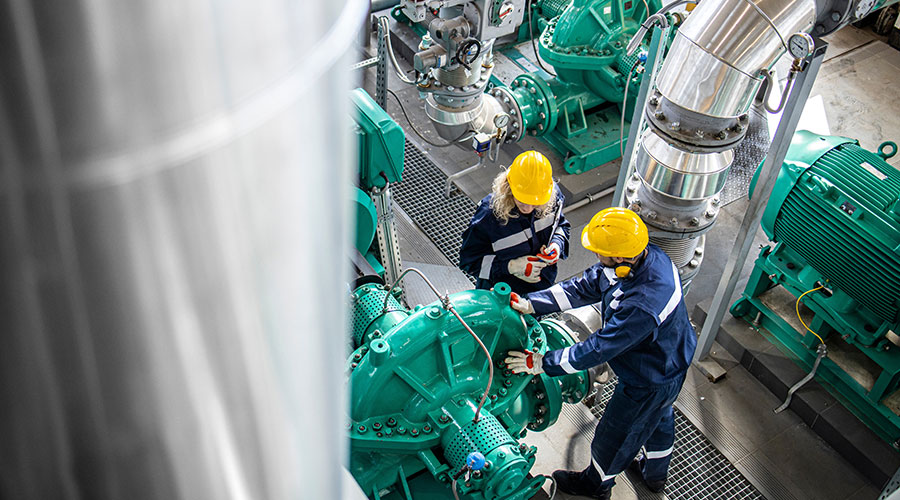
Kapel reinforces that physical interaction with equipment is an effective way to build understanding. “We have found our most training success when we can physically be there,” he says. “We routinely customize our training to the facility.”
Glynn approaches the issue from a practical standpoint, emphasizing situational awareness and decision-making under real-world conditions. For him, operator competency develops through familiarity with the system and learning to recognize what is normal and what is not.
“You learn what to look for, what sounds wrong, what smells wrong, what smells hot,” he says.
Training programs that incorporate multiple learning modalities, including classroom instruction, visual materials, hands-on practice and repetition, are the most effective. Glynn describes his own approach as intentionally layered to accommodate different learning styles.
“I try to make the class in a way that everybody can really absorb and retain the presented material,” he says.
Licensing or certification are important but not always required. Boidi explains that if there is proper automation, a facility may not need a licensed operator.
“A boiler connected to an automation system will go through an auto shutdown when an issue is detected,” he says. “Then there is likely a dead man switch that requires someone to go to the boiler room, make sure everything is OK and turn the boiler back on.”
But, he adds, automation introduces a training component that is often overlooked.
“Along with training people to operate boilers you may also have to train many of them to analyze data,” Boidi says. “These systems are collecting data and you need an operator who can look at this data and spot trends.”
Develop a continuous learning culture
One of the most persistent challenges in facility management is the tendency to treat training as a one-time event rather than an ongoing process. In a dynamic operational environment, that approach is no longer sufficient.
“Competent operators happen over time,” Kapel says.
Glynn advocates for regular reinforcement through structured, recurring training. “I think annual recurrent training is good for everybody. But with many licenses, you are not required to have continuing education credits,” he says.
For larger facilities, Boidi recommends having a dedicated trainer on site to do training monthly.
Rather than repeating the same material, facilities can introduce new topics, bring in external experts and use real-world examples to maintain engagement and relevance. This approach reinforces knowledge and also helps operators stay alert to evolving risks.
Learning from incidents is also a critical component of continuous improvement. Glynn points to the importance of analyzing failures to identify contributing factors and prevent recurrence.
“It’s going to take a root cause analysis to determine what went wrong and what were the contributing factors?” he says.
Practical steps for facility managers
Beefing up boiler training does not require a complete overhaul. Often, meaningful progress begins with an assessment.
“Bring in an outside consultant to test your people and your processes,” Kapel says.
Glynn offers a similarly pragmatic starting point. “Determine the overall knowledge of your crew,” he says.
From there, training can be tailored to address specific gaps. Sometimes, that may involve formal education or certification programs. In other cases, it may mean developing site-specific training based on the equipment and operational needs of the facility.
Customization plays a key role in effectiveness. Glynn frequently incorporates facility-specific details into his training programs to make them more relevant and actionable.
“Send me pictures of your boiler so we can walk through it,” he says.
Even simple actions, such as reviewing logbooks, updating procedures or conducting walkthroughs, can reveal opportunities to improve knowledge and performance.
Boiler performance is also defined by the people who operate these systems. For this reason, Glynn reminds his students that the responsibility is personal. “I tell students, ‘You see that person in the mirror? You are responsible for their safety,” he says.
In an environment defined by pressure, heat and precision, that responsibility cannot be assumed. It must be built through training that is consistent and grounded in the realities of today’s boiler rooms.
Ronnie Wendt is a freelance writer based in Minocqua, Wisconsin.
Related Topics: