Are Your Warehouses Sustainable?
Warehouse spaces offer sustainable opportunities for facility managers.
By Ken Sandler, Facility Influencer
Key Takeaways:
- Warehouses present one of the largest untapped opportunities for sustainability, with energy-efficient technologies and rooftop solar capable of significantly reducing emissions and operating costs.
- Successful warehouse solar projects require careful planning around structural capacity, financial incentives, tenant-owner coordination and integration with batteries, EV charging and smart energy systems.
- Industry leaders like Prologis and Amazon demonstrate how warehouses can become clean energy hubs by combining solar power, electric vehicle infrastructure, sustainable building practices and operational efficiency.
When I’m on a plane descending into a city, I often notice the acres of commercial rooftops passing underneath. And my obsessions being what they are, I tend to think: are these roofs a wasted resource? Could they be powering the area with renewable energy?
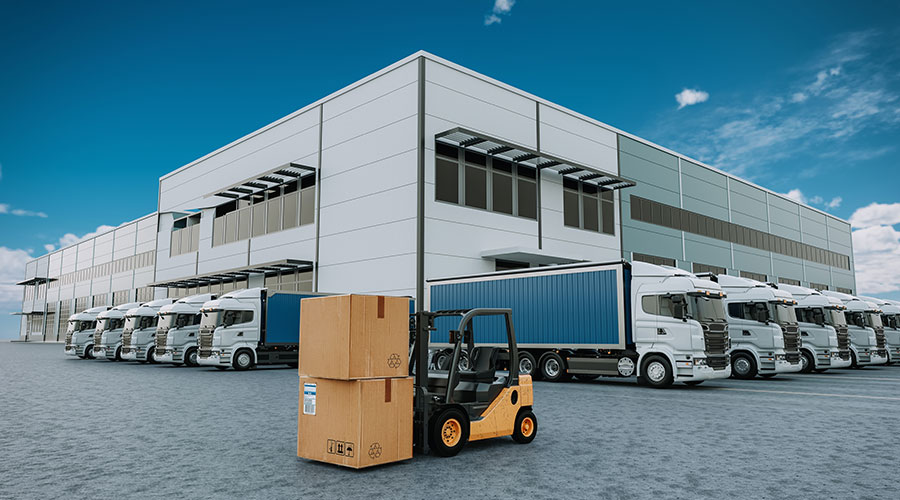
A large percentage of those rooftops belong to warehouses. According to Environment America, 16.4 billion cumulative square feet of rooftop space representing 450,000 such buildings in the U.S. Per the automation firm Opex, the average non-refrigerated warehouse in the U.S. consumes about 6.1 kwh of electricity and 13,400 Btu of natural gas per square foot of space.
Whether your organization owns and manages its own warehouses or outsources these functions to third party logistics (3PL) firms, they offer significant opportunities for sustainability and clean energy deployment.
Many standard building energy efficiency techniques can have supercharged impacts in the vast expanse of a large warehouse. Lighting costs can be staggering, making every improvement in LED technologies or control strategies even more significant. As workers move from space to space, motion controls become essential.
Building management systems provide critical opportunities for analytics and uncovering anomalies in energy use, particularly as warehouses become increasingly automated. Switching forklifts and other internal transport devices from gas to electric makes a lot of sense in an environment in which…well, range anxiety is not an issue. And who really wants combustion exhaust inside your building? Particularly when you factor in the ventilation savings once you can eliminate those indoor pollutants.
Amazon piloted such techniques and others at a Same-Day “fulfillment center” in Sacramento, California known as SCA5, which achieved the stringent Zero Carbon Certification from the International Living Future Institute (ILFI). The building is heavily insulated and all-electric, with high efficiency motors, low friction belts and low-friction rollers to cut energy use from material handling equipment. It is designed to host a rooftop solar array that can generate as much as 80 percent of the facility’s annual energy needs. Other features of SCA5 include low carbon concrete and drip irrigation to save water on landscaping.
Environment America estimates that maximizing solar photovoltaic (PV) deployment on warehouses could provide enough electricity to power more than 19.4 million households per year. While warehouse rooftops (and yards in some cases) can provide major opportunities for solar, it would be a stretch to call it a “no-brainer”, as there are a number of factors a building owner or manager must consider before making this decision, as the firm EQT discussed in a piece on the topic.
First, it is essential to do the proper analysis to ensure the roof is able to bear the weight of the solar array – and reinforce it as necessary. The average PV panel can range from approximately 45-85 lbs. each, with the number of panels needed depending on the size of the desired array.
The calculation of savings, payback, etc. possible from installing solar will vary widely, depending on a range of factors from state and local government and utility incentives to local power rates. As I discussed in a previous column, although federal solar tax credits are being phased out, the hikes in grid electricity prices in many places can still make solar a wise investment – which, once paid off, becomes a free source of power.
There may also be disconnects between building tenants and owners, either in terms of a mismatch between who pays the costs and who reaps the benefits (“split incentives”) or regarding issues of roof access and liability. The EQT article notes that maximining benefits from solar may involve “businesses integrating solar PV, batteries, electric vehicle infrastructure, and smart controls across their estates, sometimes through microgrids or by participating in demand-flexibility schemes.”
One strategy being employed by California-based logistics firm Prologis, one of the largest warehouse owners in the U.S., is community solar. Prologis established a partnership with the Clean Power Alliance (CPA) to generate over 5 MW of power from solar on five of its buildings and provide fixed rate clean energy from these arrays to disadvantaged communities near its properties. The arrangement was expected to provide enough energy to power over 2,400 homes per year. Even where such a deal does not pencil out financially, its value in building community goodwill can be priceless.
Overall, Prologis reported owning 814 MW of solar globally in its 2025/2026 Global Impact and Sustainability Report, as well as 296 MW of battery energy storage. The Solar Energy Industries Association (SEIA) ranked Prologis in 2024 as the number two company in the U.S. based on the size of its onsite solar capacity. Joining it in the top four were warehouse-heavy retailers Target, Walmart and Amazon.
Prologis continues to take its sustainability journey in many interesting directions. As the company states on its website, “The exterior of a sustainable warehouse is easy to detect because it usually has a rainwater harvesting and management system, solar panels, reflective/cool roofing, strategically planted shade trees and other elements.” The company also focuses on packaging reuse, reduction and recycling, and even implemented a program to surround its facilities where possible with green spaces for employees and customers to enjoy.
And Prologis is leading on an emerging frontier of clean energy deployment, in setting up charging stations for electric trucking – an issue on which the U.S. lags badly behind China. Per EE News: “Partnered with shipping firm Maersk, it operates two heavy-duty truck charging hubs in the Los Angeles area. The largest, in Torrance, can charge up to 96 vehicles at the same time” – with six more stations planned for Southern California.
Amazon, meanwhile, has become the largest operator of private charging infrastructure in the U.S. after installing over 17,000 chargers for its delivery vans at 120 of its warehouses.
Finally, there are many energy and waste reduction benefits that warehouses can gain from optimizing their operations. This ranges from resource optimization through predictive analytics to strategically locating warehouses to reduce transportation impacts and benefit from existing infrastructure rather than requiring disruption of undeveloped areas.
So, warehouses don’t need to represent a bland, dreary vista – they could be the inspiration you see flying into a city, with dynamic solar rooftops, green surroundings, electric truck charging stations and the knowledge that their owners and managers are doing all they can to reduce their environmental footprint. It’s one more piece of building a sustainable, clean energy future – even in sometimes forgotten spaces.
Ken Sandler, Ph.D., is a clean energy and sustainability analyst and thought leader who spent 35 years advancing green building and sustainability policies and programs across the federal government. In addition to being a FacilitiesNet sustainability columnist and Facility Influencer, he writes his own newsletter, Regenerative Futures at LinkedIn and Substack.
Related Topics: