 Photo credit: Joe Sorrentino
Sustainable K-12 Schoolyards Grow in Popularity
Asphalt-covered spaces are being replaced by more environmentally friendly options.
The traditional image of K-12 schoolyards is not often favorable. Typically, they are hot, unwelcoming asphalt jungles.
Believe it or not, there was a point in time when those designs were desired.
“It used to be a beautification,” said Christos Chrysiliou, chief eco-sustainability officer for the Los Angeles Unified School District, while speaking at the U.S. Green Building Council’s Green Schools Conference in February. “Thirty, 40 years ago, that was a better space for them. ... Now, 30 years later, we’re like, ‘What have we done?’”
Times have certainly changed, and the dedication to providing more pleasing learning environments for the students and community has, as well. More school districts realize the student benefits of greener schoolyards, or living schoolyards, with help from organizations like the Trust for Public Land (TPL), which has helped create 420 community schoolyards nationwide.
“We know we need to do better,” said Danielle Denk, TPL’s senior director for the schoolyards initiative, during a presentation at Green Schools. “There are too many schoolyards across the country with nothing but broken asphalt, asphalt that heats up in the summer to 160 degrees, floods when it rains, shuttering schools and sending a message to the community’s teachers, parents and kids that they don’t matter. These spaces should be better, can be better and we’re working to make that standard.”
Research from the organization Climate Central shows the importance of transforming these spaces at K-12 schools. During her presentation, Denk cited statistics from a study of public heat exposure that looked at the 65 largest U.S. cities that covers more than 12,000 K-12 public schools and 6.2 million students:
- Seventy-six percent of students attend school in extreme urban heat islands, which is defined as a metropolitan area significantly warmer than surrounding areas due to human activities and development with at least 8 degrees more heat.
- In nearly 25 percent of cities, 9 out of 10 students attend school in an extreme urban heat island.
Additional research from TPL and its academic partners shows that green schoolyards have improved community life by:
- reducing injuries
- improving culture and climate
- mitigating heat impacts
- changing behavior of students and use patterns.
Examples of the ways K-12 districts can benefit from green schoolyards were on display at the conference from two of the largest school districts in the country — the School District of Philadelphia and the Los Angeles Unified School District. Each entity discussed the impact of green schoolyards on their students and staff and offered suggestions on how school districts can forward the conversation on improving their schoolyards.
Find partners
Beautification of its schoolyard spaces was not the top priority for the School District of Philadelphia. Safety for the community takes precedence, though the schoolyards still are visually appealing.
“Many of our schools sit in neighborhoods with significant heat burden and sit in watersheds that a storm impacts quickly,” said Megan Garner, director of sustainability and green schools for the Philadelphia district. “For us, redesigning a school yard is not cosmetic. It’s infrastructure and one of the few moments when we can meaningfully change how campuses perform for decades.”
Philadelphia’s transformation was boosted by its ability to work with local partners to help with the planning and construction. Philadelphia also brought in entities such as the city water department and a non-profit such as the William Penn Foundation to support the projects.
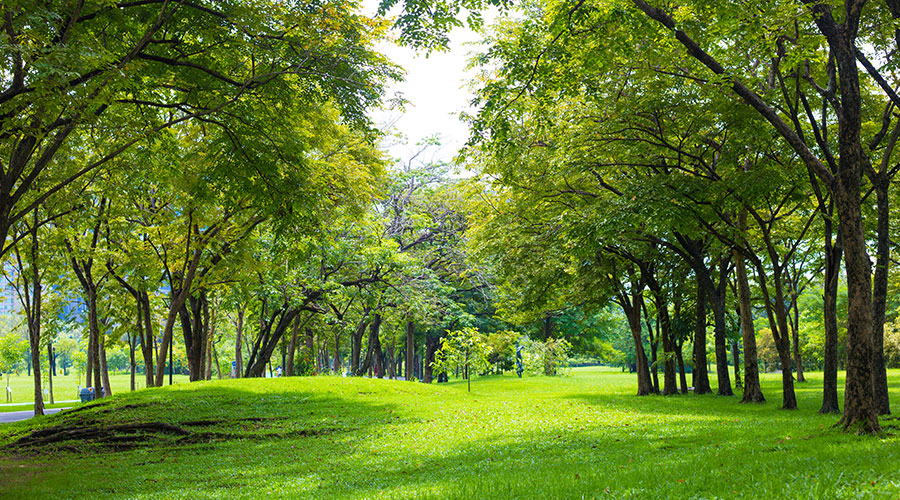
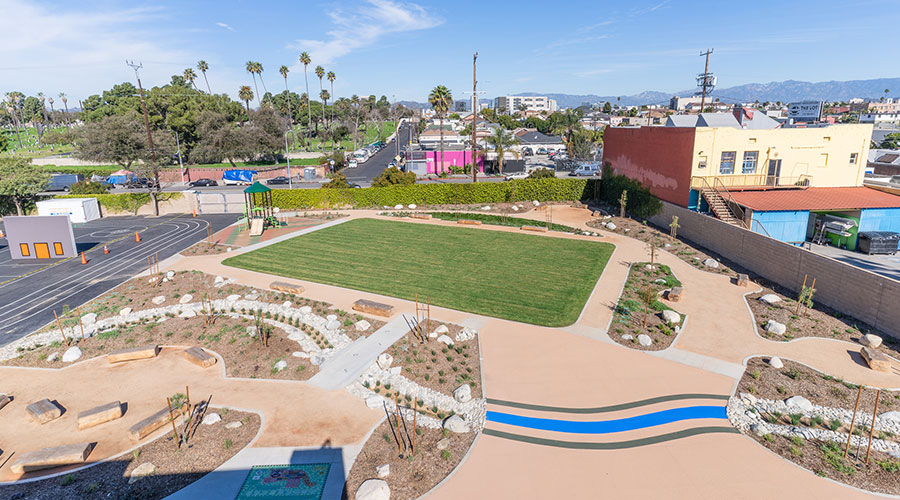
The partners assist in funding and planning design and construction of the schoolyards, including establishing stormwater systems and tree canopies, as well as de-paving surfaces to create more natural and environmentally friendly spaces.
“Redesign is one of the few moments where we can layer multiple benefits at once and protect long-term savings,” Garner said. “Tree canopies can help cool campuses, and we can reduce localized flooding while supporting watershed help.”
Have a plan
When the Los Angeles Unified School District set out to establish a sustainability program, it passed a resolution to convert 30 percent of every schoolyard in the district to permeable green spaces by 2035 and provide tree shade to 20 percent of its schoolyards.
The district has more than 150 green projects in the planning or design phase, with almost 30 more completed projects. Chrysiliou said the district initially focused on projects that could be completed quickly.
“We went through the process of trying to find solutions and how we can accelerate the implementation of those projects,” he said. “We wanted to see projects that we can turn around in a year’s time, not something that’s going to take four or five years to do. It’s a great program that’s moving well, and we have a plan to continue to build it.”
The School District of Philadelphia took a similar approach when building its schoolyards.
“We’re trying to build a system, not a series of disconnected projects,” Garner said. “Establish (projects) as part of long-term district planning, rather than isolating site improvements.”
Taking a long-term approach to projects also allows faculty to focus on maintaining and improving green spaces on school campuses even as grounds managers and teachers who launched the initiative might have moved to other jobs.
“There is a need to embed the curriculum into district systems and ownership into the structure, so the project doesn’t become dependent on one enthusiastic champion that leaves,” Garner said. “You should design against the fragility.”
Student involvement
In addition to the mental and physical benefits green schoolyards can bring, districts are also incorporating students into the equation from an education standpoint when designing and even maintaining them.
“The students are there every day and they’re learning, so let’s get them involved in the design so that they have a sense of accomplishment,” Denk said. “That’s project-based learning, and then stewardship. These things need to be maintained, need to be cared for and there are ways to work around stewardship models that help to drive not only change in the moment but sustainable change.”
By bringing students into the design plan, each schoolyard offers a unique presence, whether the finished product is located across the country or in the same district.
“The schoolyards look different everywhere because every community has a different set of needs and expressions that should be theirs,” Denk said.
Dave Lubach is chief editor of the facilities team. He has 10 years of experience writing about facility management and maintenance issues.
Related Topics: