 Photo credit: University of Maine
Handling Winter’s Worst: How the University of Maine System Tackles Snow and Ice
The University of Maine System’s successful snow and ice management program hinges on preparation, trained staff, clear priorities and contingency plans.
By Ronnie Wendt, Contributing Writer
Key Takeaways:
- Prepare early: Winter readiness starts months ahead with equipment servicing, material stockpiles, route planning and staff drills—not when the first storm arrives.
- Tailor operations to local conditions: Choose deicing materials, equipment and clearing methods based on the specific mix of snow, ice, temperatures, surfaces and sustainability requirements.
- Put people and continuity first: Train and support crews, prioritize emergency routes and critical buildings, and maintain backup equipment, parts, fuel and contractor relationships.
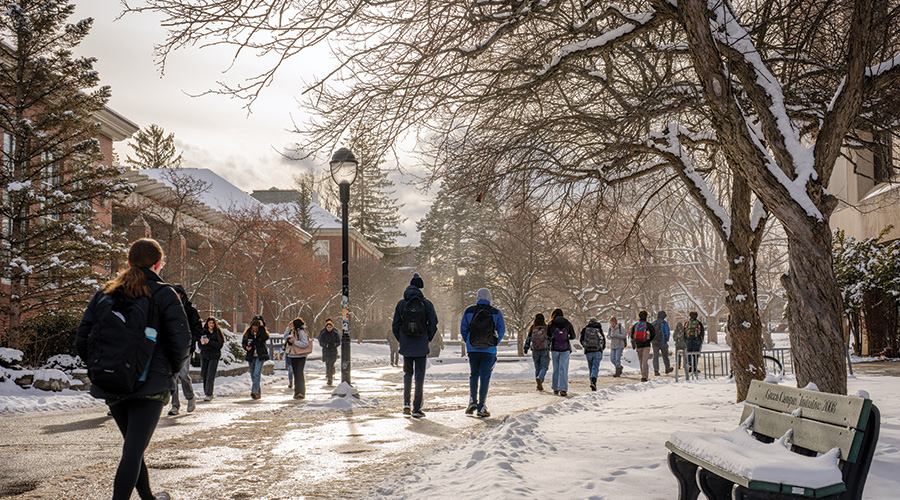
If most grounds managers at institutional and commercial institutions think their winters are tough, they need to try keeping a campus running when annual snowfall can be up to 200 inches, temperatures plunge as low as 40 degrees below zero and snow blankets the ground from Thanksgiving until May.
This scenario is reality for grounds managers across Maine, where winter is a months-long operation that demands careful planning, reliable equipment and teams ready to respond around the clock.
Three facility leaders at University of Maine System campuses in Presque Isle, Machias and Farmington share the ways they navigate deep inland snow, coastal ice and winter chills. Their stories provide practical strategies that managers elsewhere can use to strengthen their own winter operations.
Where winter means business
Though all these leaders are part of the University of Maine, each of their campuses faces unique winter challenges.
Joe Moir, executive director of facilities and regulatory compliance, says the Presque Isle campus in Northern Maine sees annual snowfall totals up to 200 inches and temperatures down to 40 degrees below zero.
In contrast, Byron Perry, director of facilities at the Machias campus on Maine’s Down East Coast, deals with a mix of snow, ice, wind and freezing rain, while Scott Foster, director of facilities at the Farmington campus in Western Maine, must cope with 120 inches of snow annually and maintain the campus in addition to public sidewalks through the center of town.
Though their winter challenges differ, these managers agree that successful winter operations demand advance preparation and well-trained staff.
Equipment matters
Plans for winter start in the heat of summer. This is when crews winterize engines and hydraulic systems, maintain service plows and inspect high-wear components.
“We start staging equipment well before the first snowfall,” Moir says. “We switch tractors over from summer operations to winter operations. We put on the snow blowers and scraper blades, and service all equipment.”
Crews change engine oil weights, moving from the 15W-40 summer oil to a 10W-30 winter oil. The oil’s reduced viscosity ensures better flow to ensure equipment starts in freezing conditions, which lessens engine wear and protects equipment.
“We also go through hydraulic fluids to make sure that if we hit a super cold snap, we do not damage our equipment,” Moir says.
Crews inspect and repair plow attachments to prepare them for mounting onto three-quarter-ton plow trucks. But they do not attach them until right before a storm.
“They are already serviced for winter,” Moir says. “We just need to put them on. They only take 5 to 10 minutes to put on the trucks. We add more dedicated equipment once winter really rolls in.”
After a storm, crews reinspect the equipment.
“When we get done with a snowstorm, everything is thawed out and gone over,” Moir says. “And all the components that need attention are readied for the next storm.”
Farmington follows a similar procedure, going through every piece of equipment before winter hits and after each storm. The department has three tractors with snowblower attachments and two smaller units with spreaders for rock salt and sand.
Deicing material
While all three campuses rely on rock salt, the ways they use it depend on the climate.
Crews at the Presque Isle and Farmington campuses use rock salt on sidewalks because it melts snow and ice and leaves behind a cleaner surface.
“We found that using sand creates a very dirty environment, and then there are the silica concerns with it drying out and blowing around,” Moir says. “The rock salt, though a bit more expensive, does a better job of keeping walkways bare.”
Farmington stockpiles rock salt to melt snow and ice, but Foster adds it comes with some challenges.
“Rock salt can be harder on equipment, so we have to spend more on repairs because it eventually eats through it,” Foster says. “On our concrete stairs, we have to (combine) various products to protect the concrete.”
At the Machias campus, where freezing rain and ice are common, Perry relies on a sand and salt combo and keeps 2,000 pounds of bagged rock salt on hand in case bulk supplies run low. The campus also uses deicing products that are environmentally friendly and pet friendly.
“We are more worried about ice,” he says. “So we have to use mixed ice and sand. But because we are a regional campus, we follow the University of Maine’s sustainability policy.”
The Maine managers’ collective advice? There is no one-size-fits-all deicing strategy. Material choice depends on weather conditions, desired performance, maintenance costs, environmental policies and surfaces being treated.
Staff training
Equipment does not remove snow, people do, which is the reason that the time to prepare staff is months before winter arrives.
Moir says he trains new operators on the equipment in controlled conditions every summer.
“We familiarize them with the equipment, though it will operate slightly differently with a bucket or snowblower on it,” Moir says. “But we start with the basics to build their skills so they know how the equipment works. We go through operator’s manuals and train them on safety procedures, too.”
The campus leaders pair seasoned employees with new staff and review snow routes and safety procedures with everyone. Tabletop exercises in late summer ensure every employee understands their responsibilities, equipment assignments and winter storm response plans.
For the first storm, Moir has a senior staffer drive while a newer employee rides along. He keeps this team together for subsequent storms so they can take turns plowing.
“This gives the new employee an understanding of where to push the snow and how the equipment works,” he says. “I have a very detailed map, right down to the direction I want the snow plowed in every parking lot because it makes a big difference in how much snow we have to move.”
Farmington restricts equipment operation to specific employees and has the custodial staff shovel or use walk-behind snowblowers. This changes the required training, Foster says.
“My crew is very dedicated and knows what to do during a snowstorm,” he says. “After the snowstorm is over, they even use equipment to sweep the sidewalks to remove any remaining snow and ice.”
Machias follows training established by one of his predecessors.
“We still use the training manuals he developed,” Perry says. “We train in August. We have employees hook up and unhook the snowplows, back up and drive around. If they don’t have enough hours of training, we won’t put them on the equipment.”
Crews inspect equipment before every shift and wear proper cold-weather gear, spikes on their boots and high-visibility apparel during a storm. Managers ensure staff take breaks to warm up when it is very cold. They also continuously monitor staff for fatigue during extended snow events.
“We want to keep everyone safe,” Perry says. “Our staff are the unsung heroes. They come in no matter how bad the storm is, sometimes staying overnight or working in shifts just to keep people safe.”
Perry uses pizza parties to recognize and reward staff during a storm.
“We bring in pizza and drinks, give crews breaks, rotate people and even let them sleep between shifts during lengthy storms,” he says.
Foster emphasizes leading by example in snow emergencies.
“It’s not beneath my assistant director and me to be out on a piece of equipment,” he says. “When your team sees you working hard alongside them, they’re more likely to put in the effort for a big snowstorm.”
Managing the storm
It is not possible to clear everything at once during a storm, so crews must know their priorities beforehand.
Viewing multiple weather apps and live radar helps project when the storm will hit and when to start clearing snow. Moir recommends using Weather Underground, a commercial weather service, and NOAA Weather Radio. Campuses also communicate with each other, staff and faculty through mass communication systems before, during and after a storm.
Clearing emergency routes is a top priority, so crews work continuously to keep fire lanes clear. Next, they focus on the buildings that need to open earliest, such as residence halls, dining facilities and childcare centers, as well as areas with high pedestrian traffic.
Moir says they might start clearing snow between midnight and 4 a.m., depending on when the storm starts.
“It doesn’t matter if you get a ½-inch or 4 inches or more,” he says. “You have got to touch everything. Anything over 4 inches takes extra time.
“We never truly stop. I’ve got a 24-hour staff that continuously plows all fire lanes and roadways for emergency vehicles. If those guys get behind, they will reach out to the grounds crew and activate more people to come in. Our goal is to have everything plowed and cleaned off by 6:30 a.m. so that things are ready when classes start at 8.”
Campus closures mean crews need to prioritize safe access for students who live on campus.
“If the campus closes, we regroup,” Perry says. “We want to make sure everybody stays safe and gets home safely.”
When school is closed, Foster shifts his team to keeping dining halls, dorms and walkways clear and puts less focus on administrative or educational areas.
“But if school is open, it’s all hands on deck,” he says. “We just keep going.”
Planning for the unexpected
Because even the best maintained equipment can fail, these leaders build redundancy into winter operations. They stockpile high-wear replacement parts, keep fuel and deicing materials on hand, and maintain relationships with local contractors who can pitch in if needed.
Moir says he maintains more equipment than the campus typically needs.
“That way, if something breaks down, we can just move to another piece of equipment while it is being repaired,” he says.
His team also keeps an inventory of bearings, chains and other high-wear components so the team can maintain equipment immediately rather than wait for parts to arrive. He also keeps bulk fuel on campus so that they can refuel vehicles without leaving the grounds.
Outside partnerships are invaluable when equipment fails during a storm.
“My loader broke down last year, and I was able to reach out to my local contractor,” Moir says. “He dropped off a payloader for me.”
Farmington regularly shares equipment and deicing materials with the local municipality, and Machias relies on support from other University of Maine campuses and local contractors to keep things moving.
Once winter arrives, these leaders say it is too late to prepare.
The University of Maine System’s leaders say successful snow and ice management is built months in advance through preventive maintenance, well-trained crews, clear response priorities, and contingency plans.
When combined with a deicing strategy tailored to each facility, these efforts can keep operations safe, efficient and moving no matter how much snow and ice falls.
Ronnie Wendt is the owner of In Good Company Communications and a freelance writer specializing in articles for the facilities management, aviation, recreation vehicles and automotive, meetings and events, security, logistics and business technology industries.
Related Topics: