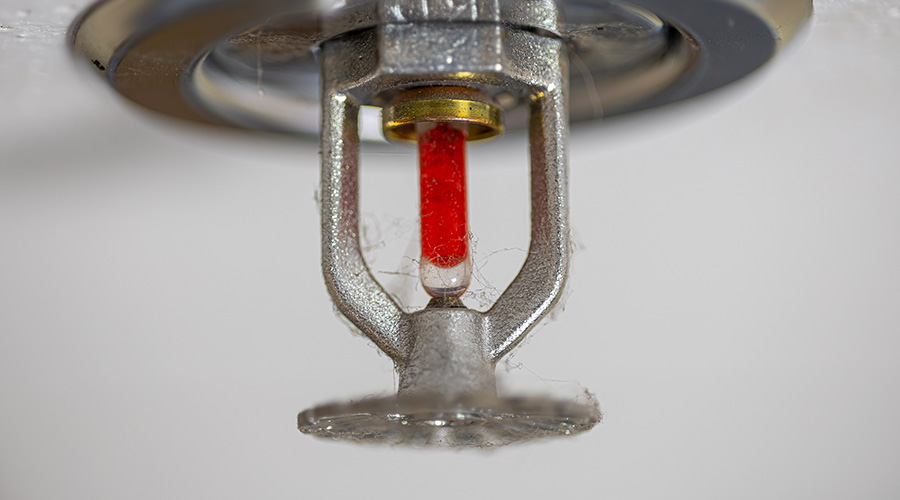
Smarter Fire Protection: Where AI Can Help
Artificial intelligence is reshaping facilities management, and fire prevention is no exception.
By Joel Williams, Contributing Writer
Key Takeaways:
- AI can streamline fire-safety work by accelerating plan reviews, inspections, monitoring, risk analysis and data analysis, allowing facility professionals to focus on higher-priority decisions.
- AI has significant limitations because its accuracy depends on quality data and appropriate training; models can miss critical variables, produce false results and perform poorly outside their training environment.
- Human expertise remains essential, as organizations should use AI for narrow, measurable tasks, protect sensitive information and develop industry standards for transparency, validation and responsible use.
Artificial intelligence (AI) is reshaping facilities management, and fire prevention is no exception.
At the 2026 NFPA Conference & Expo in Las Vegas, Jonathan Hodges, Ph.D., lead research engineer at UL Research Institutes’ Fire Safety Research Institute, and Leslie Marshall, Ph.D., executive director of the SFPE Foundation, outlined the benefits, limitations, and responsible use of AI in fire protection.
Hodges says understanding what is happening “under the hood” helps practitioners judge where AI offers value and where caution is required.
AI is a tool, not a single solution
Fire-protection AI systems generally combine six tasks: classification and localization, anomaly detection, clustering, regression, translation, and generation.
Classification can identify a sprinkler, detector, valve, or pull station in a drawing or image. Anomaly detection compares present conditions with an established normal state. Clustering organizes records into meaningful groups. Regression predicts outcomes such as temperature, smoke-layer height, response time, or probability of failure. Translation converts information from one form to another, while generative systems create text, images, code, or structured content.
Faster plan review without surrendering judgment
Computer-assisted plan review can locate and count components (sprinklers, detectors, valves, and extinguishers); compare layouts with room geometry; flag missing information; and route likely problems to reviewers.
Language models can organize checklist comments, while rules-based logic enforces requirements that should not be left to probabilistic models.
This hybrid approach matters because drawings contain exceptions, project assumptions, and relationships that may not appear on one sheet. They emphasized that automated plan review should remain a decision-support tool:
These tools can reduce the need for symbol counting and document searches, freeing facility engineers to focus on higher-priority reviews.
Monitoring and detection between inspections
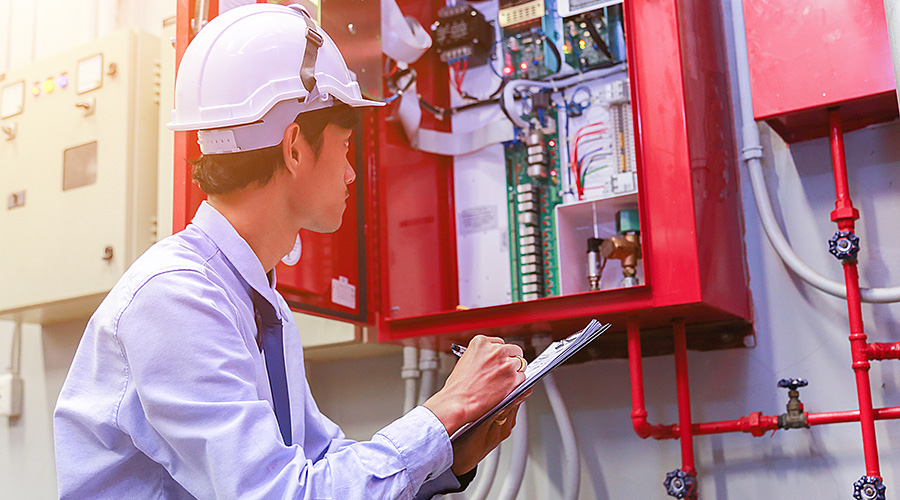
AI can strengthen inspection, testing and maintenance tasks by identifying visible deficiencies such as obstructed detectors, improperly positioned valves, corrosion, damage and missing signage. Models can also monitor pressure, flow, temperature, battery condition and performance to support condition-based maintenance alongside required intervals.
But data integrity remains essential. Hodges warns that models cannot compensate for a failed sensor, an undocumented configuration change, or missing context unless those conditions are detected and managed separately. Facility teams still need procedures for sensor calibration, network continuity, alarm escalation, and documentation.
AI can also combine sensors, video and thermal data to recognize developing hazards earlier and reduce nuisance alarms. Overall accuracy can be misleading when fires are rare: a model may appear accurate by predicting “no fire” almost every time. Engineers must examine false positives, false negatives, and performance across fuels, environments, devices, and failure modes.
For example, the presenters highlighted a critical limitation of using AI to model real-world fire dynamics:
If a manager trained AI to predict a fire occurring but was never told that windows can fail, AI will not be able to predict a fire. It would be dangerous to possess a device that’s going to tell a firefighter if it’s safe to go into a room and the model has no concept of ventilation being a changing factor.”
Risk analysis and faster modeling
Machine learning can combine weather, vegetation, topography, structural characteristics, historical losses, and remote sensing data to estimate wildfire likelihood, exposure, and spread. Image classification can support fuel mapping and damage assessment, while clustering can group facilities or communities by risk.
Utilities can use anomaly detection for unusual electrical or thermal behavior, computer vision for remote inspection, and regression for risk or remaining useful life estimates. Battery and emerging-hazard models must evolve as chemistries and failure modes change.
AI-based surrogate models can learn from fire-simulation results and rapidly estimate related scenarios for design exploration, sensitivity studies, emergency planning, or live decision support. Yet these models remain bounded by their training domain; changes in geometry, fuel, ventilation, or operations can undermine a plausible prediction.
The presenters warn that fast answers are not automatically a useful answer, and incident commanders need concise, actionable information, along with a clear explanation of assumptions, uncertainty, and what the system does not know.
Marshall called for industry-wide standards to guide the development and use of AI models that approximate complex fire simulations. The presenters are calling for industry standards that show what model development and workflow should look like to ensure reliability and transparency.
Responsible use starts with narrow tasks
Marshall advocates starting with a narrow, measurable task — such as identifying symbols, extracting defined values, flagging one visible condition, or comparing text with an approved checklist — rather than asking AI to “review the fire-protection design.”
Organizations must protect project drawings, security-sensitive information, proprietary calculations, personal data, and unpublished incident records. General-purpose language models can cite the wrong code edition or jurisdiction, invent quotations, and provide confident but incorrect answers.
Hodges demonstrated this risk during the session with an AI-generated fire-sprinkler image that displayed inconsistencies and AI’s inability to understand the directions it was given. Models also reflect their training data. Underrepresented building types, manufacturers, climates, communities, or incident conditions can produce uneven performance, making documentation of assumptions, limitations, and human-intervention points essential.
The presenters called for consistency and transparency with AI, stressing the need for a standardized framework that’s openly accessible for the kinds of data that are included in models and what it needs to look like for fire-protection and fire-safety systems.
They say participation in those standards will help the fire-protection industry adopt and shape future AI applications. Both presenters agreed that AI can reduce repetitive work and identify patterns, but engineers, code officials, facility operators and incident commanders should remain responsible for questioning results and exercising final judgment.
Building competence across fire safety
Marshall said the SFPE Foundation is supporting research, education, shared data resources, benchmark cases, validation frameworks and pilot projects tied to fire-protection workflows.
Practitioners need not become machine-learning developers, but they must understand training data, testing, domain limits and failure modes. AI developers likewise need fire-safety expertise.
Marshall said fire protection must advance its AI capabilities before related professions establish design workflows that overlook life-safety systems. She said managers need to make sure that fire protection systems are part of the conversation in the design phase. Marshall reiterated that the goal is not to promote AI for its own sake but instead to use it to determine where methods can meaningfully improve fire safety and what is necessary to use those methods responsibly.
Both presenters agree that AI should extend—not replace—professional capabilities by reducing repetitive work, identifying patterns, improving access to information, and supporting better decision-making.
Jonathan Hodges, Ph.D., is a Lead Research Engineer at UL Research Institutes' Fire Safety Research Institute (FSRI) and may be reached at Jonathan.Hodges@ul.org. Leslie Marshall, Ph.D., is the Executive Director of the SFPE Foundation, a global non-profit organization affiliated with the Society of Fire Protection Engineers, and may be reached at LMarshall@sfpefoundation.org.
Joel Williams is a freelance writer based in Frankfurt, Illinois.
Related Topics: