Yet history suggests those benefits rarely materialize on their own. The true legacy of a World Cup, Olympic Games or Super Bowl is not determined during the event itself. It is measured years later, when cities either continue building on the momentum those events created or discover that once the crowds leave, so too does the economic activity.
The most successful cities do not simply build for an event. They use the event to accelerate plans they already were committed to pursuing. The difference rarely comes down to the stadium itself. Stadiums are catalysts, not destinations. What matters is everything that surrounds them: governance, partnerships, programming and a long-term vision for the city beyond the closing ceremony.
Building for the city, not the event
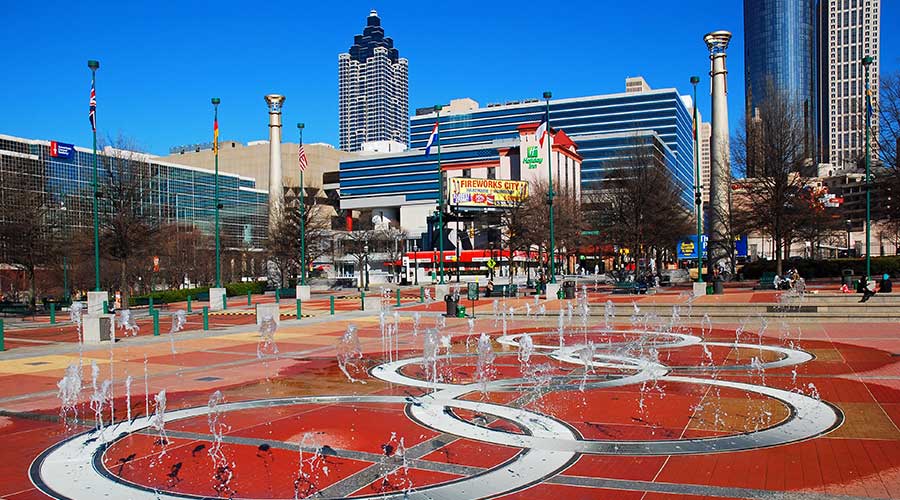
Atlanta remains one of the strongest examples of the way a major sporting event can serve as the catalyst for decades of urban redevelopment. The 1996 Olympic Games are often remembered for introducing Centennial Olympic Park, but the park itself was never the end goal. From the outset, the park was designed as part of a broader long-term vision. It closed for a year after the games to complete improvements that would support year-round public use before reopening in 1998.
Over the following decades, downtown Atlanta evolved around that investment. Attractions including the Georgia Aquarium and World of Coca-Cola helped anchor the district, convention facilities continued to grow, and the area became home to State Farm Arena, Mercedes-Benz Stadium and an expanding entertainment corridor. The surrounding area also added more than 1,500 residential units and millions of square feet of office space.
Thirty years later, projects such as Centennial Yards are still linked to decisions made during Atlanta’s Olympics planning. The surrounding land uses also were well suited to redevelopment, allowing investment in Centennial Olympic Park to unlock opportunities that already had been identified. That investment was reinforced through long-term alignment between state and municipal governments, developers, businesses, philanthropic organizations and civic institutions. It created the partnerships needed to sustain momentum long after the Olympic flame was extinguished.
Centennial Olympic Park became the visible symbol of Atlanta’s legacy. But the real achievement was creating partnerships that allowed investment to continue for decades. That mix of housing, workplaces and attractions gives people reasons to return beyond the event calendar.
Creating a tenant mix that serves game days and nongame days is challenging. Regular visitors seek place-based experiences. They want a destination that feels organically part of a city’s culture. Restaurants and bars are key for everyday activation, but simply having them is not enough. Locally oriented concepts, like a famous ice cream shop with a long history in town, give people a reason to return between games.
The spaces between buildings matter just as much. Sidewalks, streets and public spaces help differentiate a district from competing destinations, reinforce its identity and create a vibrant experience from arrival to departure.
Too often, discussions around the legacy of major sporting events focus on physical infrastructure. While buildings and public spaces provide the foundation for redevelopment, they are only one part of the equation.
Lasting success depends just as much on what happens after construction is complete — ongoing programming, active management and organizations dedicated to ensuring these places remain vibrant long after visitors have left.
Operations planning for large events is more complex and involves more uncertainty because attendance patterns are hard to predict, even for ticketed events unless entry is timed. Large events place greater burdens on venues and surrounding neighborhoods because of their physical impact and the number of visitors.
Building owners and managers must plan for those peaks while also considering the way their properties will function on ordinary days. Because large events are complex and expensive, planning for a second life of daily, smaller-scale events and activations is often assumed to be even more difficult.
Combined with the emphasis on a successful opening ceremony or major event, operations planning for what comes next often gets delayed or ignored. Where civic and business leaders take a life-cycle approach from the beginning, they have created projects that are more financially sustainable, open opportunities for new public-private partnerships and support more economic development.
Who pays for shared public spaces and the programs that activate them varies by city. It is not always the same entity that manages or owns the space. Ultimately, those willing to pay are those who stand to benefit — public agencies interested in residents' quality of life and economic development, property owners who can achieve higher rents from attractive public space, and foundations whose missions are advanced through civic projects.
In downtowns and urban neighborhoods, income from concessions, sponsorships and events often can offset expenses. Developing that revenue usually requires a public-private governance structure. Major events offer an opportunity to establish partners that can play a long-term role in funding and managing shared spaces and programming. Those funding and management responsibilities need to be established before opening.
Indianapolis provides a different perspective on decisions and actions that create a lasting legacy. The city successfully hosted Super Bowl XLVI in 2012 and delivered an event widely praised for its operations, visitor experience and downtown atmosphere. Its experience also illustrates that hosting a successful event and creating long-term urban transformation are not necessarily the same thing.
Projects such as the Georgia Street redevelopment helped energize downtown during Super Bowl XLVI and created an inviting public space for residents and visitors. But a successful event does not automatically create decades of sustained investment. Cities spend years planning for opening day. Building owners and their partners need to devote the same attention to what comes afterward.
Building a common vision among powerful stakeholders is challenging. Developers need to understand that a team’s brand and public image are paramount and that from the team's perspective, their projects are an extension of that brand.
Teams need to understand that game days do not make real estate successful. The physical organization of a sports-adjacent district must prioritize the daily functioning of a neighborhood over a limited number of days or evenings with major events, although that balance becomes more complex with arenas because they host so many more events.
Governments need to understand developers’ financial constraints to help projects get built. They also are positioned to encourage teams to see themselves as anchor institutions with a vested interest in the long-term health of their cities. That shared understanding needs to be established before opening while plans can still be shaped around the district’s daily life.
As Los Angeles prepares for the 2028 Olympic Games, it has an opportunity to learn from decades of experience and define its legacy before visitors arrive. LA28’s emphasis on existing venues reflects a shift toward maximizing assets rather than building for one moment in time.
That philosophy extends beyond competition venues. Public spaces, transportation improvements and neighborhood investments should be evaluated by the way they improve daily life for residents, as well as how they perform during the games. Sustaining those improvements after the games requires the same attention to everyday uses, partnerships and operations.
Governance: The real legacy
Measuring success is different in different cities based on their goals. What matters is an upfront planning process that defines short-, medium- and long-term goals, develops strategies to achieve them and decides the way progress will be measured. In one city, the most important measure might be shovels in the ground, while in another, retail spending and growth in retail space is most important. In a third city, permanent jobs created matter most.
In all of these cases, cities will have used a major event to create governance structures, management arrangements and communications channels that outlast the event. The most enduring legacies are not defined by stadiums or ceremonies but by the partnerships and governance that sustain investment long after the crowds have left. The more important question is not the way a district performs during opening week but who is responsible for it on an ordinary Tuesday five years later. That is when legacy planning truly begins.
Ben Donsky is principal at Agora Partners, an urban real estate development firm.