 Photo credit: JPMorgan Chase
Solar Is the Star at JPMorgan Chase's Polaris Facility
A host of strategic considerations combine for a successful photovoltaic installation at JPMorgan Chase's Polaris facility.
By Dan Hounsell, Senior Editor
Key Takeaways:
- Nearly 7,700 solar modules were installed on JPMorgan Chase's Polaris facility rooftop, and more than 32,000 solar panel carports were installed in the campus parking lots.
- In addition to gauging the effect of the solar installation project on the building, the JPMorgan Chase team needed to minimize the project’s impact on its operations and occupants.
- Photovoltaic technology is hardly new, but its growing popularity offers several crucial reminders for building owners considering their own projects.
From sustainable design and eco-friendly materials to waste minimization and renewable energy, a host of sustainability measures have emerged over the last 30 years with an eye toward helping institutional and commercial organizations lessen the impact of their facilities on the environment.
Financial services giant JPMorgan Chase has incorporated many such sustainability measures into its facilities over the years, but efforts at its regional headquarters in Polaris, Ohio, have put a spotlight on one technology in particular — photovoltaic systems. The facility presented a compelling use case for on-site solar technology, in large part due to its size.
“People here sometimes joke that Polaris is like a skyscraper flipped on its side,” says Zach Livingston, the organization’s executive director and global head of energy and sustainability, global real estate. “It has approximately 2 million square feet, and that means a tremendous amount of roof space, as well as parking lot footprint, both of which created opportunities for us to deploy renewable energy on-site at a meaningful scale.”
Setting the stage for solar
The Polaris building is the firm’s largest with more than 12,000 employees. The four-story, 2-million-square-foot building was redesigned over the last six years to transform the 27-year-old facility into a sustainable workplace with smart technology.
The facility earned LEED Gold status from the U.S. Green Building Council with help from a range of building technologies and systems, including: more than 17,000 LED lighting fixtures and 2,600 occupancy sensors; intelligent lighting control systems to enable automatic dimming for daylight harvesting and individual fixture lighting controls; and automatic faucets that save one-half gallon of water per minute and automatic flushing that saves 1.6 gallons of water per minute.
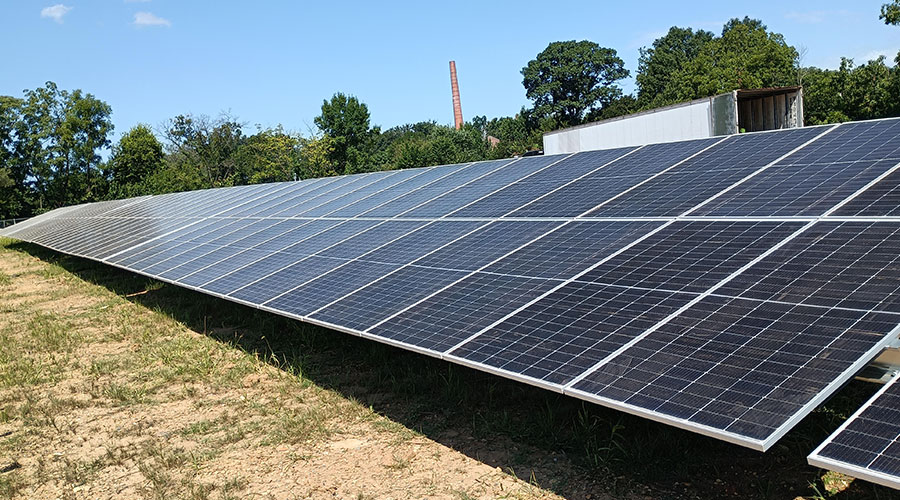
But the on-site solar installation is the facility’s high-profile sustainability star. Nearly 7,700 solar modules were installed on the building’s rooftop, and more than 32,000 solar panel carports were installed in the campus parking lots. The size and goals of the solar installation project — started in early 2020 and finished in late 2021 — presented the JPMorgan Chase team with daunting challenges.
“The goals were to generate renewable energy on site at meaningful scale to offset a significant portion of the building’s electricity consumption and reduce emissions, costs and reliance on the local electricity supplied from the grid,” Livingston says.
“The solar deployment at Polaris is a roughly 14.8-megawatt installation, and that includes roughly 7,700 modules on the rooftop and more than 32,000 modules across carports and the parking lots. Together, that allows us to meet roughly 75 percent of the building’s electricity needs, making it one of the largest commercial offices to utilize renewable energy at this scale.”
The project’s success rested on the ability of the team to ensure the existing facility could host the new technology.
“As part of any project of this sort, we’re always looking at the existing infrastructure that exists at the building electrically, the land space, parking lot space, rooftop space, rooftop condition, etc., to ensure that those existing elements can be married with a new project such as this,” says Vanessa Williams Stevenson, the firm’s vice president and head of energy and sustainability onsite project management. “The scope of a project like this usually does include all of the upgrades or additions to our electrical infrastructure to support something like solar.”
Assessing the impact
In addition to gauging the effect of the solar installation project on the building, the JPMorgan Chase team needed to minimize the project’s impact on its operations and occupants.
“Our main priority in implementing a project like this is to have the least amount of impact on the operations and the experience of the employees at the site,” Williams says. “That kind of planning as it relates to logistics, schedule and communication around changes is very, very important for a project of this magnitude. We really took a look at the resources that are going to be required — the steel, the solar modules, as well as the human resources, like electricians and pavers — to get the whole thing done.”
The planning process also extended into the turnover of the project from the construction phase to the operation phase.
“Once the project is built, we’re involved with the commissioning and the testing, getting the thing online and then ultimately ensuring that the folks who are on site — our facilities management and engineering teams — have all of the education and the information to manage the asset now that it’s live,” Williams says. “There’s a lot that goes into not only developing the project but executing the project and then ultimately getting it online and turning it over to the onsite teams.”
Spotlight on lessons
While photovoltaic technology is hardly new for institutional and commercial facilities, Livingston says its growing popularity offers several crucial reminders for building owners considering their own projects.
“You're dealing with a lot of new component types,” he says. “You’ve got modules, inverters and combiner boxes. You’re dealing with DC electricity, AC electricity and the monitoring and data acquisition equipment to make sense of all that.
“Then you’ve got to learn a lot of the key operational performance indicators. How does different weather affect the performance of the plant? What is the typical useful life of the equipment? When can you expect failures related to what we’ve learned at other locations?”
Successful solar projects also need to consider the broader scope beyond the technology itself.
“One of the key lessons is that solar needs to be considered in the context of the entire property,” he says. “Naturally, people associate solar with rooftop, but building owners should look beyond available rooftop space and consider roof condition, parking, land availability, electrical infrastructure, utility interconnection requirements, permitting, rebates, incentives and ultimately how construction will interact with day-to-day building operations.
“Polaris is a really good example because it’s got a pretty unique and unusual physical footprint that provided both rooftop space and extensive parking space.”
Williams says planning considerations also need to involve owners who have a strong understanding of their facilities and the possible impact of solar technology.
“You really have to think about how implementation of any project is going to impact your day to day,” she says. “You also have to really understand what you have existing already.
“In my experience there, I’ve seen a lot of projects go away because an owner didn’t understand the condition of their roof. It wasn’t something that could withstand solar. So it was a great idea and it would have been impactful, but there would have been another investment that owner might have needed to make.”
For the Polaris solar installation, these considerations ultimately have combined to result in a successful project.
“It’s performing as expected,” she says. “It continues to generate energy on site, and it continues to help us offset our electricity consumption. We have both rooftop and carport solar on this site, and we are planning to expand with additional carport solar on the site. We’re happy with the end product. It’s doing exactly what we planned for it to do.”
Dan Hounsell is senior editor for the facilities market. He has more than 30 years of experience writing about facilities maintenance, engineering and management.
Related Topics: