Strategic Upgrades Help Aging Buildings Meet Modern Demands
Rising utility rates, sustainability goals and evolving regulations are putting pressure on building owners and facility managers to improve building performance.
By Ronnie Wendt, Contributing Writer
Key Takeaways:
- Aging building systems are driving higher energy costs and pushing facility managers to prioritize strategic upgrades and long-term capital planning.
- Energy incentives and tax programs can help offset modernization costs, but experts say projects should focus on operational value first.
- Simple improvements such as insulation, sealing leaks and lighting retrofits can deliver fast energy savings before larger HVAC upgrades are considered.
As building systems age, they become less efficient, increasing energy consumption and driving up operating costs.
At the same time, rising utility rates, sustainability goals and evolving regulations are putting pressure on building owners and facility managers to improve building performance.
This changing landscape has pushed facility leaders to take a more strategic approach to capital planning and long-term building investments.
Now, modernizing aging facilities starts with identifying upgrades that deliver the greatest operational and financial value then assessing available state and federal incentive programs that can offset construction and equipment costs.
Aging infrastructure meets new expectations
Steven Barnes, a partner at Wipfli, advises building owners, developers and facility managers on the tax and construction considerations behind building upgrades tied to energy-related projects.
He says operational upgrades have become a growing priority, as many facilities continue to rely on infrastructure installed decades ago. “Many commercial buildings constructed in the 1970s–1990s are now reaching or exceeding their intended service life,” he says.
These aging structures often rely on lighting systems dating back to the 1990s, mechanical equipment operating beyond its expected service life and outdated building envelopes that contribute to energy inefficiency and higher operating costs.
At the same time, expectations surrounding building performance have increased, says Barnes.
Concerns surrounding indoor air quality have accelerated HVAC upgrades in hospitals and public buildings, while sustainability initiatives have pushed commercial property owners toward higher efficiency standards.
“If you buy a building that was built in the 1970s, in many places, the city is going to require you to meet a certain energy compliance to get that building up to par,” Barnes says. “That is going to require a lot of capital.”
These requirements demand that facility managers conduct a deeper analysis of project feasibility, timing and return on investment (ROI) before projects begin.
Incentives are changing the payback conversation
With construction costs at a premium, federal incentives such as 179D and other energy-related tax programs are also playing a larger role in project planning. These incentives provide a pathway for updates that may otherwise elude budget-strapped building owners.
However, though these incentives pack many benefits, Barnes cautions against chasing after them without fully understanding the economics of the project itself.
“I do not ever recommend chasing incentives,” he says. “You will never upgrade lighting systems, for example, just to get 179D. But if you are going to do this upgrade, take a look at incentives that can reduce your capital spend and save some tax dollars.”
Where to start
An aging building might have so many needs that it’s tough to know where to begin. Barnes says to first evaluate how efficiently the building operates as a whole. Sometimes energy modeling will show that updating the building envelope is more cost effective than a lighting or heating retrofit.
He explains that older facilities often lose significant amounts of conditioned air through inefficient windows, poorly insulated walls or aging roofing systems. Improving those areas can reduce energy demand.
“Caulking, replacing insulation, repairing the roof or exterior walls and replacing windows, can button up the building so it loses less energy,” he says. “These are really cheap repairs and can be your starting point before you look at lighting and mechanical systems.”
From there, he recommends lighting retrofits, which can provide some of the fastest operational payback.
“Lighting systems are usually the easy button for many reasons,” Barnes says. “The top reason is energy cost reduction. Our models show that many buildings will see up to a 60% to 70% reduction in electricity use with a lighting retrofit.”
Lighting upgrades also are less disruptive to operations than large mechanical retrofits. Fixtures can be replaced in phases with minimal disruption.
In contrast, “a total retrofit of your mechanical system can get pretty involved,” he stresses.
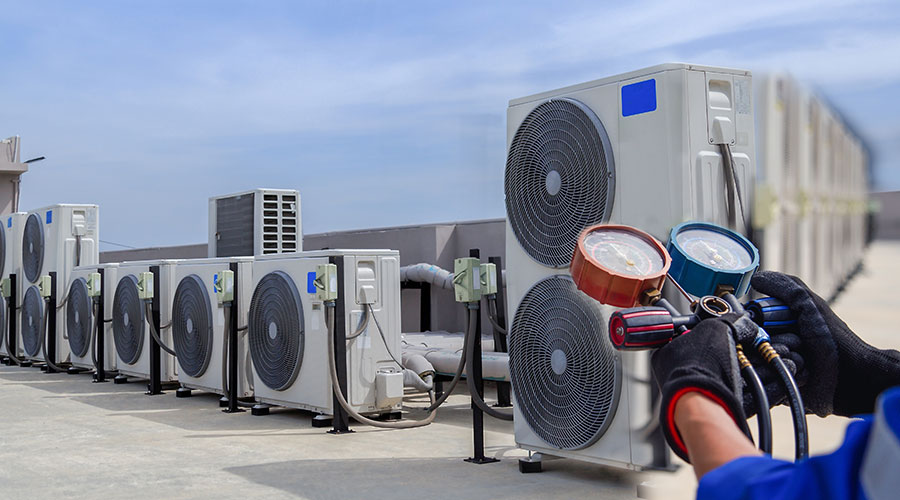
Barnes explains that replacing an HVAC system can include electrical piping and ductwork modifications, thus requiring coordination across multiple trades. Rising labor and material costs have also made these projects more difficult to budget.
“These upgrades can have meaningful impacts, and should be done at some point,” he says. “But you will not see as much of an impact as a lighting retrofit. You may only see a 10-30 percent reduction in energy use with an HVAC update.”
Why early planning matters
Barnes encourages facility leaders to involve tax and incentive consultants early in the planning process rather than after projects are already underway.
“Get these professionals involved on the front end,” he says. “A boots-on-the-ground project manager is juggling many things. They are an expert on getting the project moving forward, not on federal and local incentives.”
Incentive programs evolve as governmental administrations shift. A professional stays abreast of these changes, Barnes emphasizes.
For instance, several sustainability-related programs are currently facing phase-outs or modifications, as political debates continue on the future of clean energy incentives.
“We've always stressed to lobbyists and to Washington that it's really hard to plan projects if you're constantly changing policy and programs around incentivizing them,” Barnes says. “But it’s always been that way. Now they are phasing out 179D again but are already talking about bringing it back. Based on what we have seen historically, we could have programs coming back, some coming back in different forms, some new programs and some that will stay dead.”
Barnes warns that organizations that try to go it on their own may miss filing requirements, overlook labor compliance standards or not abide by program rules tied to federal incentives. As an example, May 15 is an important filing date for tax-exempt organizations to file for specific incentives or tax credits.
“It’s important that you check all the boxes,” he says. “The IRS, Department of Energy and the Treasury Department do not make this process easy.”
Missing a significant deadline or a compliance requirement can cause you to miss out on these credits, Barnes emphasizes. In fact, he recalls a school district that lost approximately $3 million in incentives because it missed a filing deadline.
As buildings continue aging and energy demands increase, facility leaders who combine operational planning with thoughtful tax and incentive strategies may be better positioned to modernize facilities while protecting already strained capital budgets.
In the end, they will achieve greater energy efficiency and sustainability that benefits the entire local community.
“I try to encourage building owners to go down the path of greater sustainability,” he says. “These incentives are a way that they can do something good. That is a win for everyone.”
Ronnie Wendt is a freelance writer based in Minocqua, Wisconsin.
Related Topics: