 Image credit: Menasha Joint School District
 Menasha School District Cuts Costs with Net-Zero School
The Menasha Joint School District built one of Wisconsin’s most sustainable schools while reducing annual utility costs and creating a model for future K-12 facility projects.
After developing a long-range plan, district leaders set out to involve the Menasha community. Brian Adesso, director of business services for the Menasha Joint School District, says the district sent out a community survey to inform residents of plans to build a geothermal and solar-ready middle school. The district formed a community task force to explore and prioritize potential projects. Voters approved a 2022 referendum for nearly $100 million to build the new, sustainable school.
“In order to remodel (the middle school), we would have had challenges,” Adesso says. “First, what to do with the kids because we would be adding on a little bit of space, but we wouldn’t be adding enough to shuffle them around while remodeling. So it would have pushed the project timeline out. We believe that we’re getting a better product and using the space more efficiently by rebuilding (the new school) right behind it.
“More importantly, it was only a $2 million difference between remodeling and building new. So for the additional $2 million — when you’re already almost at $100 million — it seemed like a no-brainer. Why wouldn’t you rebuild and give that new building a full life?”
During the school’s construction, district officials recycled and reused as much material as possible for the new building. Adesso says all the cement went back into the new school’s parking lot. The space once occupied by the old building has since become additional green space and athletic practice fields.
“We tried to do the best we could to recycle and reuse the products that we had on hand,” he says.
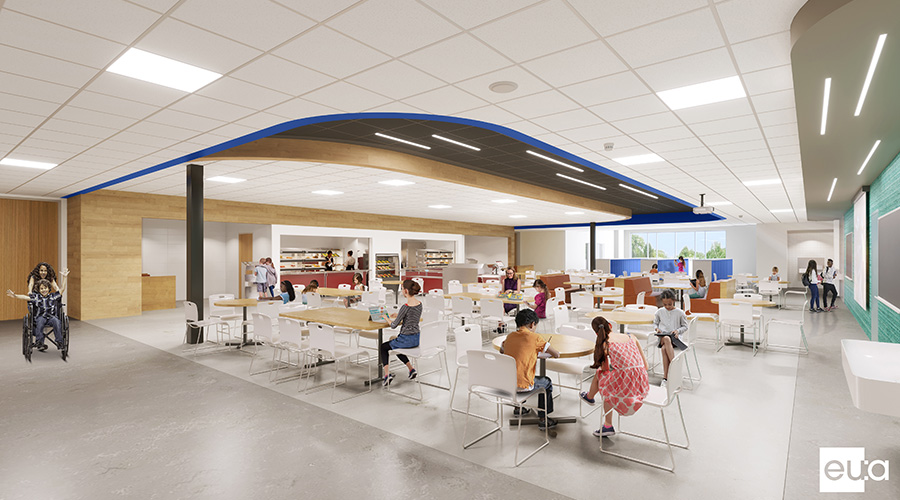
Maplewood is among the first schools in Wisconsin to receive Inflation Reduction Act tax credits to offset the costs of purchasing and installing geothermal and solar systems. The all-electric building consists of 60 geothermal wells and 2,747 photovoltaic (PV) panels. It is predicted that the school will use roughly 1.4 million kWh annually, but the PV system eventually will offset all energy use. The building also contains significant amounts of natural light to connect students to the surrounding environment.
“A main driver was the Inflation Reduction Act,” Adesso says. “It covered solar and battery backup, microgrids and a geothermal system. Our solar investments were all under $4 million, so it could be said that the Inflation Reduction Act paid for the solar rays to be put up. We also use debt defeasance, and that’s a fancy way of saying paying off debt early to be able to save our taxpayers money. This allowed us to get our projects done earlier.”
Political divide
In recent years, sustainability has become a divisive political topic. Throughout the construction project, the Menasha Joint School District invited political leaders on each side to see the progress that was being made at the school.
“It’s good to get politicians to see a project, especially one like this, so they can see that it’s possible, and hopefully when they’re doing policy, they can think about our school,” Adesso says. “We had Democrats and Republicans stop in. Gov.r Tony Evers also stopped in.
“We did a lot of things above code, and it didn’t cost us anything more. We got to talk with local leaders about maybe there should be an adjustment to codes to make buildings better. Just being able to hear all their voices helped get the message across and helped with publicity because we think this is a really cool project. It’s something our community should be really proud of.”
Regardless of the political aspects of sustainability, Adesso says he tries to focus on the financial benefits of the new Maplewood school. Through sustainable enhancements, the district is saving $190,000 in utility bills each year, he says.
“This is our first geothermal building, and it’s our first net-zero building,” Adesso says. “There’s a lot to learn, and the right people who are willing to learn about how geothermal buildings operate differently (than other buildings) can make the difference. You have just got to find the balance.”
Mackenna Moralez is the managing editor of the facilities market and the host of the Facilities in Focus podcast.
Related Topics: