High-Rise Buildings Help Solve Student Housing Crisis
Commercial buildings are being converted into other uses, and college and university students are reaping the benefits.
By Valerie Dennis Craven, Contributing Writer
Enrollment at higher education institutions has gradually increased over the past few years following a decade of decline exacerbated by the COVID-19 pandemic. College and university enrollment is now rebounding, and as tuition rises, students expect more from student housing.
Gone are the days of dorms with two roommates in a tiny space and a community bathroom.
To keep up with expectations and attract students, colleges and universities are exploring creative ways to bring elevated living experiences and higher-end amenities to the student population. In one case, that includes a high-rise, hotel-to-dorm conversion that brings together students from multiple schools to live together in New York’s Financial District.
Improving student satisfaction
The “2025 State of the Student Housing Industry Report” by StarRez reported nearly a 7 percent drop from the previous year of institutions reporting high resident satisfaction. Institutions that truly create a sense of community and safety and provide amenities around privacy and health are more likely to experience gains in satisfaction and retention, according to survey findings from the community management software provider.
Traditional on-campus housing models and aging infrastructure are not going to cut it. Higher education institutions need to attract and retain students, and housing has a role in bringing in people initially and keeping them.
Consider that many major office-market cities are seeing record numbers of high-vacancy buildings — more than one in five — as recently as early 2025, according to CoStar Group findings. Creative institutions are turning to adaptive reuse to stay competitive by providing students quality housing options quickly.
“Forces shaping campus planning have never been more complex or interdependent,” says Theresa Genovese, principal at CetraRuddy Architecture in New York. “Institutions must navigate demographic shifts, financial pressures, sustainability mandates, technological disruption and evolving expectations around student experience, all while safeguarding their mission and competitive position in a dynamic sector.”
External social, environmental, economic, political and technological drivers are forcing institutions to consider long-range planning and asset strategies, not just individual buildings, she says.
“Adaptive reuse has emerged as a central planning strategy for campuses seeking to optimize existing assets in service of multiple institutional goals,” Genovese says. “Planners and architects are reporting increasing emphasis on reimagining legacy buildings as a way to manage capital costs, reduce embodied carbon and accelerate delivery timelines in a period of fiscal constraints."
One case-in-point is 99 Washington Street in lower Manhattan, the world’s tallest student accommodations — soaring 50 feet high and consisting of 650 beds — following a conversion from a 492-room Holiday Inn.
Led by adaptive reuse construction firm BDB Construction Enterprises, FOUND Study FiDi offers occupants a communal kitchen and dining areas, laundry rooms, lounges, shared study zones and a fitness center.
An integrated approach
BDB Construction is focused on quickly bringing to market more student housing options to address these demands for better housing. Recent projects include a 75-student apartment Found Study Downtown Berkeley and a dormitory-style redevelopment in Newark, New Jersey.
This speed to market was accomplished by being involved in the earliest planning phases and contributing to decision-making, says Tallal Bhutta, BDB Construction founder and CEO.
“You finalize specifications in the phase and elements such as flooring and lighting with a long supplier lead time, can be approved by the client early,” he says. “The construction provider can bring their expertise to reviewing the design early and issuing questions and requests for information, allowing the facility leaders to be more proactive and to try to solve challenges likely to come up.”
This co-involvement is crucial, especially in the case of 99 Washington Street, where logistics abound. The Financial District is a dense neighborhood that leaves little room for maneuvering and laydown spaces, Bhutta says. The building also was planned for a phased opening.
Some details worked in favor of Found Study FiDi’s speed-to-market goal, such as the fact that in New York, hotels and dorms fall into the same occupancy group under the local zoning and building codes. The requirement for elevated amenities also did not require much modification since it was previously a hotel with common amenity spaces.
The building was opened in two phases to allow for earlier occupancy and revenue generation. As a result, the BDB Construction team had to consider occupant comfort, including noise, dust, movement of construction waste and elevator use.
While most of the work was done on the inside, the height challenges were minimal beyond elevator availability and advanced planning. For example, some building elements are typically divided into zones, such as plumbing, heating and hot-water systems, “so you have to have a good plan in mind as to when you would stage upgrades and make any alterations,” Bhutta says.
Another challenge to retrofitting a tall building was floor height related to exhausting the laundry machines, since the floor-to-ceiling room was very slender, Bhutta says.
Logistically speaking, the team did luck out regarding tenant amenities. Found Study FiDi added space by purchasing the building next door, which had been a pub and a chapel. A floor from the chapel building was turned into a new amenity space for residents, in addition to student amenity areas in the tower.
“In these kinds of projects, if you add certain amenities, you can also dramatically affect the occupant user reviews you receive,” Bhutta says. “Amenities are really a must for student residences, so it was fortunate that we had the Moran’s chapel next door to expand the amenity program.”
Found Study FiDi is an off-campus housing option for students and interns in New York City. It features furnished spaces from single rooms to deluxe triple spaces. The building features 24-hour security, high-speed internet, on-site laundry, a fitness center, communal kitchen and dining areas and dedicated study and common spaces.
Factors leading to shifts
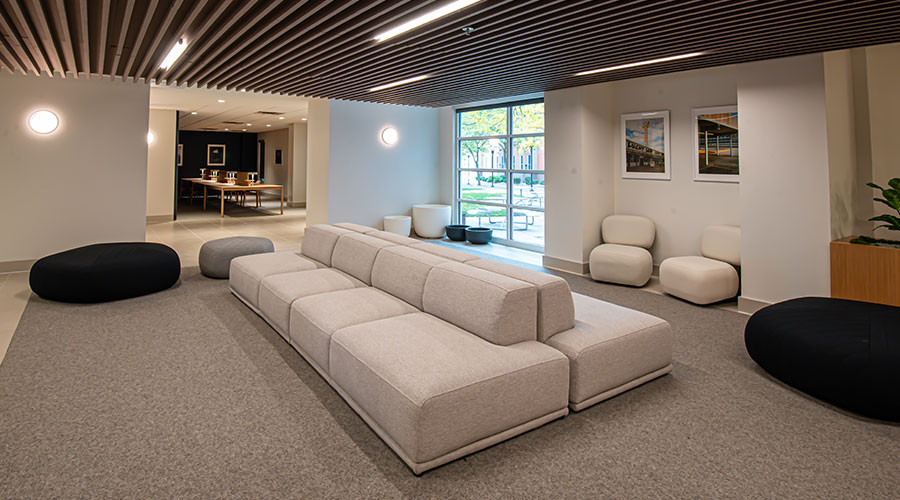
“Residence hall design is being redefined at the intersection of student experience expectations and broader institutional forces,” Genovese says. “While the traditional conception of dorms focused primarily on sleeping quarters, today’s residence environments are designed as integrated living-learning ecosystems that support wellness, community, collaboration and belonging, all of which are essential to student recruitment and retention.”
This trend reflects insights from the Society for College and University Planning on planning for student-centered environments: Campus facilities are considered vital components of the institution’s strategic value proposition, rather than simply real estate assets.
“At Columbia University, our comprehensive assessment of over 500,000 square feet of graduate housing informed a phased, sustainable reuse of Bancroft Hall, demonstrating how legacy residential stock can be transformed to meet contemporary expectations for quality, sustainability and operational efficiency,” she says.
Genevese says key aspects of residence hall planning should include amenities that speak to students, including:
flexible, multi-use areas that can support academic, social and wellness activities
the ability to adapt to different populations over time — undergraduates, graduate students, faculty-in-residence, interns and guests
community-building design elements to foster connection and wellbeing, from co-working spaces to shared kitchens and lounges
integrated data and technology to inform space utilization and enhance the student experience as part of broader campus planning and retention strategies.
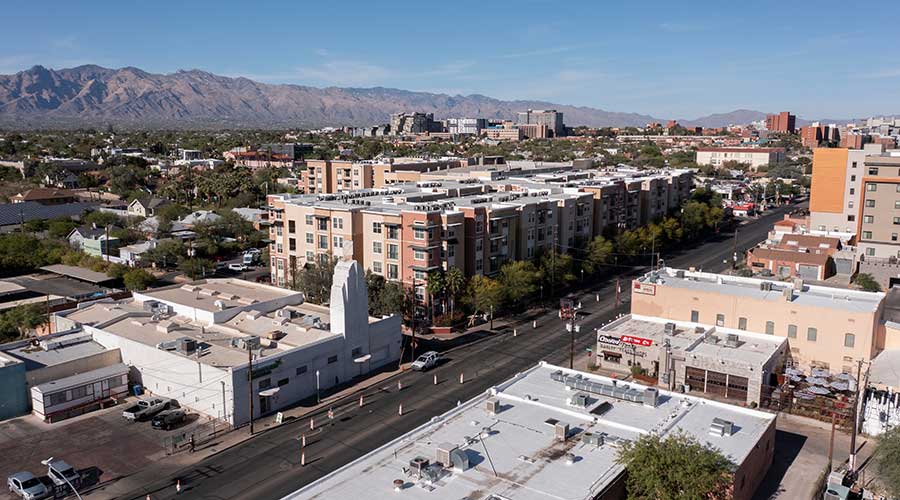
San Francisco is second only to New York in population density and lacks residential development in downtown commercial districts, says Charles Bloszies of architecture and structural design firm Office of Charles F. Bloszies.
As an alternative, “buildings in established neighborhoods at the fringes of the downtown core, close to public transit, are perfect candidates for city homes,” Bloszies says. “Many of these buildings are older with high ceilings, large operable windows and street-level charm. Buildings with these characteristics are ideal and attractive to many renters and buyers, including for student housing.”
Architectural strategy
To be good stewards of resources and money for existing buildings and institutions, those in the construction and architecture space see ongoing potential.
Bhutta points out the growth potential of integrated project delivery, a method the AIA says is a highly effective collaboration between the owner, the prime designer and the prime constructor that begins at early design and continues through project handover.
“It should be the preferred project delivery method to improve the overall experience of residents and to cut schedules and costs for conversion projects and other types of building projects,” Bhutta says.
Adaptive reuse and residential hall design are responses to shifts in higher education, Genovese says noting the uptick in integrated, cross-functional planning, with reuse projects often serving as catalysts for broader campus revitalization, community engagement and place-making.
“Ultimately, the most forward-thinking institutions are treating architecture not as discrete projects but as strategic interventions that support mission fulfillment, institutional resilience and long-term affordability,” she says. “Whether through creative reuse of historic fabric or thoughtful design of new residence environments, architecture is a tool for shaping the future of the university in a landscape of volatility and opportunity.”
Valerie Dennis Craven is a freelance writer based in Plymouth, Minnesota.
Related Topics: