 Image credit: Vogel Bros
 How Geothermal HVAC Cuts School Energy Costs and Improves Comfort
Wisconsin's Waunakee Community School District demonstrates how geothermal HVAC can reduce operating costs, improve occupant comfort and deliver long-term value.
Key Takeaways:
- Waunakee Community School District demonstrates that geothermal systems can deliver long-term savings, reliable performance and improved occupant comfort when decisions are based on lifecycle costs rather than upfront expenses.
- Federal incentives and emerging technologies, such as Dynamic Closed Loop geothermal, are making geothermal heating and cooling a more practical option for schools and other facilities with varying site constraints.
- Successful geothermal projects begin with comprehensive feasibility studies and early collaboration among owners, engineers and geothermal experts to ensure the system aligns with building needs and long-term goals.
When facility managers consider geothermal heating and cooling, two questions usually come to mind: Does it really work? And is it practical for my campus?
Two Midwest school districts have helped answer these questions.
In Wisconsin, Waunakee Community School District has spent a decade proving that conventional geothermal systems can deliver lower operating costs, reliable performance and comfortable learning environments.
Just across the border, North Shore School District 112 in Illinois has installed one of the nation’s first-known K–12 implementations of Dynamic Closed Loop geothermal technology, a technology designed to make geothermal viable on smaller sites.
Together, these projects illustrate why more facilities are giving geothermal a second look.
“School districts (and other aging buildings) are already looking at major renovations and replacing older mechanical systems,” says Steven Barnes, partner at Wipfli. “When they compare a traditional boiler or forced-air system with geothermal, then factor in today’s federal incentives, the conversation changes.”
Look beyond the lowest bid
When Steve Summers, executive director of operations for Waunakee Community School District, began planning Waunakee Intermediate School over a decade ago, he sought to reduce future utility bills, and a geothermal system emerged as a viable option.
Rather than relying on assumptions, the district hired an independent engineering firm to compare a conventional HVAC system with a geothermal alternative. The consultants evaluated local geology, modeled the building’s expected energy loads and calculated the long-term return on investment for both systems.
“They were able to document that in about 10 to 12 years the geothermal system would pay for itself through reduced utility costs,” Summers says.
That lifecycle perspective convinced district leaders to invest in a geothermal system.
Sara Ross, co-founder of UndauntedK12, a national nonprofit helping K–12 schools transition to healthier, climate-resilient, zero-carbon campuses, says Waunakee made the decision to go geothermal based on the long-term economics before the tax credit was a factor to consider, and has since added geothermal projects to two other schools because of the federal incentives. But in the past, many communities decided that while the long-term economics were compelling they couldn't afford the larger upfront costs. Now, once building owners factor in federal incentives, geothermal becomes financially competitive.
“Geothermal has always had strong lifecycle economics,” Ross says. “Now, with federal incentives helping to offset installation costs, organizations don’t have to choose between doing what’s sustainable and what’s financially responsible.”
According to Barnes, Waunakee’s wins highlight the importance of considering mechanical equipment costs over a building’s lifecycle. Long-term operating savings are as important as first cost, he says.
“We recommend, if geothermal is being considered, even if you don’t have construction drawings drafted up yet, that you get geothermal experts involved,” Barnes says. “Collaborating as a team from start to finish is key to your success.”
A decade of proof
Waunakee has found geothermal technology is low maintenance and increases building comfort. The district has since added geothermal technology to Heritage Elementary School, and Waunakee Middle School.
“We contract out the preventative maintenance for our HVAC,” Summers says. “But there have been virtually no major mechanical issues in the 10 years we’ve operated geothermal in the district.”
In-house, the district does not need specialized technical expertise.
Teachers and students, as well as the entire building operations team, have also noticed a difference in comfort.
“The building is very easy to balance,” Summers says. “We hear very few heating and cooling concerns from our geothermal buildings compared to our older buildings.”
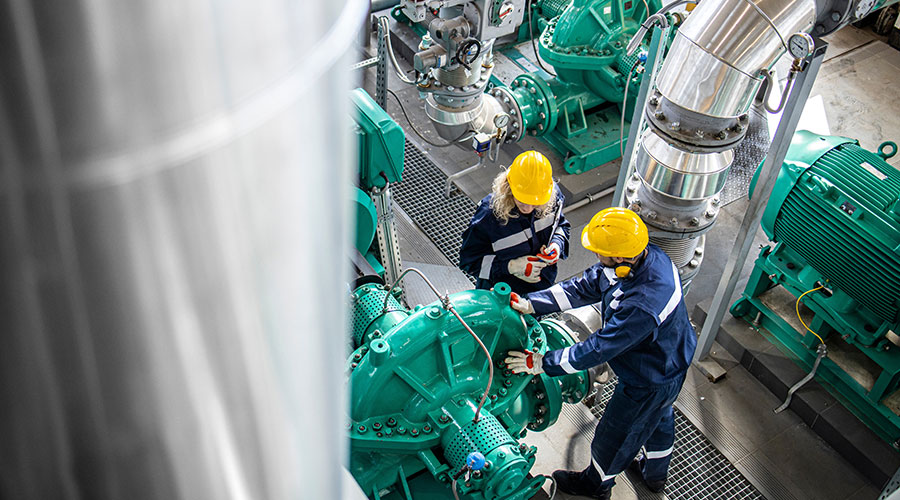
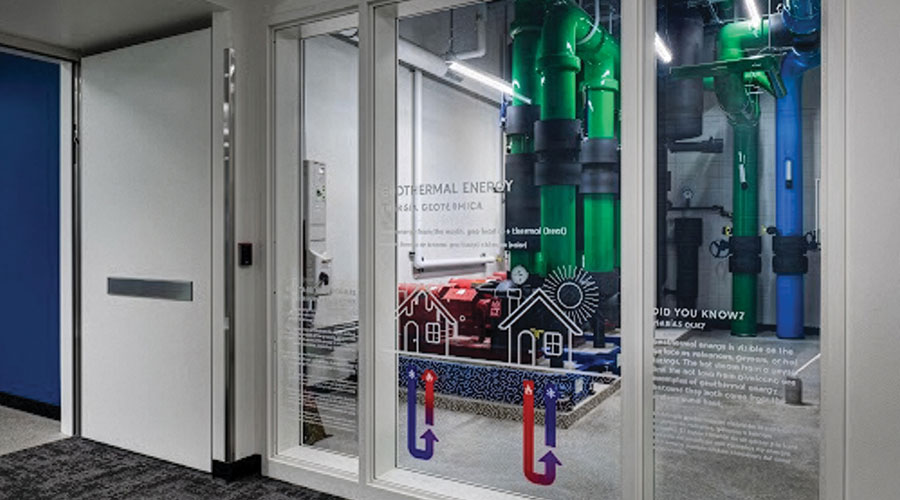
The district also uses the geothermal system as a teaching tool. Mechanical equipment is visible through viewing windows, so students can see renewable energy technologies in action.
Summers says the educational component is just as important as the energy savings.
“We’re teaching students that there are different ways to think about energy and sustainability,” he says.
Ronnie Wendt is a freelance writer based in Minocqua, Wisconsin.
Related Topics: