Count the Cycles: Budget Your Overhead Doors Before They Budget You
Most disruptive door failures originate with spring, cables or rollers wearing out.
By David Yifrach, Contributing Writer
Key Takeaways:
- Overhead-door springs should be budgeted by their cycle rating—not years—because high-use commercial bays can exhaust a standard 10,000-cycle spring in roughly one year, making regular cycle counts essential for proactive replacement planning.
- Most disruptive door failures originate with springs, cables, or rollers; addressing early warning signs and replacing related worn components together prevents damage to operators, unsafe door conditions, and costly operational downtime.
- Facility managers should specify component quality, testing, service response times, warranties, and contractor insurance in maintenance bids so planned replacements can replace emergency repairs and avoid losses from stalled operations.
A torsion spring on a sectional overhead door isn’t rated in years. It’s rated in cycles, one cycle being a full open and close. The most common spring I pull out of a failed door is rated for 10,000 cycles. On a house that opens its door four times a day, that spring lasts about seven years. In an institutional and commercial facility's receiving bay that opens 40 times a day, five days a week, the same spring is used up in about a year. Same part, same price, completely different line item.
Most facility teams I meet have never counted their door cycles. They budget the door the way they budget the roof, in years, and then it fails as a surprise on a cold Tuesday morning with trucks parked behind it. I’ve been the technician on that morning more times than I can count. Here is how I’d run the numbers from your side of the desk.
Estimate the real cycle count
You need an honest number for daily openings and a calendar.
Start with traffic. A receiving dock that takes deliveries all day might see 40 to 80 openings. A fleet garage that lets the vans out and back in might see 10. Count a normal day, multiply by working days. Forty openings a day, five days a week, is about 10,000 cycles a year.
Now match that to the spring. If the rating isn’t documented anywhere, assume 10,000 cycles, because that’s what most buildings got at construction. Heavy-duty commercial springs are often rated for 20,000 to 25,000 cycles, which sounds generous until a busy auto shop that opens a bay 30 to 50 times a day burns through it in under two years. High-cycle springs rated for 50,000 exist for exactly that door.
Divide the rating by your yearly cycles and you have the spring’s real service life. Put that date on the calendar. That’s the whole trick, and almost nobody does it.
The three failures that close a bay
Most commercial door downtime I see traces to one of three parts, and they tend to fail in order.
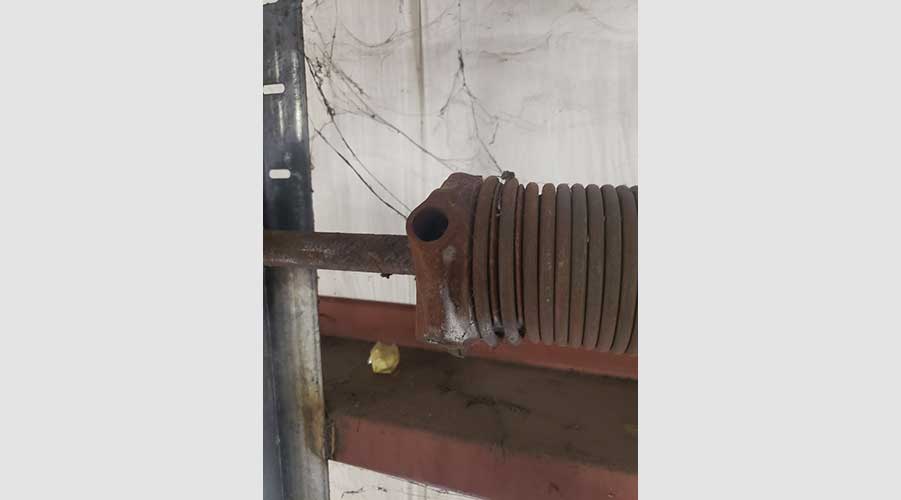
Springs go first. A torsion spring breaks with a bang, usually on a cold morning when the steel is at its most brittle and the first cycle of the day puts peak stress on tired metal. A 14-foot insulated commercial door can weigh 400 pounds or more, and with the spring gone nothing counterbalances that weight. The operator wasn't built to lift it. Hit the button anyway and you can strip the drive gear or burn the motor, and one repair becomes two.
Cables go second, and rarely on their own. A lift cable frays because something upstream is dragging on it, most often a roller that has seized or worn a flat spot. The seized roller pulls the cable off its clean path on the drum and grinds it until it lets go. I once took a 9 a.m. call from an auto shop with a customer’s sedan trapped on the lift inside a bay whose door had dropped 8 inches on one side and jammed crooked. The cable had snapped. The cause was a roller two stiles up from the bottom bracket that had seized solid. Replace the cable and not the roller and you’ll be back in a month.
Rollers go third, the quiet one. A plain steel roller with no sealed bearing is fine in a dry climate. Within a mile of salt water it corrodes, drags, and eventually flat-spots. A door that squeals, hesitates partway up, or shakes in the track is telling you. Rollers are cheap to swap on a scheduled visit and expensive to discover after the cable goes.
The operator is a distant fourth, and it usually fails because one of the first three did and somebody kept pressing the button.
What to put in the service spec
When a facility manager asks me why three bids for the same door came back at three different prices, the answer is almost always that they weren’t for the same job. A spec fixes that. Here’s what I’d require in writing:
Spring cycle rating and spring count. A 10,000-cycle spring and a 50,000-cycle spring are not the same part, and the upgrade cost is small next to doing the job several times as often. When one spring on a two-spring door breaks, replace both. They were installed together and carry the same fatigue.
Cable specification. On a commercial door I want 7-by-19 galvanized aircraft cable at a gauge matched to the door’s weight, and both cables replaced together, since they’ve run the same cycles in the same air. Replacing one cable on a busy bay is a false economy.
Roller type. Sealed-bearing nylon rollers cost a bit more than plain steel and outlast them by years in humid or coastal air. If the bid says “rollers” with no type, ask.
Completion tests. A balance test with the operator disconnected, a reversal test on the safety edge or photo eyes, and a full-cycle run before the door goes back in service. If people work under that door, the reversal test is a safety event, not paperwork.
Response window and warranty. The arrival window in hours and the workmanship warranty in years, both in writing.
Proof of license, general liability and workers’ compensation. Winding a commercial spring is one of the more dangerous jobs in building maintenance. Check the paperwork before anyone climbs the ladder.
Then the last line item
Once you know a door’s cycle life, its spring replacement goes in next year’s budget instead of this quarter’s emergency spend, scheduled for a slow afternoon with the bay empty. The 14-foot door I re-sprung at 6:40 one morning, with a distributor’s box trucks trapped inside, cost the same in parts as it would have the previous Thursday. The difference was two idle trucks and three paid employees standing around, which the owner put north of $700 for that one morning.
Count the cycles. Everything else follows.
David Yifrach is the owner of Seaside Garage Door Experts in Virginia Beach, Virginia, and still works the truck. A licensed Virginia contractor since 2013, he services residential and commercial sectional doors across Hampton Roads, where salt air and heavy use shorten every part’s life.
Related Topics: