Designing Higher-Ed STEM Facilities for a Rapidly Changing Future
As college and university campuses evolve, planning buildings with longevity and performance in mind are essential.
Across the nation, colleges and universities are confronting a challenging and rapidly evolving landscape. Enrollment uncertainty, rising operational costs, aging infrastructure, and shifting workforce demands are accelerating the need for facilities that are more flexible, more culturally attuned, and more sustainably designed than ever before. Nowhere is this shift more visible than in science and research facilities — buildings that must evolve as fast as the STEM fields they support.
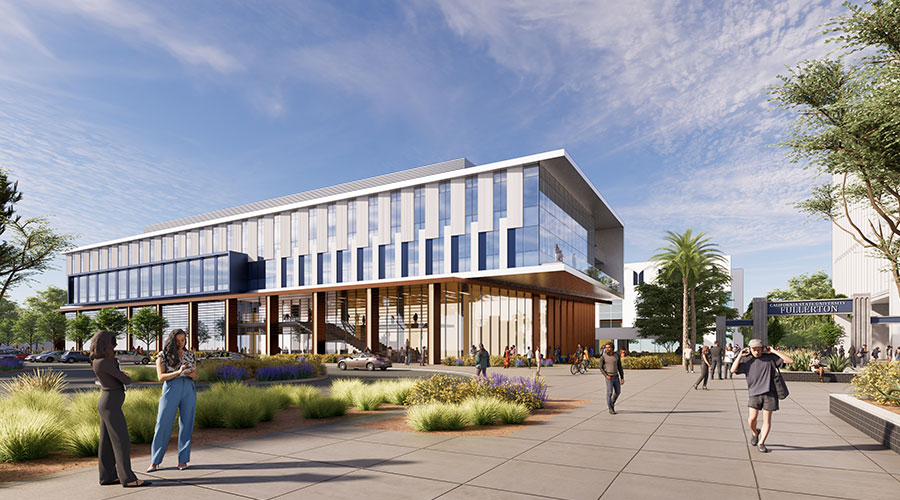
Recent feasibility efforts such as the California State University Fullerton Science Lab Replacement Building (SLRB) reaffirm an important truth: to future-proof STEM facilities, planning and design must go far beyond solving today’s problems. They must create frameworks with the resilience and capacity to serve generations of students, researchers, and educators.
Reactive maintenance to future-readiness
Traditional models of capital planning — focused on incremental repairs or isolated replacement projects — can no longer keep pace with the academic and technological evolution underway in STEM disciplines. Universities require facilities capable of supporting not only next year’s curriculum but entirely new scientific methodologies.
In the Fullerton SLRB feasibility study, this future-ready approach is expressed through multiple program stacking and blocking scenarios, each designed to maximize long-term adaptability. These configurations test different combinations of research labs, teaching labs, science-intensive spaces, offices, and support zones, ensuring that the building can flex with pedagogical shifts and emerging research priorities. This methodology reflects a trend we see across higher education: institutions increasingly prioritize planning resilience over fixed-function layouts.
Repurposing and renewing existing structures remains a powerful strategy, but where new construction is required, it must be nimble. Science buildings, in particular, benefit from universal structural grids, modular lab planning, and shared support spaces, which allow reconfiguration with minimal disruption — core principles embedded in the SLRB study’s organizational framework.
Supporting people, culture and well-being
STEM learning is becoming more collaborative, interdisciplinary, and student-centered. As a result, campuses are looking beyond strict technical requirements to create environments that support culture, community, and student well-being.
The SLRB feasibility study integrates these values through its site and amenities strategy. The study maps how the new building will connect to Fullerton’s broader pedestrian network, open spaces and campus dining, aligning the facility with major student flows and social hubs. This includes analysis of existing campus amenities, visualized in diagrams that show dining, retail, recreation and academic nodes surrounding the site.
By embedding the SLRB in the fabric of campus life, the plan recognizes that STEM buildings must serve as destinations for collaboration — not isolated technical facilities. Flexible study lounges, quiet rooms, outdoor seating zones and informal gathering spaces are essential components of a culture-supporting science facility.
These design principles also support student mental health — an increasingly urgent priority for institutions. Access to natural light, intuitive navigation and a variety of communal and retreat spaces help reduce stress and increase student belonging. STEM buildings, which often risk feeling intimidating or inaccessible, can instead become welcoming academic homes when planned with holistic well-being in mind.
Craig Atkinson is the director of higher education for Carrier Johnson + Culture. He has more than 30 years of experience in the planning, designing and construction of educational projects ranging from athletic facilities to student centers and technology complexes. He is also active in the design industry as the president of the Southern California chapter of the National Organization of Minority Architects.
Related Topics: