Retrofitted School Becomes Inclusive Senior Community
The Pryde retrofitted an historic old school into a senior living space designed for dignity and connection.
By Mackenna Moralez, Associate Editor
Millennials and Gen Xers are currently facing one of their toughest dilemmas yet: deciding if they should move their loved ones in a senior care facility. The decision is emotional as seniors have to leave behind their homes and lifestyles that they have built over the years. While family and friends are able to visit their new home, it’s just a constant reminder of what they once had.
It is not a surprise that family members are now demanding luxury senior care facilities for their loved ones. However, this is a challenge in many major cities as there are limited spaces available for new buildings. Old buildings – while not always the most aesthetically pleasing – allow architects and designers to at least have a starting point when it comes to a retrofitting project.
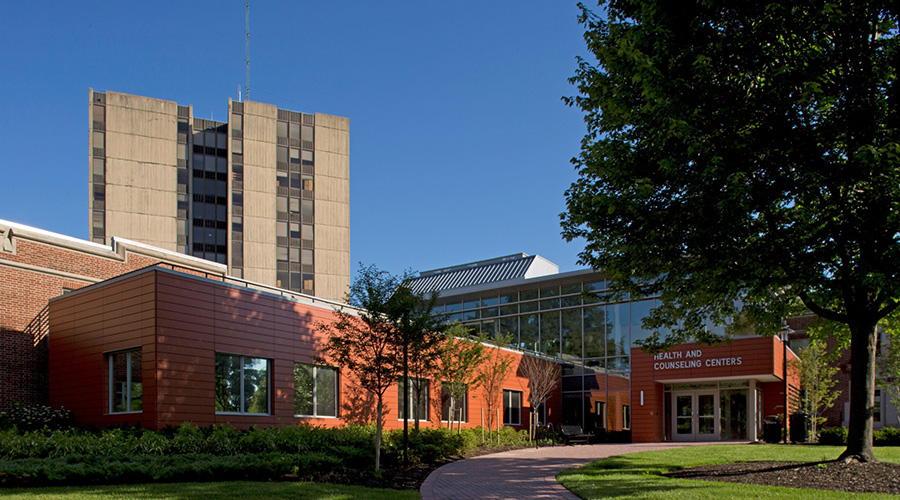
The Pryde, a LGBTQ+ senior care facility located in the Hyde Park neighborhood in Boston, understands this challenge. The 74,000-square-foot building, formerly a middle school, was first built in 1902 and had not been updated since 1933. When the city of sought to convert the facility into housing, the LGBTQ Senior Housing Inc., a nonprofit for aging LGBTQ+ members, and DiMella Shaffer, an architecture firm, jumped at the chance.
“Boston is difficult to find pieces of properties and usually they’re expensive,” says Philippe Saad, principal, DiMella Shaffer. “So, the reason why we went the route of using an older building was because it’s owned by the city and the city has a program that facilitates the development of affordable housing for not-for-profits like us (LGBTQ Senior Housing Inc.).”
Saad explains that the building’s location checked off everything that they had on their wish list: pedestrian friendly, close to stores and restaurants, and inclusive.
“It’s also a neighborhood that has been very welcoming to the LGBT population,” Saad says. “As we were starting to explore more about what the building could become, it became apparent that reusing resources and using a building that’s already there just adds to a better story of how housing should be a part of the community and responsible to the environment and integrated in society. So, this school was perfectly located and answered all these questions.”
Backed by over 400 letters of support, The Pryde broke ground in 2022 and accepted its first residents in 2024.
Inclusive design
During the initial planning process, there was very little data out there as to what LGBTQ+ seniors wanted or needed as they aged. The firm knew that they wanted to take a multi-faceted approach to inclusivity, focusing on how the building could best support the health and wellbeing of all residents, staff and visitors.
Saad explains that the firm held listening sessions, taking note of design opportunities. For example, the definition of a household differs by the community. For some LGBT members, a household might just be two friends – not necessarily a romantic couple or family members related by blood. Instead, they are opting to live with their chosen family.
“Designing two-bedroom apartments in a senior housing for LGBTQ+ residents became an element that is a differentiator than regular senior housing,” Saad says. “When you’re a roommate with somebody, you want two equal bedrooms. We have nine two-bedroom units out of the 74 units that’s specifically made for thought about the LGBTQ+ household living arrangements.”
When designing for inclusive spaces, Saad considers the following elements:
- Age
- Ability
- Gender
- Sexual orientation
- Culture, race and ethnicity
- Socio-economic status
The prewar building is on the register of National Historic Places and was built at a time when accessibility was not required. The first challenge Saad and his team had to overcome was determining how to add these elements while still adhering to guidelines provided by the National Park Services.
“Accessibility usually is more challenging in historic places like these, but we took it upon ourselves because we believed it was essential,” Saad says. “It took us a little bit more time to figure it out, but we have all units, kitchens and bathrooms accessible for this specific reason.”
The Pryde also added two elevators towards the back of the building and added ramps and sloped hallways. The front entrance also doesn’t have stairs so people can easily enter the building.
“We added two elevators because it’s essential that if one breaks down, there’s always another one for older people,” Saad says. “The handrails were not compliant, so we had to raise the handrails on the stairs. There were a few doors that didn’t meet accessibility guidelines, so we had to replace some and kind of match the historic doors for that purpose. The windows as well are all new, but are also historically compliant.”
A lot of these nuanced thoughts were put into the design so people can age in their homes. All seniors deserve to age respectfully. For example, the historic guidelines state that echoes in hallways needed to be preserved as it’s part of the character-defining element of a school. However, echoes can confuse older adults. Saad explains that stretched fabric was used for acoustic treatments to help reduce echoes in communal areas, such as the auditorium and community center.
Running ducts and pipes through an old structural system also proved to be challenging. Saad explains that there was always a team of people on the ground working together with the contractor and developer to figure out how to address an issue.
“Adaptive reuse buildings are usually buildings that are very loved by the community,” Saad says. “They’re sometimes schools or factories, but they have a history. It’s not because that they’re old that they’re valuable to me, it’s because people have relationships with these buildings. They’ve lived in them. They created stories, raised families. The lesson that I would like more of us to do is give these buildings as we think of them a second life. I think that’s part of what we did with this building. If we allow them to continue to be a part of the larger realm, they will serve the general public for a longer period of time.”
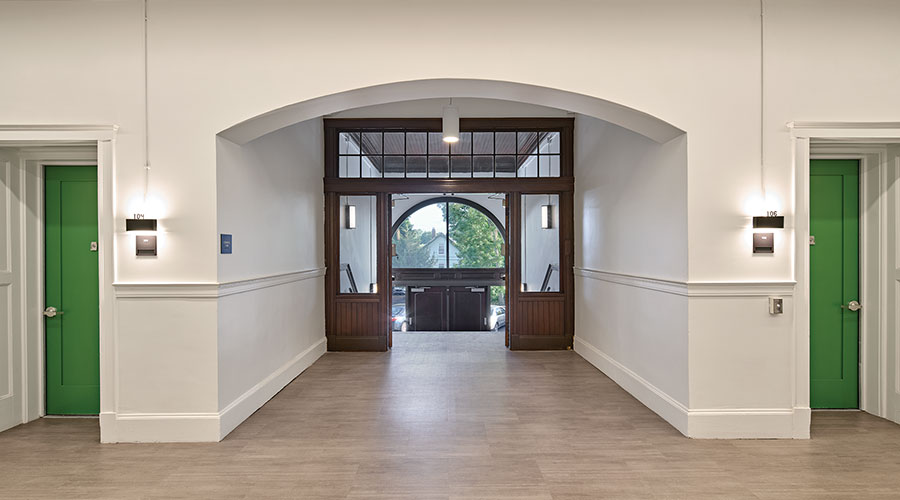
Many historical elements from the school are incorporated within The Pryde’s final design. To adhere to historic guidelines, original classroom doors were pinned open in hallways and painted white to assist with wayfinding.
Each unit has a chalkboard that was from its former classroom, and the building’s gym lockers remained in place in the fitness center and were incorporated as storage elements in the art building. The school’s bells were also preserved and made into a wall installation.
Design elements also celebrate the LGBTQ+ community. The multipurpose room has a rainbow on the floor and an installation of light fixtures in rainbow colors. Multi-colored furniture in communal areas adds to the facility’s overall aesthetics.
Community value
The Pryde has a community center that is open to the general public. People who don’t live in the building or have previously attended to the school could still go in and be a part of a program. According to The Pryde’s website, the Pryde Gallery, a public art gallery and exhibition space, features rotating art exhibits showcasing work by LGBTQ+ artists. In addition, a library and education center is open to the public and encourages community members to be lifelong learners.
Saad explains that they didn’t want residents to come to the facility and feel like they have to reestablish their social connections and lives once they moved in. Part of The Pryde’s goal is to connect people within the community.
“We’ve designed internally different types of spaces for people to socialize,” Saad says. “It’s not one community room, there’s multiple rooms. It allows people to just hang out and make it their own – do things you and I do, like watch a movie. I think this is a gift that older buildings give us that sometimes we can’t afford to do in a new building. In an old building, we have to maintain its parts, so it gives back spaces that are unintended.”
The elderly – regardless of how they identify – deserve to have a place where they can age safely and with respect. The Pryde proudly displays the LGBTQ+ flag outside its entrance, signifying that it welcomes all.
“It (The Pryde) didn’t start as a safe place – it was more thinking about people being able to be themselves,” Saad says. “I want us to think about it less as a fortress and a safety place to hide from the world, but more as a place where we feel we can be ourselves. I think that’s the safe space I imagined or that I intended. Not just a safe place that prevents us or shelters us from the world. It’s not a shelter. It’s a place that supports people’s lives.”
Mackenna Moralez is the associate editor of the facilities market and the host of the Facilities in Focus podcast.
Related Topics: