 Photo credit: Ankrom Moisan
 Adaptive Reuse Bringing 1906 Hotel into 21st Century
Renovated hotel will balance facility’s historic nature with modern demands for energy efficiency and comfort.
By Dan Hounsell, Senior Editor
Key Takeaways:
- Adaptive reuse projects can transform historic buildings into modern, economically viable destinations while preserving architectural character and strengthening connections to surrounding communities.
- Success in adaptive reuse often depends on flexibility and collaboration, as owners, architects and contractors must navigate unforeseen conditions hidden within aging structures and adapt plans as new discoveries emerge.
- One of the biggest challenges is balancing historic preservation with modern expectations, requiring careful decisions about systems such as HVAC, windows and energy efficiency upgrades to meet current standards without compromising a building’s identity.
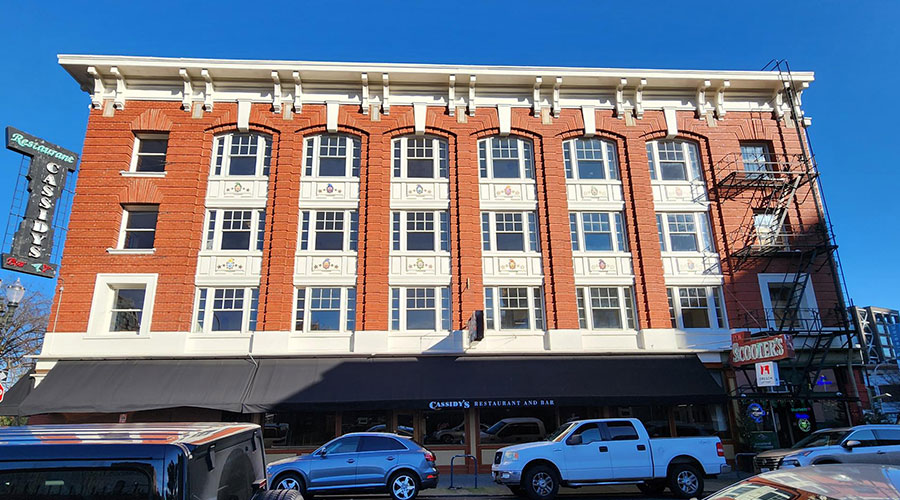
If it’s true that eventually, everything old is new again, visitors to Portland soon will have a new but somehow familiar lodging option to consider. A recently launched adaptive reuse project aims to renovate the historic 1906 Taft Hotel into an updated facility that will be part of an expanded entertainment district for the city.
The project is one example of adaptive reuse, the increasingly popular process that offers institutional and commercial organizations the opportunity to rethink and renovate an existing facility to meet their current and future needs. The process can deliver several advantages related to location and cost over new construction, but it also can present building owners and executives with challenges that inevitably come with old buildings and the mysteries they hold.
The most common challenge in adaptive reuse projects — knowing exactly what lies behind walls and above ceilings of aging buildings — also can provide owners and architects with promising opportunities.
“You often don’t know what you’ve got until you start picking at it,” says George Signori, principal with Ankrom Moisan, an architecture and interior design firm that is working on the project. “Everybody wants to get it done as soon as we can. We try to get permits as quickly as we can. But that’s part of the fun. It’s always a surprise.”
Chasing a dream
Ankrom Moisan is working with the facility’s owners, McMenamins Inc., to renovate the 31,000-square-foot building that most recently operated as low-income residences. The renovated hotel near McMenamins’ Crystal Ballroom and Crystal Hotel will feature 63 rooms on its second, third and fourth floors, as well as a gift shop, three restaurant-bars and a skybridge linking it to the ballroom.
“The part about this project that is the most attractive for us is that it’s right next door to the Crystal Ballroom and having that connection with the hotel rooms right there,” says Shannon McMenamin, president of McMenamins Inc. “We’re going to be putting a sky bridge through a light well that goes from the hotel into the ballroom so guests who are staying in the hotel get access to shows.”
Adaptive reuse has become more popular in part because it enables owners to take advantage of existing facilities in desirable locations that are otherwise unavailable, as well as tie into the local community more closely.
“When we’re looking at projects and we’re looking at our properties and we’re looking at our footprint in different areas, one of the things we look at is what’s surrounding us and how that may eventually be incorporated,” she says. “This was kind of a natural progression — really a dream for the property — to have it be like this, where you can create an entertainment zone at one end of the town. We’ve already got hotel rooms about a block away in the Crystal Hotel and a soaking pool there. This expands that footprint in the downtown area.”
McMenamin and Signori credit their business relationship, which includes the project’s contractor, for the success of their projects.
“We’ve been doing this together for a long time and worked on a lot of different projects for years,” McMenamin says. “That’s always been part of the process — being there and asking questions and really understanding the impacts of the different changes that we’re making and trying to make things good in the end.
“George is great at knowing what we as a company value in our projects and are trying to preserve and showcase and figuring out ways to make that work with the plans and meet the codes and also do some crazy stuff.”
Opportunities and challenges
As with many adaptive reuse projects, the McMenamins’ hotel project seeks to bring new life to an existing building that has gone through several reincarnations.
“The building was actually in really good shape,” Signori says. “Structurally, it was in fine shape. The masonry was in good shape. The roof was in pretty good shape. The interior cosmetic stuff was probably the worst. They had however many layers of flooring and variations of flooring from carpet to tile to wood to fake wood.
“The systems were pretty much intact. They had a fire sprinkler system that was fine. The alarms were fine. They had an old boiler that was still working, but barely. The elevator was not working, but it just needed repair. It’s working now. Fire escapes are currently being upgraded. Other than that, I think it’s one of the simpler ones that we’ve tackled.”
While the structure is in relatively solid shape, McMenamin and Signori say they still have to confront the mysteries of an old building in trying to complete the work.
“We’ve been working on it piece by piece for several months now,” McMenamin says. “I don’t exactly remember when we started that. We’re planning on opening sometime within the next year. We don’t have an open date as of right now. We’d like to get it open. We’re trying to move as quickly as we can on it, but there are still a lot of questions that need to be answered in order to make it happen.”
One particular issue in the project has been trying to meet the demands of modern travelers for 21st Century accommodations in a 20th Century building.
“When you’re dealing with 1906 buildings, they don’t have air conditioning,” Signori says. “We like to try to keep them as original and intact as possible, but there are modern demands. Those are probably the biggest challenges.
“We’ve tried some super-sophisticated, super-energy efficient mixed box HVAC systems that were just a disaster. Now we’re trying to go back: What’s the simplest HVAC that still works?” Architects working on such projects must consider a range of cooling options, including whole-house systems that provide cooling to an entire structure and even individual window units.
“We’re somewhere between those options, and I don’t think we’ve landed on it yet,” Signori says.
McMenamin says she knows that the solution to the cooling challenge must balance operational and energy efficiency with customer expectations for a historic facility.
“How do you modernize and give people what they expect when they go in to stay in a hotel without wrecking the look and the feel of a place?” McMenamin asks. “How do you make it comfortable for the modern traveler? It’s trying to strike that balance and make it cost-effective. That’s probably the biggest challenge: to use what’s there and not destroy it in the quest to make it more comfortable for today’s traveler.”
Signori points out that the balancing challenge does not end with cooling systems.
“We like old windows, and some of the old windows are leaky, and they’re single pane,” he says. “To be the most efficient, you’d put vinyl triple-pane windows and argon glass. And they look like hell. It’s a question of trying to keep the thing looking cool and old and real and meeting energy code.”
Embracing the unknown
While adaptive reuse projects can have a great deal in common with new construction, they can differ greatly when it comes to the architect’s role.
“It’s very different from most architects and architectural projects where you draw everything and you go out on site as the architect in charge of construction and administration, and your job is to make sure that everything is built exactly the way you drew it,” Signori says. “This (project) is almost the opposite. The challenge is best met by just being on hand and answering questions on the fly.”
McMenamins says she handles the unpredictable nature of the adaptive reuse project by being available onsite to help troubleshoot problems that inevitably arise.
“Being on site very frequently helps you see things as they’re happening,” she says. “You can help guide the conversation and make sure that things just don’t happen without a good conversation around them,” McMenamin says. “The plan says one thing, but what if the plan doesn’t make sense anymore and you move forward anyway? That can be really problematic. It’s that constant evaluation and being flexible and rolling with the different things that you see every day and staying very present.”
While adaptive reuse allows building owners and executives to avoid the many complexities of new construction projects, they also give owners a unique experience that can deliver unexpected benefits to their organizations and the surrounding community — taking something old and making it new again.
“This is hard work and fun work and important work,” Signori says. “We need to keep these old buildings going. They’re hard to fix, and they’re more expensive to fix, so people don’t fix them, or they tear them down and build something new and awful. It’s important work, and more people should be trying to do this.
“In the architectural world, there’s a lot of talk about saving the planet and being green. There is nothing greener than taking a building that’s been standing there for 100 years, 120 years and giving it another 100 years’ worth of life.”
Dan Hounsell is senior editor for the facilities market. He has more than 30 years of experience writing about facilities maintenance, engineering and management.
Related Topics: