Bottom Lines Are Putting Water Efficiency In Spotlight
It's one of the first things you use in the morning and it plays a major role in your everyday routine. You consume it, wash with it and perhaps enjoy it at the beach. Yet you may never pause to consider its impact on your personal and — in the case of facility managers — professional life. The subject is water, and although it may not always be top of mind, a shift in thinking has prompted a reevaluation of the use of the world's most abundant resource.
It might seem odd to be so concerned about the quantity of something that takes up 70 percent of the planet's surface, but there's growing agreement that water should no longer be considered an expendable resource for facilities.
One of the biggest factors driving the change in thinking is something facility managers can appreciate all too well — the bottom line.
"Unfortunately, it is often the forgotten natural resource when a facility considers going green or is looking for ways to reduce utility costs," says Bill Hoffman, senior engineer at Water Management. "Water and wastewater costs are impacting your bottom line and will have even greater impact in the future."
Water as an End Product
The numbers support Hoffman's assertion. Since 2001, water and wastewater costs have increased 1.45 times faster than electricity costs, according to data from the U.S. Department of Commerce.
One reason costs are increasing has to do with the logistics involved in transporting water from its source to the areas where it will be used.
"Water is not just a resource — it's an end product," says Bruce Lung, program manager, industrial sector at the Alliance to Save Energy. "It requires a lot of energy to deliver."
If water efficiency is to achieve a higher place on the facility management agenda, cost will have to be the largest driver of change, say experts.
"Historically, the cost for water and sewer service has been small — about 10 percent of operating costs — but the cost of water is increasing and it may double or triple in the next five years," says Amy Vickers, president of Amy Vickers & Associates, a water conservation consultancy. "I think cost is the reason many Fortune 500 companies are doing a lot with water efficiency. They see the economic benefit, they have the resources and they see the link with energy. A lot of these companies even have goals of zero discharge."
Alexander Filippov, senior program manager, international at the Alliance to Save Energy, agrees.
"I think people start noticing it when they feel something on their budget," says Filippov. "Money is the strongest driver."
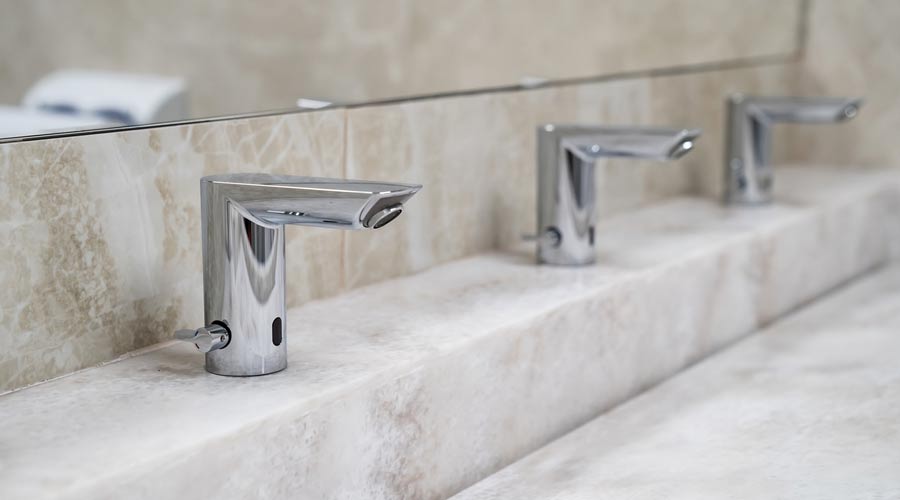
Fortunately, there are steps facility managers can take to monitor and reduce their water use and costs. The most simple among them includes performing a leak audit to locate potential inefficiencies. Low-flow toilets and sink fixtures also are available.
Facility professionals should also become familiar with local standards and regulations that govern water in their area, since these vary across the country.
Assistance in finding obvious problems often can be found in-house.
"Often times, the maintenance staff in facilities are the brains of what could be done to improve water efficiency," says Vickers, who authored the water efficiency requirements for plumbing fixtures adopted under the U.S. Energy Policy Act of 1992. "You can perform water audits and maintenance personnel can tell what is wrong. Some fixes are free — and if you don't fix it, you'll pay a high price later. Your investment will reap big rewards."
For more complex issues, however, it also may be helpful to seek outside help.
"Consultants can get an evaluation done of how they use water and where the opportunities are," says Hoffman. "Some have the expertise to do this internally, but most should employ professional help in doing this."
Related Topics: