 Photo credit: Mt. San Antonio College
 Project Delivers Plumbing, Restroom Benefits to Mt. San Antonio College
$118 million project upgrades faucets and other fixtures and brings greater efficiency to operations.
By Dan Hounsell, Senior Editor
Key Takeaways:
- Aging facilities may eventually require complete replacement rather than incremental upgrades when systems can no longer meet operational demands or modern standards.
- Careful planning during design and construction can improve long-term maintainability by identifying future access, inspection and repair challenges before a facility opens.
- New facilities often deliver greater capacity, efficiency and sustainability, but their increased size and complexity can create new maintenance and operational demands.
- Even with a facility built for speed, time catches up.
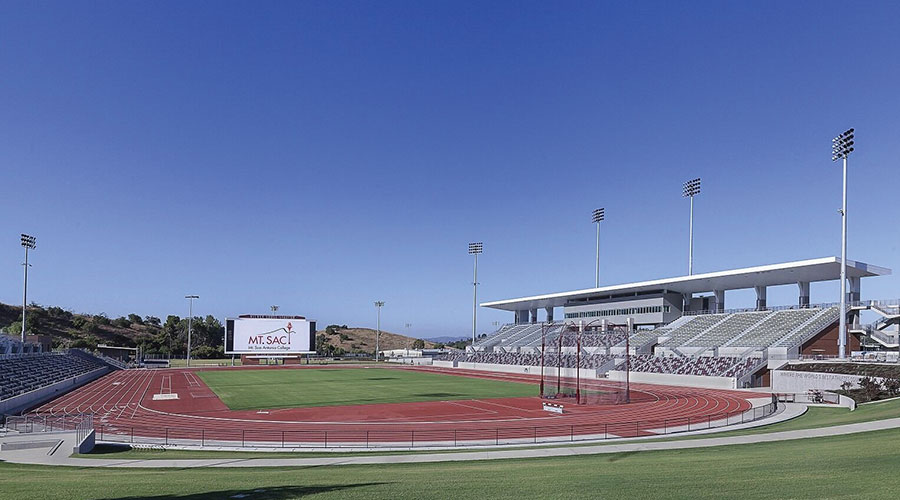
Hilmer Lodge Stadium on the campus of Mt. San Antonio College in Walnut, California, on the eastern side of Los Angeles County opened in 1948. The stadium has hosted a vast array of high-profile track and field events over the years, including the storied Mt. SAC Relays. Twenty-one track and field world records have been set there, and in August 1960, seven world records were set in one night. The stadium has hosted events that drew 28,000 participants.
But by 2012, the stadium had seen better days.
“The old stadium was at the end of its lifespan, and there was a lot of need,” says Steven Wolters, lead plumber in the college’s facilities planning and management department. “There wasn’t the capacity that we needed for our events. The plumbing system and all of the utility systems were failing. There were a lot of things that went into the decision to do a complete teardown and rebuild to bring it up to modern standards.”
As a result of the facility’s condition, the decision was made to bring the stadium into the 21st Century.
Tearing down, building up
Hilmer Lodge Stadium sits on the college’s 420-acre campus, where 70,000 students attend class. The campus’ plumbing needs are handled by a three-person crew headed by Wolters.
The stadium’s $118 million renovation called for replacing spectator seating on the hillside facing the field to a 10,739-seat grandstand, which is expandable to 20,000 seats for their large events. The project features a concession area with public restrooms. Calling the stadium project a renovation really does not do it justice.
“It wasn’t an upgrade per se,” Wolters says. “It was a complete teardown and rebuild. We had a steep hill we eliminated that the old grandstand sat on top of. We put in a grandstand building, an actual ticket booth building, a visitor side grandstand and two additional restrooms. We also have gymnasiums, offices, locker rooms and commercial laundry zones.”
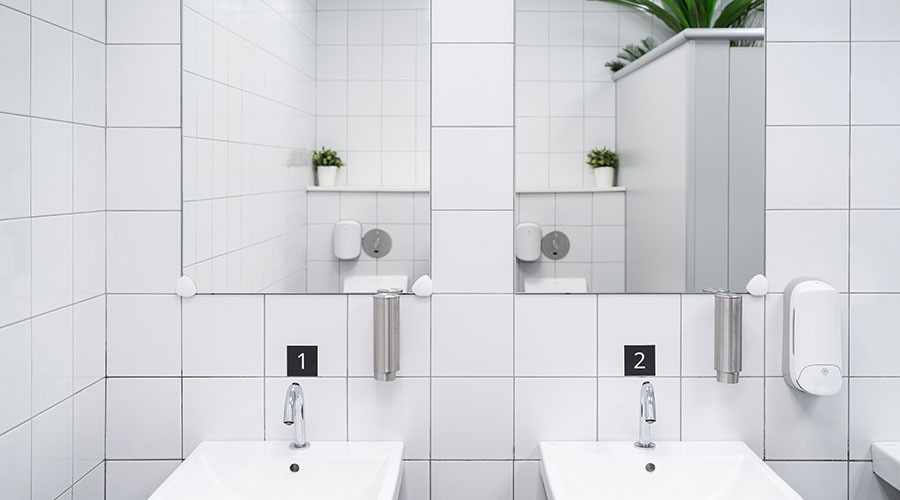
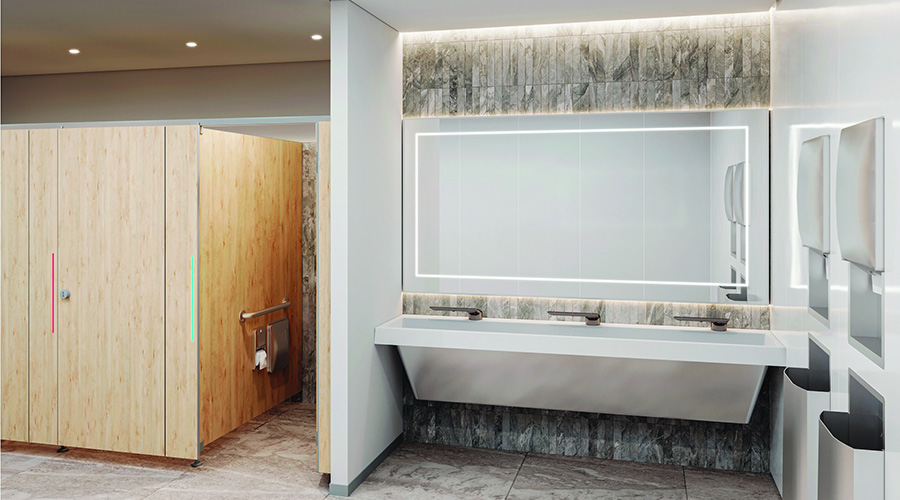
Wolters played a central role in selecting plumbing fixtures for the project’s single-use and large public restrooms, including faucets for the 19 restroom sinks.
“I was part of the design, and I am responsible for the plumbing specs and the utility specs,” he says. “I take everything that we’ve done very personally. I was a part of a committee, but at the end of the day I had to come up with something that was appropriate that I felt would work with the least amount of maintenance and have the most longevity that I can squeeze out of those parameters. So far, we’ve had a lot of success with them.” He selected EQ faucets from Chicago Faucets.
The college’s large student population puts demands on the facility, including its faucets, so the selected faucets had to provide durability, as well as ensure compliance with a host of standards and requirements for modern-day fixtures.
The faucets, which feature touchless, instant on/instant off operation, comply with ASSE 1070 requirements for scald protection and with NSF/ANSI/CAN 372, the standard that verifies low lead content in drinking water system components.
Water conservation is a major issue in California, especially in the southern part of the state, and the entire campus is under pressure to control water utility costs. The faucets provide a flow rate of 0.50 gallons per minute (GPM) or 0.35 GPM, which align with the state’s CalGreen standards, as well as with the U.S. Green Building Council’s LEED rating system.
Challenges and opportunities
The many complex aspects of the Hilmer Lodge Stadium project provided Wolters with an opportunity to review and improve his project management skills.
“With every single project, I see a different thing that I need to improve on. With this one, it was just making sure that I went through all of the phases of the project and paid attention and was aware of the things that I found weren’t up to my standards and addressing them.”
In particular, the project enabled him to take time to consider the future inspection and maintenance needs of the new facility.
“When you see something built from the ground up and you get a chance to go in there as it's being installed before the walls are in place and everything else, you really get a sense that, for example, this is going to be a bad area to have an issue with supply piping in the future,” he says. “How am I going to access this when this fails? How is the next guy going to be able to achieve this? It’s being able to catch it later on the next project and knowing that I experienced this in an earlier project. I want to catch it in the design phase so we don’t have to visit that in the actual construction phase.”
Among the challenges the project presented was the timing of its completion — early 2020.
“This was wrapping up right about the beginning of COVID, so the commission was very difficult,” he says. “Some things you learn after a project because you don’t have proper commissioning because of the circumstances of the time.” The pandemic also complicated the opening and early days of the new facility
“We had Olympic athletes come in here silently and do events during COVID, which was neat,” Wolters says. “We also hold graduations here, and one of our first full-occupancy events, we had issues. We had collapsed sewer lines from compaction. We had challenges that we had to address really rapidly.”
While it might be easy to assume that replacing an aging, failing facility that had required constant repairs with a new, modern facility means less work for Wolter’s team, that is not the case.
“It’s a much bigger facility, and it has all the modern complexity of a modern structure,” he says. “We were dealing with something that was failing, that was only designed to have a 20-year lifespan and piping that had been in the ground since 1946. It was just constant.
“There has been a higher frequency of events that need attention because of the magnitude and the size and the scope of (the new facility).”
Dan Hounsell is senior editor for the facilities market. He has more than 30 years of experience writing about facilities maintenance, engineering and management.
Related Topics: