A Roadmap to Digitally Connected Facilities
A structured roadmap for advancing digital connectivity helps address operational challenges while improving efficiency, reducing costs and supporting data-driven decisions.
By Samarth Kathare and Arati Sakhalkar, Contributing Writers
Institutional and commercial facilities are no longer simple operating environments. They rely on interconnected mechanical, electrical, life safety, energy and information technology (IT) systems that must perform reliably amid growing regulatory, financial and operational demands. Systems that once operated independently now exist within a complex ecosystem spanning design, construction, commissioning, maintenance and daily operations.
Despite this evolution, many facilities still manage systems through fragmented platforms and siloed data. Building automation systems (BAS), computerized maintenance management systems (CMMS), fault detection and diagnostics (FDD) platforms and similar analytics tools often function independently, limiting visibility into asset condition and lifecycle performance. As a result, operations remain reactive, with teams responding to alarms and service requests rather than proactively managing performance and risk.
A structured roadmap for advancing digital connectivity helps address these challenges while improving efficiency, reducing costs and supporting data-driven decisions. One approach involves three sequential phases, with each phase builds upon the previous one and strengthening the foundation before introducing additional complexity.
Phase 1: Establishing building blocks
A digitally connected facility requires strong foundational building blocks. Advanced technologies like digital twin and predictive maintenance strategies cannot deliver value without a mature infrastructure, data environment and aligned operational processes. Maintenance and engineering managers looking to advance towards a digitally connected facility should focus on three key areas.
Modernize existing systems and validate field devices. Before implementing advanced technologies, existing building systems — including the BAS, electrical power monitoring system, lighting controls and metering infrastructure — should be assessed for opportunities to upgrade or replace legacy hardware and software. Managers also should strongly consider platforms built on open architectures and communication protocols, such as BACnet/IP and Modbus TCP/IP. Open systems are foundational to a connected ecosystem, enabling interoperability because they simplify integration and reduce vendor lock-in.
Besides system upgrades, verifying field-level devices is critical to ensure accurate data collection. Properly functioning sensors and instrumentation ensure a reliable data layer that supports meaningful analytics and long-term operational insights. For new construction, managers should incorporate interoperability and adequate instrumentation during design to support future analytics capabilities.
Establish strong data and IT standards. A strong data foundation is the backbone of digitally connected systems. This involves establishing consistent naming and tagging conventions that align with industry best practices, as well as creating data models that define relationships between assets. A robust data framework makes it easier to gather, analyze and leverage data consistently across platforms.
As facilities become more IoT-enabled, data and network security become paramount. A digitally connected environment requires a secure and scalable network architecture capable of supporting increased connectivity and data exchange along with strong IT and data governance. Clearly defined network security requirements, governance frameworks, data security policies and data ownership requirements must guide implementation and ongoing management.
Strengthen core facilities management. Technology alone does not translate into operational efficiency. People and processes are central to impactful operational advancement. Well-defined and documented facilities management processes enable insights to drive measurable operational improvements. This includes establishing preventive maintenance workflows, standardizing alarm management and escalation procedures, clearly defining roles and responsibilities, and aligning asset and work-order data across systems.
Phase 2: Optimizing systems and platforms
With data standards, governance frameworks and foundational systems in place, the focus shifts to the way existing platforms perform in daily operations. Most institutional and commercial facilities already operate a BAS and a CMMS, and many have implemented analytics or FDD tools. At this stage, the objective is not to introduce new technology but to maximize the effectiveness of the systems already in place.
Within the BAS, managers should review control strategies and sequences of operation to confirm they reflect current building use because overrides and setpoint adjustments often accumulate and degrade performance. Alarm management should be structured around clearly defined priority levels, routing rules and escalation paths, with suppression logic to prevent nuisance alarms caused by upstream failures.
For example, a failed air handling unit should not trigger a cascade of downstream temperature alarms. BAS point names should be standardized, and trend logs should be configured for long-term storage. Key performance indicators such as chilled water delta T and plant efficiency should be configured to provide clear visibility into overall building performance.
For facilities using FDD or analytics platforms, configuration should emphasize actionable insights and feature rules that detect common operational issues, such as short cycling, control instability, sensor drift, and command and status mismatches. Clear rule logic and prioritized fault outputs improve efficiency and usability, while continuous data health monitoring ensures reliable analytics.
The CMMS also must align with the asset hierarchy and naming conventions used in the BAS and analytics systems. Consistency in equipment names, locations and classifications across platforms is essential, along with standardized work order types and failure codes for better reporting and lifecycle tracking. Managers should link faults and alarms to work orders to improve traceability.
True optimization occurs when these systems integrate through consistent data models and shared asset identifiers. Integration planning should address data storage strategies, interoperability standards, network performance and coordination with IT on cybersecurity requirements. When platforms are aligned structurally and operationally, operators gain a clear, unified view of asset performance. At this point, the facility is no longer operating in silos and is positioned to support advanced analytics, as well as long-term stability and scalability.
Phase 3: Digital twins and advanced maintenance
Once the foundational building blocks are in place and existing building systems are optimized, the next phase is to adopt advanced strategies that use the connected data ecosystem to further elevate operational intelligence. A digital twin represents one such strategy.
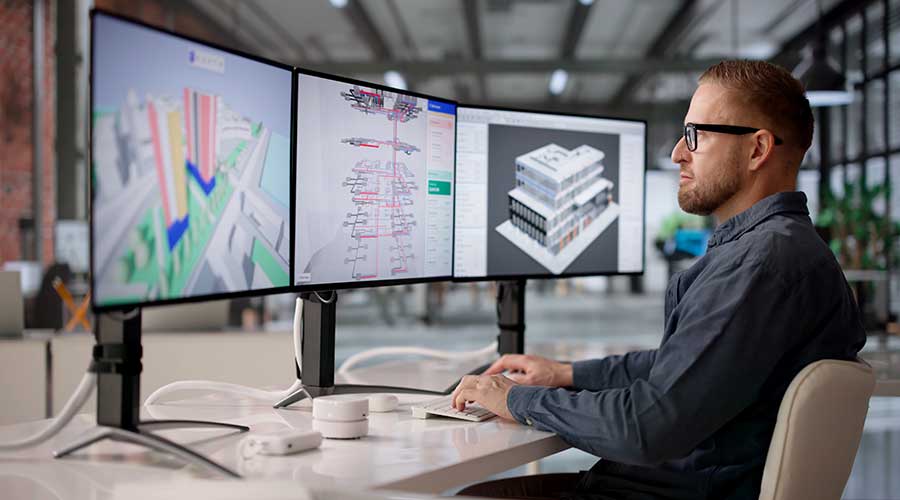
At its core, a digital twin is a dynamic, virtual representation of a physical building or asset that uses real-time and historical data to enable smarter operations. Developing a digital twin requires several foundational elements — a robust data strategy, open-architecture building systems capable of sharing operational data, IoT-enabled sensors for granular field visibility and a reliable integration framework. A building information model (BIM) or a 3D model can add another layer by providing accurate building geometry and structured design and construction data to giving spatial context to operational data.
For managers, a digital twin delivers a unified view across systems, eliminating siloed dashboards and fragmented reporting. It enables advanced analytics to identify patterns and trends for faster root-cause analysis while providing visibility into asset performance with contextualized operational and maintenance data.
By integrating AI-driven tools within these platforms, managers can quickly gain actionable insights into building performance without sifting through multiple dashboards and reports. Predictive analytics allow forecasting of energy use, space utilization and potential equipment failures, while automation features support optimized control strategies. Ultimately, the true value of a digital twin lies in its intelligent feedback loop, which transforms raw data into operational intelligence and paves the way toward autonomous, adaptive building control.
Beyond operational intelligence, a digital twin establishes a foundation for advanced maintenance strategies. With integrated systems and high-quality data feeding into the platform, organizations can transition from traditional preventive maintenance to a data-driven, condition-based maintenance strategy where maintenance is performed only when asset condition shows wear or impending failure.
Managers can further extend this process by using the digital twin’s machine learning capabilities to predict maintenance needs and forecast issues before they occur to transform maintenance into a proactive, data-driven function that improves asset performance, enhances reliability and reduces lifecycle costs.
Organizational and change management
Advancing toward a connected facility environment requires alignment across people, processes and governance. Clear roles and responsibilities must be defined for system ownership, asset data management, cybersecurity coordination and lifecycle oversight. Collaboration between facilities, IT, construction and operations teams is essential, particularly during project handover. Ensuring asset data, documentation and system configuration transitions effectively into operations prevents information gaps and supports long-term performance.
Training also is critical. As systems integrate, technicians must confidently navigate platforms, interpret performance data and translate insights into action. Building internal capability enables the organization to sustain and evolve its connected environment. A phased implementation aligned with organizational readiness also allows progress without disruption. When supported by measurable performance indicators, continuous improvement becomes embedded in daily operations.
Managers can develop a digitally connected facility through deliberate alignment of infrastructure, data standards, operational processes and organizational readiness. Modernizing systems and establishing consistent governance practices create stability. Optimizing platforms such as BAS, FDD and CMMS strengthens visibility and operational consistency, and it enables advanced strategies, including digital twin development and condition-based maintenance.
The objectives are reliability, transparency and informed decision-making supported by accurate information. When implemented in a structured and phased manner, a connected facility becomes a strategic advantage that improves performance, reduces lifecycle costs and supports long-term resilience.
Arati Sakhalkar is a project manager and mechanical engineer at Affiliated Engineers. Samarth Kathare is a mechanical engineer at the firm.
Related Topics: