Safety Through Redundancy: Expanding Emergency Alerts on Campus
The University of Rhode Island adopted a multi-layered notification system tied to building requirements.
By Valerie Dennis Craven, Contributing Writer
Institutional and commercial buildings that are part of public complexes or campuses present unique safety considerations when it comes to sending alert notifications to occupants dispersed over a wide space. The methods in which both regular occupants and visitors physically receive notifications, and how that information is provided, are critical to maintaining a secure and safe environment.
On higher education campuses, people may be engaging in device-free focus time, sleeping in a dorm, or listening to a lecture in a buzzing lecture hall, for example, when information needs to be shared. Alerts sent via mobile devices alone can be limiting in these situations.
When the University of Rhode Island was looking to reach a larger community with campuswide notifications, the emergency management office team opted for redundancy rather than replacement. In January, it adopted the Alertus emergency mass notification system to augment its current RAVE system.
The RAVE system at Rhode Island was sent only to students, faculty and staff that opted in to receive notifications. Anyone not subscribed, including visitors, would receive an alert. Even for those subscribed, the university believes in redundant pathways to ensure that large groups of people receive timely and clear instructions during an emergency.
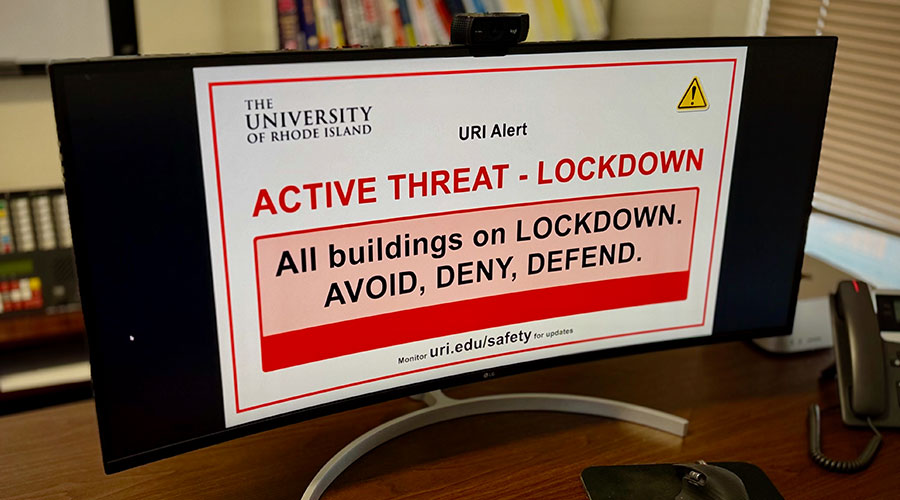
“Alertus allows us to integrate existing infrastructure to provide emergency mass notification, using things like desktop alerts on all university-owned computers and the campus digital signage system,” says Samuel Adams, Rhode Island’s emergency management director and assistant director of public safety.
Expanding to non-subscribers
While the system already in place only sent alerts to subscribers via text, email and phone call, the new system layers additional methods through more visual methods that take over desktop computers and digital signage, both indoors and out.
Additionally, the University of Rhode Island is working on bringing alerts into two types of existing infrastructure – the indoor fire alarm system and the outdoor blue light phone system from the 1980s.
As URI’s Director of Emergency Management, Adams believes in redundant pathways: This dual-alert approach will now be visible to more people on the university campus, in more ways, and offer backup should one system go down.
“Where previously large chunks of people were not getting information or clear instructions in a timely manner, this expands our reach,” Adams says. “Solutions should reflect the needs of the end user. If not, they don’t solve a problem and aren’t a great tool.”
Technical integrations and policy
With the new system, dispatchers have a rapid response console available to them at all times, all on a compact display. Not only does it take “a few taps of a screen” for the team to issue an alert, Adams says, but there was very little training needed for the public safety team to begin using the new system.
“We worked extensively with our partners on the technical side to complete the implementation, but once it’s up and running, the tool set is very effective and easy to use,” Adams says.
The challenge of bringing a new system came much earlier in the process. Historically, URI’s IT team has been compartmentalized, Adams explains. While software could be automatically deployed to everyone on the central system, those siloed outside of it needed their own rollout.
“This invoked a larger policy issue and network security,” Adams says. “Having a central IT team is key to getting the server and endpoints connected, so we needed to address firewall issues and network configuration.”
Adams advises anyone considering an implementation such as this to review and refine the IT policy, setup and compliance and discuss change management related to the rollout. Leaders need to know the “why” behind what is being asked of them or changed within their purview for project success.
Aligning needs and funding
Another consideration in projects such as this in higher education and state buildings is funding and procurement, which can be a long review and approval process in and of itself.
Adams says that for the notification system enhancement, they were able to tap into newer requirements for mass notification based on the NFPA 101 Life Safety Code to secure funding for the alert enhancements.
“Tying to requirements made it easier to get money to make this all happen and bring it campuswide,” Adams says.
But managers must consider what is best for the job, as there’s “so much tech out there. You don’t need it all, but to really figure out what’s going to be useful,” Adams says. Don’t implement something only because it’s best-in-class or new.
Adams recommends discussing the following steps early in the process. This will help ensure value in technology and bringing along teams involved with the project for buy-in and alignment:
- Identify a security and safety gap that needs addressed
- Perform a needs assessment
- Review and refine procedures to make sure any changes align with current needs
- Determine what solutions will solve the problem
- Review those solutions
“Following this means you are more likely to get value in the solution you move forward with versus ‘oh, this is cool’ since it’s a critical system,” he explains.
Valerie Dennis Craven is a freelance writer based in Plymouth, Minnesota.
Related Topics: