Touchless Restroom Upgrades Deliver Big ROI
For facilities not yet equipped with touchless technology, the path forward is straightforward.
Upgrading to modern sensor-based faucets, soap dispensers and hand dryers delivers measurable sustainability and operational benefits.
For example, it’s possible to set hard roll towels for a short, medium or long length. Likewise, some soap dispensers only dispense a specific amount of foam soap into a person’s hand and will not dispense more soap until the user withdraws their hand and waits a few seconds before putting it back.
“There is more control with these systems,” Craddock says. “People will not take the time to wait for more hand towels or soap because everyone is in a hurry.”
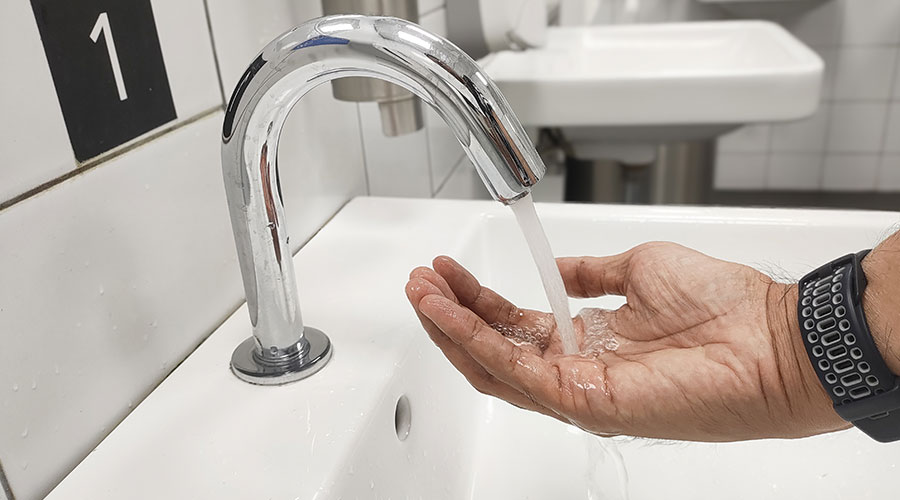
There is a definite return on investment (ROI) to these systems, Gagnon says. With hand dryers versus paper towels, there can be up to 95 percent savings with an ROI of less than a year. Touchless faucets dispense a controlled amount of water, which reduces water usage. A touchless soap dispenser delivers a measured squirt to get more uses out of the same amount of liquid or foam soap.
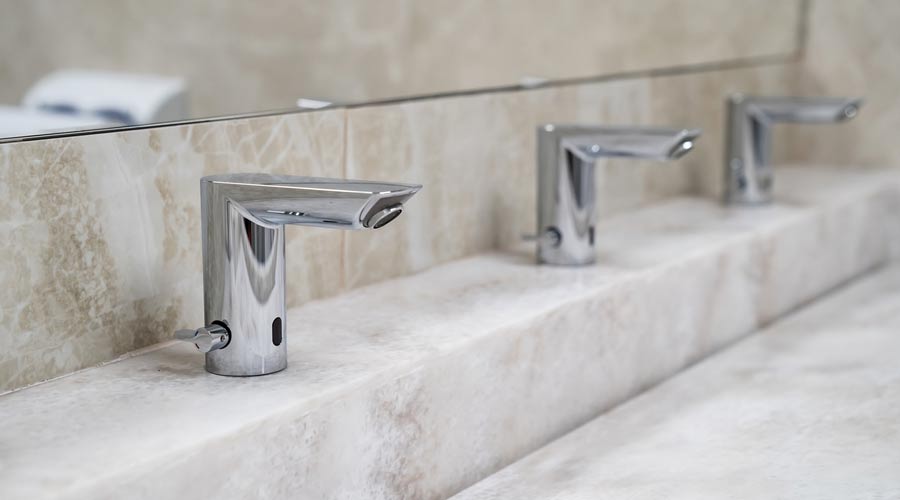
Keeler says sensor faucets also prevent vandals from leaving them running. “There is less vandalism like this with sensor-activated products,” she says.
For facilities not yet equipped with touchless technology, the path forward is straightforward. There are retrofit kits for flush valves and dryers to upgrade systems already in place.
“Most manufacturers offer similar retrofit solutions, so upgrading existing facilities is both feasible and cost-effective,” Gagnon says.
Touchless is the baseline
“Touchless has become an expected standard,” Hunt says.
Walldorf agrees, noting that since the pandemic, there has been an uptick in sensor devices, sensor faucets, and sensor flushometers.
“People want that touchless experience for both germs and cleanliness,” she says.
Modern sensor-enabled systems reduce the frequency of service calls, standardize water use and simplify cleaning routines. Some even collect usage data, allowing for remote adjustments or trigger automatic flushing.
“For facility teams, reliable touchless systems mean fewer service calls and more predictable performance, an essential advantage in high traffic environments,” Hunt adds. “These capabilities also help facility teams detect issues early, conserve water and optimize maintenance schedules.”
Still, Craddock says there are process changes that must occur as restrooms go touchless. The staff, he says, must realize the need to test and replace batteries regularly.
“They need some type of process in place so that maybe on the 15th of every month, they go out and replace the batteries,” he says.
Keeler says she’s seeing a push toward better batteries with longer lives and hard-wired systems to address this concern. While battery-powered systems are an option, she favors hard-wired systems because they eliminate battery replacement costs and failure risks due to low batteries.
As more fixtures become sensor-enabled, they’re increasingly being integrated into building management systems (BMS). This allows restrooms to “talk” to the same networks that control a facility’s HVAC, lighting, fire protection systems and security.
If faucets, soap and paper dispensers use the IoT and are connected to the cloud, they can push data to the BMS to monitor those systems.
This unified view delivers measurable impact by helping facility teams reduce water and energy costs, eliminate emergency service calls through early fault detection, and generate automated compliance reports that previously required manual audits, Hunt says.
“More importantly, when restroom performance data sits alongside other building systems, facility managers can optimize resource allocation across the entire building,” he says.
Rethinking maintenance
For managers looking to modernize their approach, Hunt recommends starting with a clear-eyed assessment that first identifies the most visible and high-impact areas, often the busiest restrooms, where upgrades will deliver the greatest benefit.
The next step, he says, is to gather data to understand the facility better: How many service calls do your restrooms generate monthly? What are your water and supply costs per building? What do occupants complain about?
“This assessment will help you identify high-impact opportunities and justify these investments to leadership,” Hunt says.
When evaluating technology, Hunt stresses that total cost of ownership matters more than initial price.
“Choose systems that are built to last and easy to service,” he says. “The cheapest option up front can end up being the most expensive to maintain.”
Equally important is to involve maintenance staff early. They’re the ones who understand what fails, what’s difficult to service, and where users struggle. Their buy-in determines whether a new system succeeds or fails.
Hunt reminds managers that everything does not need to be transformed overnight. He recommends starting with the basics, which he defines as reliable fittings, clear maintenance protocols and better visibility into what is happening in these spaces.
“As you learn more about your needs, you can layer in more sophisticated monitoring, automation and optimization,” he says.
Once upgrades are installed, data from connected systems can guide cleaning schedules, optimize component replacement and provide valuable insight for continuous improvement.
Back to the future
The next generation of restroom technology is already taking shape. Experts predict the wider use of sustainable materials, adaptive water controls and self-monitoring fittings capable of performing automatic hygiene cycles or alerting staff to potential issues.
“Automation and self-sustaining systems are poised to have the biggest impact,” Hunt says. “Fittings that minimize manual intervention and power themselves through water-generated power are reducing both environmental impact and maintenance labor.”
Walldorf says technology and data will make restroom maintenance more proactive.
“You’ll track all your consumables — paper, soap, filters on the hand dryers — everything. Not just for water usage and sustainability,” she says. “This will help you better maintain the space before someone has an unpleasant experience. I think soon this approach will be widely adopted as a way to proactively keep restrooms functioning at their best.”
Still, the facilities that lead in the next decade won’t necessarily be the ones with the most advanced technology, Hunt warns. They will be the ones who view restroom management as a discipline where decisions are driven by data, investments are measured and continuous improvement is the culture.
Ronnie Wendt is a freelance writer based in Minocqua, Wisconsin.
Related Topics: