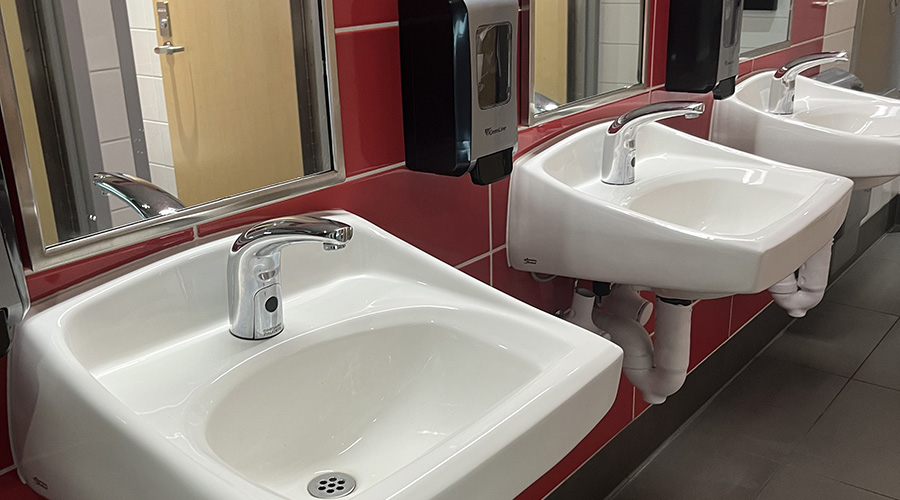
Institutional and Commercial Facilities Embrace Smart Approach to Restrooms
Touchless and sensor-based products help managers maintain clean and efficient restrooms.
Occupants can learn a lot about how institutional and commercial buildings operate simply by observing one area: the restrooms.
If the fixtures sparkle, the technology works and the space feels clean and efficient, chances are the rest of the building runs the same way. But when faucets sputter, soap dispensers fail and maintenance calls pile up, it signals a deeper problem that touches everything from public perception to operational budgets.
Once viewed as maintenance-heavy necessities, restrooms have quietly become test cases for smarter, more connected facility management.
Cleanliness matters
Cleanliness and hygiene are now top priorities for users and top challenges for maintenance and engineering managers.
“Restroom maintenance has evolved from reactive service calls to proactive, data-informed management,” says Greg Hunt, commercial product manager at Chicago Faucets. “The best-run facilities are using data and technology to stay ahead.”
The COVID-19 pandemic made this shift necessary, says Cassie Keeler, product manager of Handwashing Products for Bradley Company.
“Cleanliness or hygiene in a restroom was always nice to have, but now it’s what users and customers expect now when they go into a restroom,” she says.
A global study from Excel Dryer and MetrixLab underscores this shift. Over 4,000 participants across the U.S., Europe and Asia named restroom cleanliness as their top concern and touch-free fixtures as a primary need. Eighty percent said they would not, or might not, return to a restaurant with a dirty bathroom.
“Paper towels on the floor and overflowing trash bins were cited as the No. 1 indicators of a dirty restroom,” says William Gagnon, executive vice president and chief operating officer at Excel Dryer. “It shows that restrooms aren’t just functional spaces; they influence how people view your facility and your brand.”
Keeler emphasizes the importance of fixture condition in how the public perceives a restroom.
“Fixtures that are stained or malfunctioning give the perception that the facility overall is not maintained, and the restroom becomes part of the brand,” Keeler says. “If they have a good experience in the restroom, they’re likely going to have a good experience in the rest of the facility.”
Gagnon emphasizes that restrooms need to be a focal point, requiring a reset in how designers and facility managers allocate space and resources.
“These spaces deserve proper design, space and high-quality, touchless fixtures, because they’re used by 100 percent of occupants despite occupying only a small fraction of square footage,” Hunt concludes.
Design smarts
A high-performing restroom starts with a thoughtful design that blends accessibility, efficiency and durability. Effective layouts minimize touchpoints, make cleaning easier and promote natural user flow.
“When restrooms are designed for easy cleaning and efficient movement, the impact is huge,” Hunt says. “You reduce labor time, extend the life of fixtures and give users confidence that the space is well cared for.”
Integrated systems that combine functionality, efficiency and user satisfaction are increasingly being incorporated into restroom design.
“Integrated systems streamline the user experience while minimizing maintenance challenges,” Gagnon says.
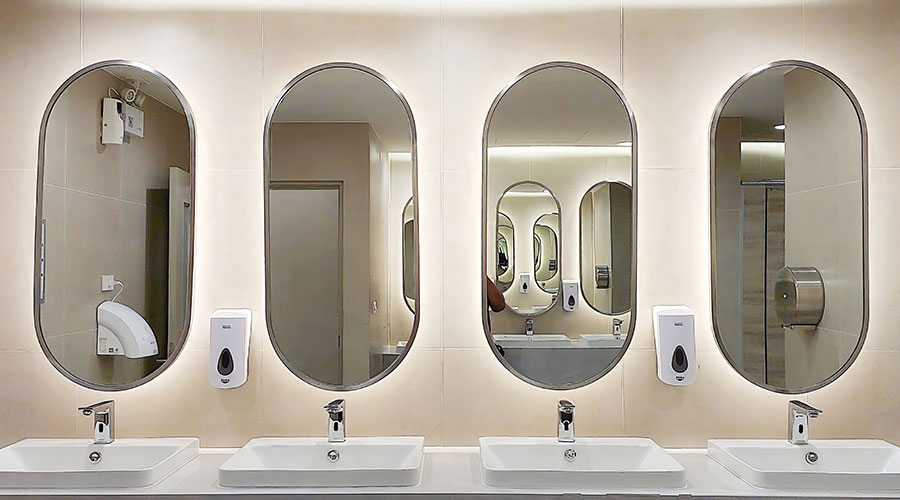
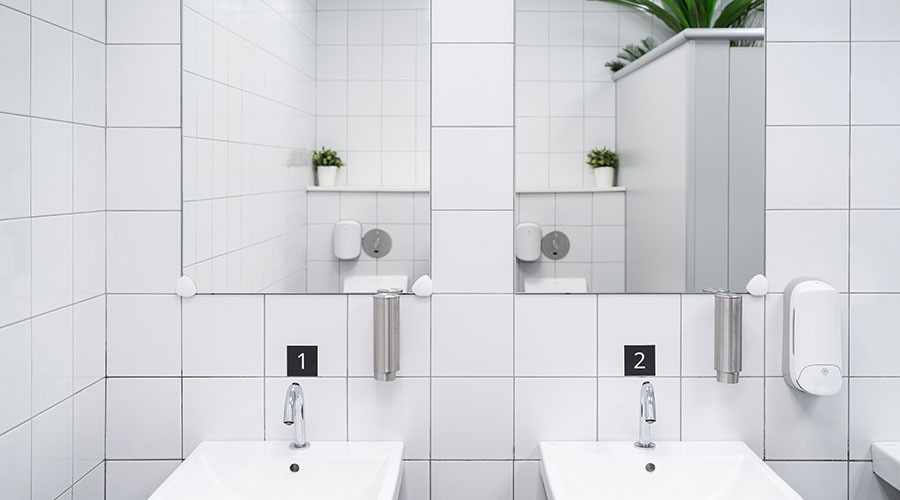
“In an integrated design, the hand dryer is next to the faucet, and then there is a waste receptacle and a paper dispenser in between the sinks, so that you have both paper and hand dryers,” Gagnon says. “It’s the best of both worlds. You are reducing your waste and your cost but still giving people both options.”
Integrating these features directly into the sink area improves cleanliness and reduces maintenance headaches.
“There’s less of a chance that you’re going to get paper or water on the floor,” Gagnon says.
Many manufacturers are also incorporating Internet of Things (IoT) technology into their devices for monitoring purposes. Some IoT systems include a visual monitor that changes color, from yellow to red, to show when dispensers are nearly empty.
“Now you know when things are low or when they’re going to run out,” says Lynn Walldorf, product manager at Sloan. “This allows you to restock things before the user has a bad experience.”
Many manufacturers offer an app that can send alerts to the maintenance team so that they know in real time when a soap or paper dispenser is nearly empty. If the filter needs cleaning or the heating elements are broken, a hand dryer could send an automated email to a maintenance technician.
“This moves maintenance from reactive to proactive,” Gagnon says.
Joel Craddock, president of Doc’s Facilities Solutions and a 30-year facility maintenance veteran, says design must also consider real-world usability.
“You need to understand the people who are going to use your facility,” he says. “If the spaces are so tight that people cannot maneuver in them comfortably, that’s a poor design.”
People also want the restrooms to feel welcoming, Keeler adds.
“They want to see coordinated finishes that make the restroom look like a cohesive, intentional space,” she says. “They want to feel comfortable and safe, and they want it to feel familiar. So, we are seeing commercial restroom fixtures’ materials and finishes bring in some residential elements to provide that comfort.”
Reliability in addition to aesthetics also must be considered during the design process. Choose products made from durable materials and from companies that keep parts on hand.
“You don’t want stalls, faucets or hand dryers down for days or weeks. You want to be able to get the parts you need immediately and generally locally,” says Lynn Walldorf, senior product manager from Sloan.
Ronnie Wendt is a freelance writer based in Minocqua, Wisconsin.
Related Topics: