Fall Protection Safety: How to Prevent Workplace Falls
Strong planning, proper equipment, hands-on training and practiced rescue procedures help protect workers during elevated tasks.
Key Takeaways:
- Treat routine and short-duration elevated tasks as potential fall hazards by requiring workers to plan safe access and avoid improvised equipment such as chairs or stools.
- Prioritize fall prevention measures—including eliminating hazards, guardrails and restraint systems—before relying on personal fall-arrest equipment, and ensure anchor points and harnesses are appropriate for the job and worker.
- Establish and practice a rapid rescue plan before elevated work begins, supported by reliable communication, hands-on equipment training and regular refresher instruction.
Some of the most common fall hazards are also the easiest to dismiss.
“The biggest misconception is the small jobs are low-risk jobs,” Edwards says. “In reality, most fall injuries I see come from exactly those ‘quick’ tasks where nobody thought a full plan was necessary.”
He says workers tend to improvise when the appropriate ladder is not immediately available, using a chair or stool to stand on instead.
“That’s where you get in trouble,” he says. “People don’t plan the small stuff, and that’s where the shortcuts can lead to danger.”
Such activities should be addressed in an organization’s fall protection program or coordinated with its ladder safety program. By asking pre-task questions such as, “How are we getting up there? How are we getting back down safely?” can help prevent improvisation.
Putting prevention first
Managers addressing fall safety also should distinguish between preventing a fall and protecting a worker who falls.
“The best fall protection system is the one that never allows the fall to happen,” Edwards says. “Arrest systems are important, but prevention — including guardrails, restraint, eliminating the hazard — that’s always the first choice.”
Prevention is also critical because it removes the need for a rescue. For example, a properly installed guardrail system around a roof edge eliminates the risk that a worker will even step into a fall zone. The goal of prevention is to eliminate the chances a worker could end up in an unsafe situation.
Improper anchorage often is part of this problem.
“I’ve seen people tie off to conduit, piping (and) anything that looks sturdy enough, but that’s not acceptable,” he says. “If it’s not an engineered anchor point, it shouldn’t be used.”
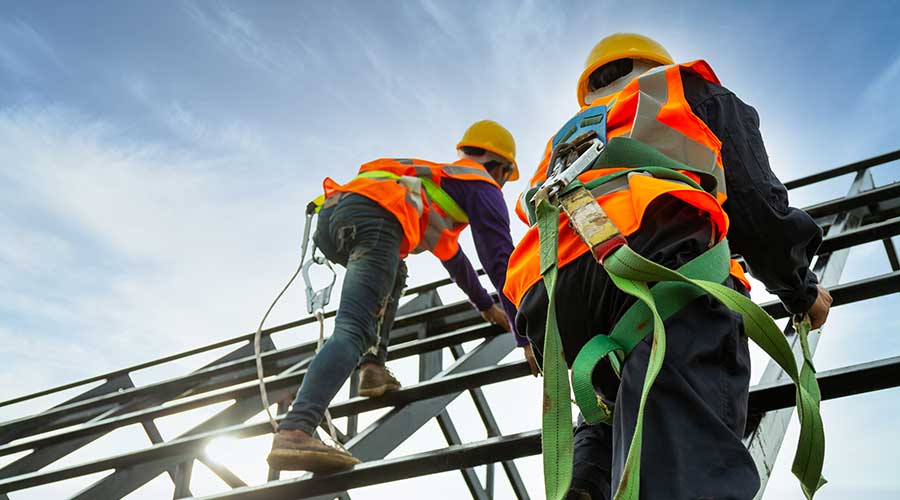
Personal protection equipment (PPE) also needs to account for the individual worker.
“Fit matters more than people realize,” Edwards says. “If a harness doesn’t fit correctly, it can actually increase injury risk during a fall event.”
A rescue plan
Stopping a fall is only part of the equation. Managers also need a plan for the aftermath.
Every elevated work plan should identify the way an employee will be rescued if a fall occurs and who will be responsible for the rescue.
“A rescue plan is not something you figure out after someone is hanging in a harness,” Edwards says. “It has to be ready before the work starts.
“Once a fall happens, the clock is ticking. You don’t have 30 or 40 minutes to figure it out. You need a response that is immediate and practiced.”
A worker suspended in a harness has a very limited safe window. Most safety guidance recognizes that suspension trauma can begin in less than 10 minutes as blood begins pooling in the legs and circulation is restricted by the harness leg straps.
Edwards says if a worker remains suspended beyond 20 minutes, the risk becomes significantly more severe. This is why OSHA emphasizes rapid rescue capability. The goal is not just to retrieve the worker, but to do so before suspension trauma progresses to a critical medical emergency.
Achieving that goal might involve equipment already available at the facility, as well as emergency medical services. Managers also should ensure workers are able to communicate effectively. Edwards recommends using two-way radios rather than relying on hand signals. Employees need to understand the rescue process and what to do while awaiting assistance.
Proper training
Training is another area where managers can move beyond minimum compliance.
“Online training is fine for awareness, but it’s not enough for competency,” Edwards says. “People need hands-on experience with the equipment they’re actually going to use.
“I want employees to physically inspect equipment, put it on, adjust it and understand what good and bad actually look like. That’s where real learning happens.”
One common mistake managers make is assuming an experienced maintenance employee is automatically competent to perform every fall protection task safely.
“Experience is valuable, but it doesn’t replace training,” Edwards says.
He recommends refresher training annually or whenever a manager identifies a gap that could expose an employee to a fall.
“Most companies don’t need to start from scratch,” Edwards says. “They need to tighten what they already have and make sure it is actually being used in the field.”
The best reason to improve fall protection is not to avoid an OSHA citation but to make sure employees return home safely at the end of each workday.
The foundation of worker safety is a well-written program. An ESWP turns that program into action. Proper equipment, hands-on training, documented inspections, effective communication and a practiced rescue plan complete the system.
Elaina Myers is the assistant editor of the facilities market. She has covered various topics from pest management to resilience to sustainability and covers all holidays and special days in the facilities field. She also manages the FacilitiesNet social media accounts.
Related Topics: