Drones Make Building Maintenance Safer, Faster and Cheaper
Drones can reduce fall risks, equipment costs and maintenance time, but facility managers must navigate FAA, NDAA and local regulations before deploying them.
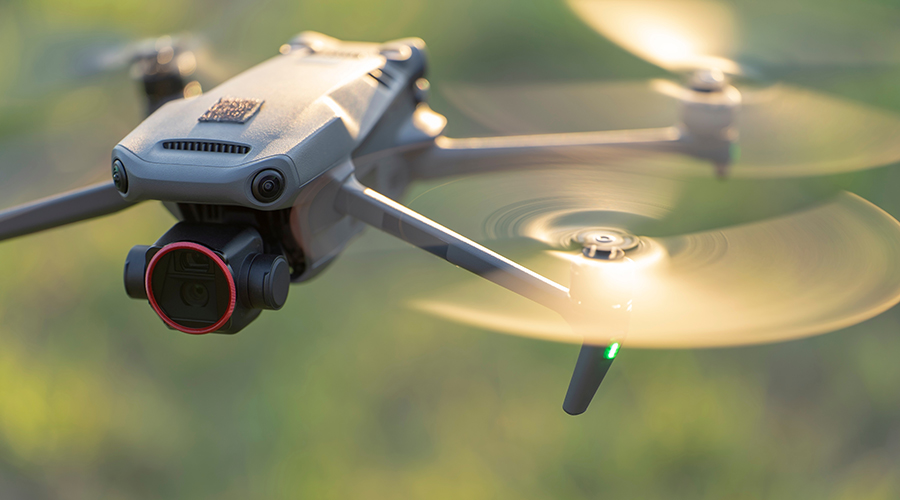
While historically, multi-story buildings have been accessed by operators on suspended scaffolding or boom lifts, drones have found their way onto the facility professional wish list as a safer, faster and sometimes even cheaper alternative.
Falls remain one of the leading causes of serious workplace injury, accounting for nearly a third of all construction fatalities in the United States, according to the U.S. Bureau of Labor Statistics.
“Reducing liability is always a top concern for building owners and local municipalities,” says Myrick. “We are seeing a growing number of cities place bans on operations like repelling due to the inherent danger involved. With the current technology available at our fingertips there is no reason to continue with outdated methodologies that impose such great risks.
Grace Dahlstrom, chief of staff, Apellix, agrees, citing a Bureau of Labor statistic that reports every other day in the United States someone dies cleaning.
“Safety is really one of the primary aspects,” she says. “That's why we include all training for free as well. It’s a safety company, boots on the ground, send the drone up to the toxic heights and into the hazardous heights and environments.”
Closely tied to improved safety, Dahlstrom adds that safer operations also help to reduce costs. For one, the cost of insurance to put people in dangerous maintenance situations can be a significant expensive.
“When you keep everyone safely grounded, that's going to go down,” says Dahlstrom.
And then there is the equipment needed to safely send facility professionals up.
“You have all of this scaffolding that takes several days to set that we've seen operators, it's up to 70% the cost of certain jobs,” says Dahlstrom. “If you just eliminate that line item, it's significantly cheaper.”
Cost savings can also be tied to the speed facility managers attribute to drones, which can often do the same job in a fraction of the time. Dahlstrom points to a customer that was able to clean a large tank within four to six hours—a process that typically took them 10 days. The result was a 50% cost reduction.
“Without drone cleaning, it cost $20,000 to clean this tank,” she explains. “It took them 10 days…our operator was able to come in, do it all in an afternoon…When you eliminate lift equipment, it becomes so much cheaper.”
Site impact is another added benefit, Hudson says, explaining that eliminating the boom lift and scaffolding eliminates damage to landscaping or blockage of loading docks.
Drone regulations facility managers should know about
Regulations are probably the biggest hurdle to implementing drones in your maintenance routine. Facility managers should be aware of several regulations, beginning with choosing the right type of drone and ensuring operators are certified pilots.
“Regulatory compliance and airspace authorization take real effort, especially near airports or in dense urban settings,” says Myrick. “Building that in-house capability or sourcing it reliably is its own project.”
For routine commercial work in the US, the FAA Part 107 regulates who can fly a drone. The regulation requires every pilot to be certified and requires operations to stay within visual line of sight during daylight or civil twilight. Operations that take place at night, over people or beyond visual line of sight would require a waiver.
The bigger near-term shift, Myrick adds, is Part 108, which is expected to become law by late 2026 or early 2027. The ruling, he says, is designed to move beyond visual line of sight operations away from case-by-case waivers toward a standardized framework, which matters for anyone managing multiple buildings or a large campus.
The FAA also regulates how high a drone can fly and how much it can weigh. For soft washing, a drone with everything it carries, like the water and cleaning solution, can only weigh 55 pounds. Drones also have to comply with Remote ID broadcasting, and flights in controlled airspace need authorization, usually through LAANC.
Where you can operate a drone is also strictly enforced by the National Defense Authorization Act (NDAA), which restrict certain foreign-made drones for public and federally funded entities. This law requires facility managers tied to government contracts or federal funding to use NDAA compliant drones. Several states have implemented similar regulations, including Florida, Texas, Arkansas and New Hampshire.
“This is a relatively new regulation from the federal government, but if you want to fly ports, or if you want to clean anything in a port, a school, a university, highways, courthouses, anything where federal funding or state funding is coming, you would need to have a National Defense Authorization Act compliant drone,” says Dahlstrom.
Hudson adds that beyond state and federal regulations it is important to pay attention to local municipalities who often have their own drone use restrictions, especially in dense urban environments.
Amy Wunderlin is a freelance writer based in Fort Atkinson, Wisconsin.
Related Topics: