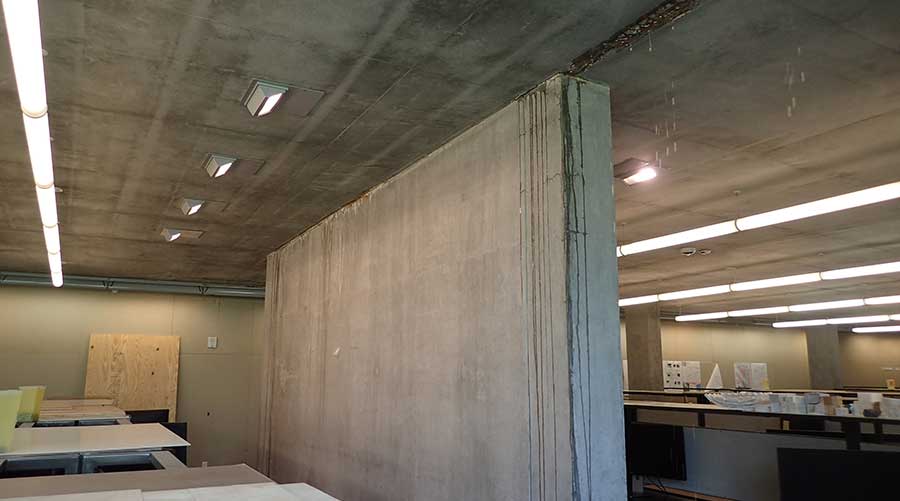
 Photos: Arate Communications
Identifying and Preventing Building Enclosure Failures
Proactive investigation, performance-based detailing and early collaboration can help facility owners address root causes and prevent recurring failures.
By Kevin Dunham, Contributing Writer
Key Takeaways:
- Visible signs of enclosure damage, including water stains, corrosion and peeling finishes, may indicate hidden moisture or condensation problems that require investigation beyond surface repairs.
- Phased evaluations using document reviews, visual inspections, infrared thermography and targeted invasive testing can help identify root causes and reduce the risk of ineffective repairs.
- Performance-based detailing, clear construction specifications and early involvement of enclosure specialists can help address vulnerable system transitions and improve long-term building performance.
Across healthcare campuses, higher education facilities and institutional buildings nationwide, owners are confronting a growing wave of building enclosure failures that threaten far more than exterior finishes. Leaks, condensation, corrosion, and mold are increasingly disrupting operations and damaging structural systems, often signaling deeper vulnerabilities that are difficult to detect, costly to repair and highly disruptive if left unresolved.
As buildings become more airtight, energy-efficient, and operationally complex, enclosure performance has emerged as a defining factor in long-term facility resilience — yet it is still too often treated as a reactive concern rather than a strategic discipline requiring proactive investigation and planning. This growing disconnect between visible distress and actual performance failures sets the stage for one of the most common — and costly — missteps in enclosure decision-making.
When Symptoms Mask the Real Problem
One of the most persistent challenges facing building owners is the tendency to mistake visible symptoms for root causes. Water staining, surface corrosion or peeling finishes are often attributed to exterior water intrusion, prompting localized repairs that fail to address the underlying mechanisms driving failure.
In many cases, the source lies not outside the building, but within it: modern airtight construction and tightly controlled interior environments — especially in healthcare and laboratory settings — can create condensation at thermal bridges, parapets, or structural connections when vapor and heat transfer are insufficiently managed. Improperly located air, thermal and moisture control layers can also cause interior water vapor to reach the dewpoint temperature, increasing the risk of condensation to occur within enclosure assemblies. These processes occur largely out of sight, repairs focused solely on surface damage rarely prevent recurrence, leading instead to repeated interventions, escalating costs and prolonged operational disruption.
The Challenge of Hidden Conditions
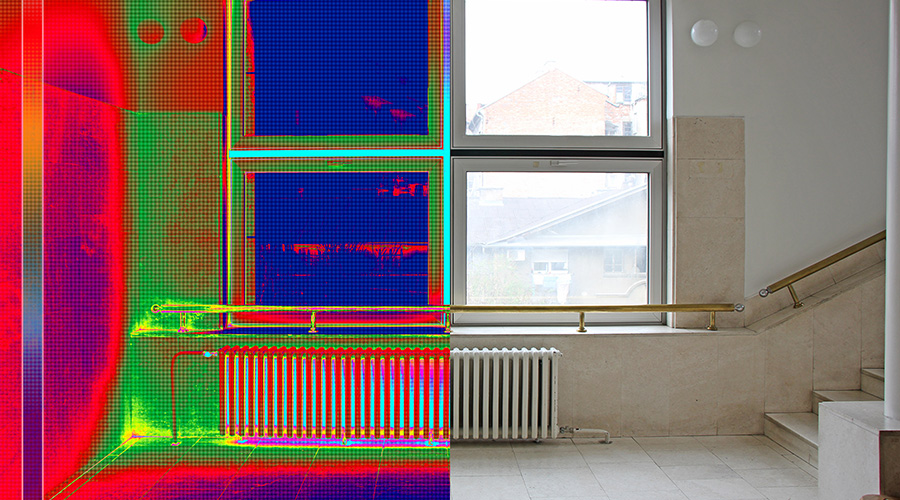
An initial observation of staining, leakage, wetness, or moisture represents a mere symptom of a larger, hidden problem that demands further investigation. Enclosure failures are often difficult to diagnose because they occur behind finished surfaces — within wall assemblies, beneath roofing membranes or at parapets — where visual inspection provides limited insight. Without targeted investigative tools such as infrared thermography, selective demolition or moisture probing, project teams are frequently forced to speculate about unseen conditions, increasing the risk of incomplete or misdirected repairs.
A phased evaluation process — beginning with document review and visual observation then progressing to infrared and other non-invasive testing, advancing to invasive testing when warranted — allows teams to replace assumptions with evidence, accurately identify root causes and develop solutions that address not only concealed deficiencies, but also the system interfaces where failures most commonly concentrate.
Where Systems Meet — and Often Fail
Among the most common and consequential points of failure are transitions between dissimilar enclosure systems. Interfaces between barrier walls and drainage assemblies, window systems and wall substrates or roof membranes and parapets are inherently complex — and frequently under-detailed.
Design documents may describe individual systems clearly while leaving their interactions unresolved. During construction, sequencing challenges and field conditions further complicate execution, increasing the likelihood of gaps, discontinuities or misaligned layers.
These transition failures are particularly problematic because they often go unnoticed until significant damage has occurred. Water may accumulate within assemblies designed to shed moisture, or air leakage may introduce humid interior air into colder zones where condensation can occur. These vulnerabilities are further intensified by modern performance demands that reshape how air, heat and moisture move through increasingly airtight buildings.
Thermal and Vapor Dynamics in Modern Buildings
As energy codes have grown more stringent, buildings have become increasingly airtight — and less forgiving of design oversights in thermal continuity and vapor control. Internal air movement, pressurization and humidity loads vary widely by building type, particularly in healthcare and laboratory environments where operational demands intensify enclosure stresses. At the same time, higher education facilities often contend with shifting occupancy patterns and retrofits.
When vapor control layers are poorly located, inadequately sealed or inconsistently detailed, moisture can migrate into assemblies and condense out of sight, gradually compromising insulation, corroding structural components and creating conditions conducive to mold growth. Together, these invisible forces underscore why enclosure failures require disciplined investigation rather than traditional reactive repair.
From Reactive Repair to Rigorous Investigation
Addressing these challenges begins with a shift in mindset. Rather than treating enclosure failures as isolated defects, project team stakeholders must view them as systemic issues that require careful investigation.
A rigorous, phased evaluation process allows stakeholders to move beyond assumptions and identify actual failure mechanisms. Initial assessments establish baseline conditions and highlight areas of concern, while targeted invasive testing provides confirmation and clarity. This methodical approach reduces uncertainty and supports repair strategies that are both effective and durable.
Equally important is recognizing when localized fixes are insufficient. In many cases, what appears to be a minor issue may be symptomatic of broader enclosure deficiencies that demand comprehensive intervention. Once root causes are understood, the focus must shift from patching failures to designing enclosure solutions that perform reliably over time.
Designing for Performance, Not Just Compliance
Once root causes are identified, effective repair and retrofit strategies hinge on performance-driven detailing that accounts for how enclosure layers manage air, water and vapor under real operating conditions — not just on paper. This approach requires use of performance modeling (WUFI, Therm, etc.) and constructability-focused specifications that clearly define materials, sequencing and interfaces, ensuring that performance intent carries through to execution.
Because enclosure failures often originate in concealed assemblies and complex transitions, repair designs typically demand greater depth than conventional construction documents, reducing ambiguity and aligning contractors, inspectors and owners around shared performance goals. Achieving this level of rigor frequently depends on specialized enclosure expertise introduced early, before critical design decisions and risks are locked in.
Kevin Dunham, PE, is Principal, Investigative Engineering with Martin/Martin Consulting.
Related Topics: