Electric Utility Vehicles Close the Power Gap in Facilities
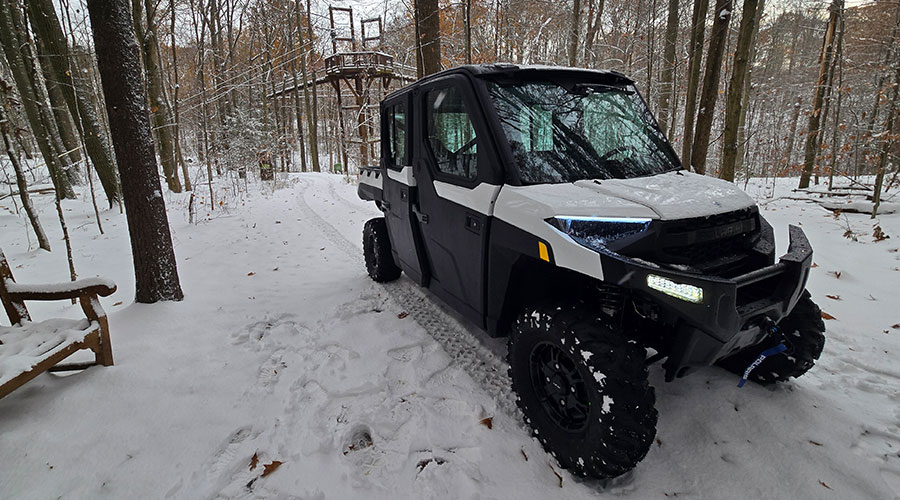
Once considered inferior compared to their gasoline or diesel-fueled counterparts, EUVs emerge as reliable options for grounds managers.
By Dave Lubach, Chief Editor
Marissa Garin hears the question so often that her answer often serves as a political campaign stump speech: How much power does a user of electric utility vehicles (EUV) sacrifice compared to users of gasoline or diesel-powered models?
“It’s one of the first questions I get when I’m presenting in front of our distributor sales teams or our customers,” says Garin, a product marketing manager for The Toro Co.
There was a time when those concerns were much more valid than they are today. EUVs have caught up to their counterparts in terms of power, say EUV manufacturers.
“Lithium-powered vehicles often outperform gas models,” says Jason DiFuccia, chief marketing and product officer for Club Car. “They offer more torque for hauling and towing, more speed control on hills and have plenty of range for a full day of work. They are reliable, efficient and built to keep up with demanding jobs.”
If market research is correct, they are growing in popularity across the United States, including in institutional and commercial facilities.
Gaining momentum
The EUV market is experiencing robust growth in North America, according to a Grand View Research report.
“Electric utility vehicles are more practical than ever,” DiFuccia says. “With performance, low maintenance and built-in safety, they are ready for a wide range of commercial and institutional applications.”
By 2030, the EUV market is expected to grow by nearly $9 billion yearly from 2024 to $29.07 billion. That represents a 6.7 percent compound annual growth rate from 2025 to 2030. While a large amount of the growth of EUVs is attributed to their increased use in agriculture, their uses in institutional and commercial settings are similar. Grounds managers use the machines for tasks such as towing large equipment around the premises or transporting staff and carrying smaller grounds tools, such as blowers, hand tools and shovels.
Common features among new-age EUVs include subscription-based updates and packages that can help grounds managers better manage battery life status and vehicle maintenance.
“We see momentum where there is a need to move people and goods across campus settings,” DiFuccia says. “From small, 5-acre sites to large facilities, key markets include schools, municipalities, resorts, manufacturing plants, warehouses and campus-style businesses.”
Environmentally friendly
As managers think more sustainably, EUV manufacturers are shifting their priorities more to EUVs and the lithium-ion batteries that power them. During Garin’s time at Toro, she has seen batteries shift from lead-based to lithium-ion.
“It’s a very low-maintenance battery,” she says of lithium-ion. “You can ‘opportunity charge’ and it’s not going to harm the overall life of the battery. You can plug into any outlet over lunch and still get a little bit of charge to get through the day, and it’s truly not harming the life of the battery. It continues to evolve.”
The Grand View Research report says the lithium-ion powered batteries accounted for more than 58 percent of the global EUV market in 2024 and that this share will grow in coming years.
“This growth is driven by the need for higher energy density, faster charging, improved safety and reduced reliance on traditional lithium-ion chemistries, which face challenges like raw material scarcity and thermal instability,” according to the report.
Starting small, thinking big
As EUVs evolve, managers must consider two potential barriers to their expanded use.
The first is the cost of EUVs. One facility manager says he bought one for his security team for $45,000. Of course, that amount is offset by savings in fuel and maintenance costs such as oil-changes and repair and maintenance on other engine components. But the initial upfront cost can be intimidating for grounds managers with tight budgets.
“It comes down to budget,” Garin says. “A lot of clients will start with our lightest duty as far as a utility vehicle, and then they really like a mower or see value in an electric mower, and it kind of bleeds out from there and continues to waterfall because they’re like, ‘Wow, they’re great. I can go out at all times of day and not disrupt anything.’ ... Some start small, and it kind of depends on the budget.”
The second concern involves infrastructure and the space and costs associated with installing enough charging outlets to accommodate large fleets of EUVs. Garin says managers should work with electricians to ensure proper wiring and setups are in place to accommodate the vehicles.
“Infrastructure is unfortunately probably one of the major hold-ups to going all-electric or even partially electric,” she says.
Despite those hurdles, EUVs are becoming more popular as they impact the institutional and commercial markets.
“Whether that be in in fuel savings, noise abatement, (or) cost savings, their cities requiring it or their companies requiring it, (EUV sales) are growing across the board,” Garin says.
Dave Lubach is chief editor of the facilities market. He has 10 years of experience writing about facility management and maintenance issues.
Related Topics: