How Tracy Morgan Uses AI and Data to Lead Facilities
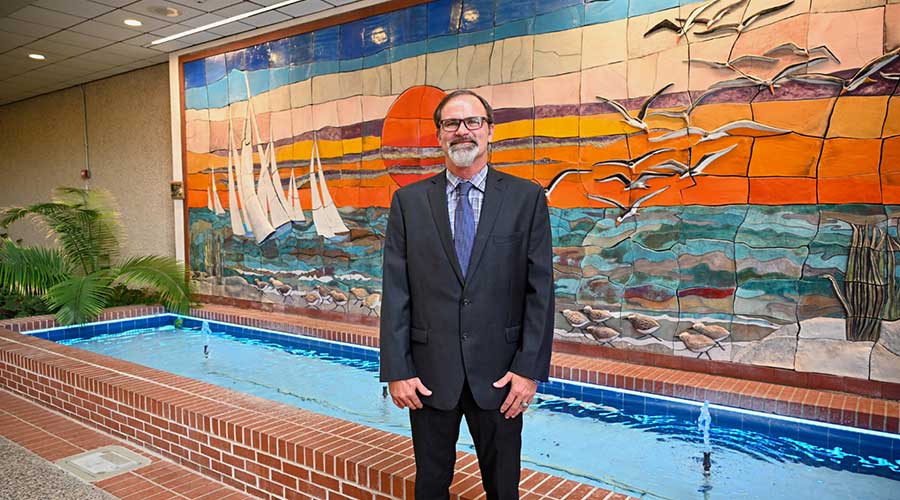
Tracy Morgan’s 25-year career has taken him from maintenance specialist to director of facilities and security at Galveston College and a Facility Champion.
By Dan Hounsell, Senior Editor
Key Takeaways:
- Morgan began his career as a maintenance specialist in the U.S. Air Force Reserve in 1999 and has worked in several other stops, including the airline industry, before arriving in Galveston in 2023.
- Morgan recently oversaw the successful implementation of a new work order management system with the goals of streamlining the maintenance request process and enabling data-driven decision making.
- Morgan’s buy-in on facilities data has included his embrace the potential benefits offered by facility applications of artificial intelligence.
Tracy Morgan has witnessed more than a few changes in his 25-year career in facilities management, from the rise of Internet of Things technology and artificial intelligence to advances related to sustainability and indoor air quality, to name just a few.
Perhaps no change has affected Morgan, the director of facilities and security at Galveston College in Texas, more than his evolution as a facilities leader.
“When I first went into facilities, if you had asked me what it’s going to take to be successful, my answer probably would have been my leadership,” says Morgan, who is also a 2025 Facility Champion. “I would have put it on me: ‘I need to do this. I need to do that.’ I would have the ‘I’ statements.
“Ask me that same question today, and it’s the team. It’s the people you surround yourself with.”
A leader evolves
Morgan began his career as a maintenance specialist in the U.S. Air Force Reserve in 1999 and has worked at several other stops, including the airline industry, before arriving in Galveston in 2023.
“When I came into facilities, I was looking at it strictly from a construction background,” he says. “I was naive coming into it, but I wanted to learn the trades. I wanted to learn all aspects of it.”
Facilities management offered Morgan the opportunity to pair his skills with his goals.
“I was really looking at a career where I could give back and see results,” he says. “In the construction world, you do the job, and you’re done. In most cases, you don’t even see the full results or potential of what it equals out to in the future. In higher ed, you get to see it almost every day.”
As he has moved through facilities management, his appreciation for using all available resources has grown, as has his understanding of the importance of teamwork.
“It is the way you utilize all of the tools and things that you have there to help you along the way,” he says. “I can’t do this by myself. There’s no way. It’s impossible.
“We rise together, we fall together. I’ve gotten several awards over the years. I don’t think you’ll find one where I didn’t say it’s because of my team because it is because of my team. When I talk about these programs, they would be great, but they wouldn’t work without a team. The input that we give, when we talk about new construction, my team has an input in that.”
While Morgan says he knew a career in facilities management would offer him opportunities to expand his skills and achieve his goals, he underestimated how many roles the profession would offer him.
“I didn’t understand how many different management roles come along with being a facility director,” he says. “I’ve been a plumber, done concrete, infrastructure roles in the Air Force, been a master plumber in several different states over the years. Each one of those roles is one specific area.
“Step into facility maintenance, and you’re going to have a lot of roles in all of the areas that have to do with this college running. I didn’t realize early on just how much experience I would get in every field. I won’t call myself an electrician, but I know a lot more about electric than I used to. With HVAC, you either learn that, or you’re in trouble because if you live on this island where it can be 90-plus degrees for five or six weeks in a row, you better know about your HVAC system.”
The latest role for Morgan involves facilities security, a role he had unknowingly prepared for.
“My college degree is in criminal justice,” he says. “However, I’ve never had a position where that mattered. I’ve been in facilities my whole life, but because of where we’re at here and the position that we’re in, it put me in a position to work alongside the vice president to get us in the best possible position we could be in for security.
“The advancements in security are amazing. There’s not one of these seminars or functions I go to where I’m not blown away with what they can do security-wise. We’ve really taken some steps to advance our security team here and make the college a safer place.”
Pushing projects
One critical element of Morgan’s career — and of any successful manager’s career, for that matter — has been effective project management. Identifying, planning, securing financing for and overseeing the completion of major upgrades and renovations to facilities are essential steps in the life of every facility.
In Morgan’s case, the projects have included HVAC system modernizations and lighting retrofits. Most recently, he has overseen a new work order management system with the goals of streamlining the maintenance request process and enabling data-driven decision making.
Morgan says the new system has “been fantastic for us. I can pull reports that help me when I’m asking for more staffing. I can show the accuracy of our closeouts. I’m able to pull that data up in real time and show that if there’s any question as to how long it's taken for us to get the things done the students need. That data is there for you. It’s trackable, which it wasn’t before.”
By tapping into this data, Morgan says managers are better equipped to make the case to top executives on the importance of investing in facilities.
“The biggest thing I’ve learned is how important it is to identify the need for what you’re trying to promote,” he says. “I’ve got a list of needs right here that is several pages long. There’s a difference between what I need and what I want. You’ve got to develop a list of things that make it worth even having the board, the directors, the vice presidents and president look at the project in the first place. You identify the need.
“Then there is the other side of that, which are the consequences of not addressing it. One of the things that has really helped me in my career is that I’m not afraid to voice the pros and cons of anything. You want to go in and talk about all the great things we can do. But in facilities, what I have learned is that you’ve got to go in with pros and cons. You’ve got to talk about the good and the bad and develop a compromise for what works best for the college.”
Trackable, accurate data is the bedrock when it comes to making a successful case for facility renovations and upgrades, as well as staffing decisions.
“You need data and facts to back up what you’re trying to do,” he says. “I could walk in at any given time with the board or the president or the vice president, say I need more staff.
“Every facility director in the United States can say that, but I can take a report from that system that proves why I need that and that shows what we’re doing, how we’re being efficient, how we're not being efficient, the areas that we’re falling back in.”
Buying into AI
Morgan’s buy-in on facilities data goes well beyond his department’s work order database to embrace the potential benefits offered by facility applications of artificial intelligence (AI).
“I’ve got several different programs that I’m using with AI, and it seems like they get better weekly,” he says. “It’s just amazing. Every time I go in there to do something, I find something else that helps me. For example, we’re going to do some chiller upgrades. Based on my experience and the way I’ve operated in the past, I’ve always leaned on my understanding and my HVAC techs and vendors.
“I found a program that not only gives me direction on those decisions but also gives me real-time results from other people who have already made this decision. I dove into that pretty hard, and as a result, we changed quite a bit on what we’re looking at doing in those upgrades.”
Morgan’s experiences with AI have led him to rethink some of his long-held beliefs about project planning and management.
“Even with the experience I have and how many times I’ve done this before, the suggestions I’m getting out of some of these different tools are probably better than my experience,” he says. “That’s hard to admit. I don’t think there has ever been anything that I’ve been a part of being implemented that helps as much as it does.
“You can go in there and ask for five options. It’ll give you five. You can ask for 10, and it’ll give you 10. How many options do you want? Then which one of those options fits best with your experience to help you get where you want to get? That’s how I've been using it, and it’s been helping.”
Morgan’s AI experiences also reflect his broader approach to facilities management — namely, the need to remain open to lessons that new opportunities can offer.
“I came into this wanting to be able to give back everything I had and help these kids get the education they want and reach their goals,” he says. “That’s really what I was looking for. I had no idea exactly what all the nuts and bolts and screws in this career would look like back in the very beginning.
“I’m still learning now, 20-plus years later. The problem-solving part of this career is really what keeps me going. There’s never a dull moment, and if there is, you better cherish it because it probably won’t last long.”
Dan Hounsell is senior editor for the facilities market. He has more than 30 years of experience writing about facilities maintenance, engineering and management.
Related Topics: