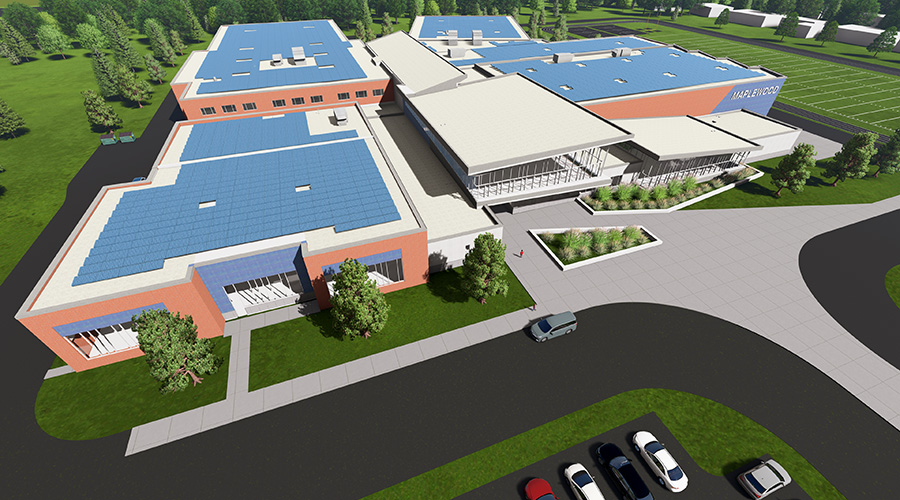
 Image credit: Menasha Joint School District
 How Menasha School District Built the Nation’s Largest Net-Zero Middle School
The Menasha Joint School District leveraged long-term planning, facility condition assessments, renewable energy investments and federal incentives to create Maplewood Middle and Intermediate School.
Key Takeaways:
- The Menasha Joint School District’s Maplewood Middle and Intermediate School demonstrates how long-term planning, facility assessments and strategic investment can help schools achieve ambitious sustainability goals, including becoming the nation’s largest net-zero middle school.
- District leaders integrated sustainability into both operations and education, using renewable energy systems and building features as real-world learning tools that help students understand environmental concepts firsthand.
- The project’s success was driven by a district-wide vision, data-informed decision-making and a commitment to addressing facility needs through a comprehensive long-range plan rather than focusing solely on short-term building improvements.
A school district tucked away in East Central Wisconsin is quickly becoming a leader in sustainable initiatives.
The Menasha Joint School District in Menasha had plans for a green school for the last decade, officially launching plans for the new Maplewood Middle and Intermediate School three years ago. The goal of the new school was to reduce energy costs district-wide through conservation efforts, renewable energy systems, cooperative partnerships and energy-saving projects. Since opening in 2025, it has been marked as the largest net-zero middle school in the country.
“It all ties together, really,” says Brian Adesso, director of business services for the Menasha Joint School District. “From the operations piece, you know how it ties into the wellness of students ... For the curriculum side, it just makes it easier for being able to teach about these (sustainable) concepts because they’re actually able to see them. It is real to (the students), and it seems like so much is believing.”
The school has over 224,000 square feet and can hold up to 1,000 students, and it effectively acts as two schools: an intermediate school for grades 5 and 6 and a middle school. Each grade level has its own learning areas, while the cafeteria, library and performance spaces are all shared areas. The district wanted to reconfigure the schools and instructional models. Adesso says grades 5 and 6 would operate more as an elementary school while grades 7 and 8 would function as a middle school. Schools often try to foster a sense of culture and climate, so the split allows students to move into older grades while maintaining a sense of belonging among their peers.
During the planning stages, school leaders visited nearby districts in Waunakee, Oconomowoc, Verona and West De Pere to look at the way the educational spaces operated. During their visits, they were able to meet with teachers at the schools to learn the way the facilities were planned. These discussions helped with designing the layout of the school to include features that would work best for the students and staff.
“We’re not in Dane County (a democratic district), and I feel like if you’re in Dane County, it’s kind of expected to build a building like that,” Adesso says, referring to a sustainable facility. “I would say that the kind of difference there is that they were very intentional and knew what they wanted to start from. When we started, we knew we wanted a good foundation, but we weren’t ever planning to go net zero right away. We were just fortunate enough that when bidding came back and the passing of the Inflation Reduction Act, we were able to add on the solar rays and microgrids.”
When moving forward with the net-zero plan, leaders knew they wanted to focus on whole district sustainability. From a curriculum standpoint, leaders knew that they wanted students to be leaders in climate action and promote a healthy learning environment. But they also needed to be able to seamlessly integrate sustainable features into the school and its operations without feeling like they were forcing the issue.
To determine a starting point, leaders performed a district-wide facility condition assessment. From there, they were able to form a strategic long-range plan that established a vision for the way they wanted the Maplewood school to look and feel for students, staff and faculty. The assessment outlined the cost of a new build vs. renovating the current middle school, laying out anticipated maintenance and operations costs for each scenario. From there, leaders were able to determine the suitability of the existing building and if it would suit future learning objectives.
“You obviously don’t want to renovate or build a building that would be fine for the next 10 or 20 years and then structurally needs to replaced,” Adesso says, adding that the assessment “went into all the ways we’ve capitalized on over the last 14 years to tick away at those deficiencies in our buildings. The assessment gave us a roadmap on what we could easily tackle. With this many years in, I’m proud that we as a district stuck to that whole-district assessment and have used it and lived by it.”
Mackenna Moralez is the managing editor of the facilities market and the host of the Facilities in Focus podcast.
Related Topics: