 Paul Vu
Adaptive Reuse Delivers New San Bernardino Health Campus
Vacant call center in San Bernardino repurposed as important community facility.
By Mackenna Moralez, Associate Editor
In a report by WalletHub, San Bernardino, California was ranked one of the unhealthiest cities to live in in America. The city, known for being the birthplace of fast-food chains McDonald’s and Taco Bell, has long endured health disparities due to increased unemployment and poverty rates. To expand access to healthcare, the city moved to open a new health campus, with the goal of providing care to underserved populations.
The vision for the SAC Health Brier Campus, which opened in the fall of 2025, first began with the goal of converting a long-vacant 280,000-square-foot call center. Design firms Perkins&Will and BNBuilders leveraged modular design principles, such as flexible layouts, streamlined workflows and natural, tactile finishes to accelerate construction and complete the project early and under budget.
“Early on, the design team recognized the potential of the building’s generous open floor plates, structural grid and large elevator to support an adaptable, community-centered clinic,” says Maryellen Westerberg, chief operations officer, SAC Health. “As the design progressed under a compressed timeline, the vision evolved into a modular, future-proof ‘healing oasis’ that could meet immediate needs while scaling according to the community’s growth. Reusing the building also saved time, cost and carbon compared to ground-up construction. The cherry on top is the view from the upper floors of the San Bernardino mountains, which inspired elements of the health facility’s design.”
The healthcare campus is expected to welcome upwards of 300,000 patients within the next five years. Officials wanted a comprehensive healthcare offering so the community could receive whole-person care within one space.
The facility includes:
- 158,000 square feet of clinical, dental, behavioral health and specialty care services
- 88,000 square feet of administrative and support spaces
- 30,000 square feet for an express care clinic for urgent community needs
- 88,000 square feet for nonclinical staff support service
- 4,000 square feet for a community resource center
Utilizing an old building aligns with the growing recognition of patient equity as a fundamental right, rather than a discretionary add-on, something that the city was striving to provide. By leveraging existing infrastructure, healthcare providers can afford to invest more in services that directly address the needs of the community that include outreach and holistic health.
Copy and paste
The SAC Health Brier utilized a modular design approach to improve speed and coordination within the project. This allowed the team to design each clinic module once and replicate it throughout the building. The simplified construction was able to reduce variability and requests for information, keeping the project from potential delays in sourcing products. The standardized modules allow for flexibility within the facility as they begin to welcome patients and community members.
“Standardized modular clinic layouts provide long-term adaptability, allowing the facility to shift functions and staffing patterns as operational needs change over time,” says Jeff Dreesman, director of medical planning, principal of Perkins&Will. “Lightweight material selections and construction strategies preserving the existing infrastructure were carried out with durability in mind, supporting the organization’s long-term maintenance and adaptability goals.”
Modularity in design also allows for the reconfiguration of spaces to meet new requirements and the integration of technology more easily. By future-proofing designs, the facility can easily adapt to evolving trends and remain functional over the long term.
The design team also prioritized reusing the building’s envelope, mechanical systems and major infrastructure to minimize environmental impact and reduce carbon emissions while also introducing strategic upgrades to support clinical operations for years to come. Dreesman says that the balance allowed the facility to meet healthcare performance standards while preserving resources and reducing waste.
Meanwhile, integrating new mechanical, electrical and plumbing systems requires careful coordination to fit within the constraints of the already existing building. The modular clinic layout simplified routing and standardization, reducing conflicts between systems. Dreesman explains that reuse of existing major systems helped maintain efficiency while supporting today’s healthcare needs.
Community ties
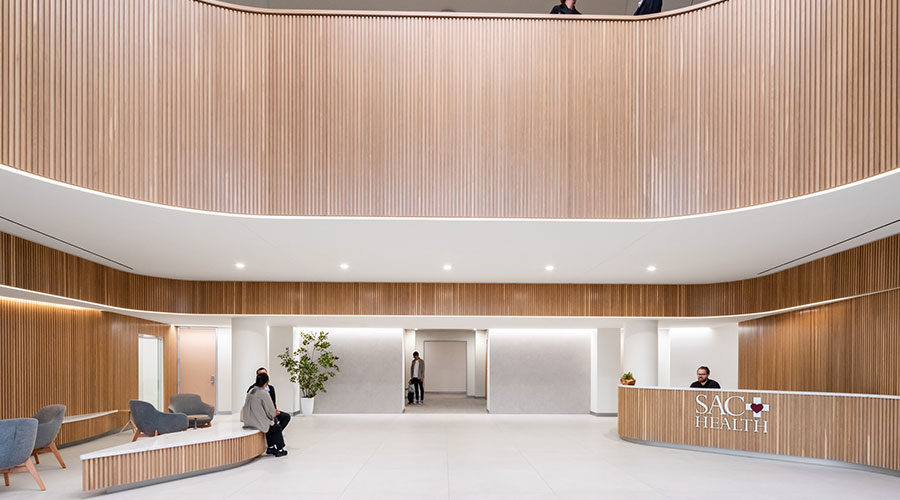
The San Bernardino community is closely connected to its indigenous roots. The facility’s interior design intentionally incorporates inspiration from the Yuhaaviatam of San Manuel Nation and local healing traditions, Westerberg explains. Drawing from the city’s deep cultural and spiritual heritage, natural materials, tactile finishes and references to the region’s arrowhead landscape helped create a sense of place and belonging so that patients don’t feel so isolated while receiving care. Connecting the design to important community values fosters trust and comfort for the diverse population the clinic aims to serve.
“Access to daylight, mountain views and natural textures help counteract the stress often associated with clinical settings,” Westerberg says. “These elements reinforce a connection to the surrounding native landscape and nearby Blue Zone region, evoking calm and promoting wellness. Staff also benefit from a more uplifting and restorative workspace, supporting retention and overall morale.”
Still, with every project comes a series of challenges. Dreesman explains that the biggest challenge was transforming the former call center’s corporate interior into a fully functioning clinical environment in just 16 months.
Working within the existing building’s structural limits allowed the design team to be creative with their solutions. When the team needed to address the facility’s three-inch raised access floor, they devised a lightweight infill strategy that used Styrofoam, hat channels, plywood and a thin leveling compound that averted new structural costs and delays in permitting. Close collaboration among designers, builders and engineers allowed the design process to stay on schedule.
“Using an innovative lightweight flooring solution became a key breakthrough for staying on schedule and within budget,” Dreesman says. “The infill strategy, coupled with the team’s modular design system, resulted from a highly collaborative process that aimed to address immediate construction constraints and long-term operational needs. This approach expedited the construction phase, allowing the project team to finish four days early and remain under budget.”
Even with the tight deadline, designers of the SAC Health Brier Campus understood the needs of the old building. However, with a forward-looking approach, they were able to retrofit the facility to enhance the care of patients. Throughout the process, the design team stayed informed on healthcare advancement and community ties so that they could truly design with the patient experience in mind. Accommodating a diverse patient population was a fundamental aspect of the facility’s design.
“This project demonstrates how adaptive reuse can meaningfully expand healthcare access while reducing environmental impact,” Westerberg says. “By delivering the building ahead of schedule and under budget, the project team helped SAC Health avoid reimbursement losses and begin serving patients more quickly. Most importantly, the project stands as a model for how rapid development and inclusive design can come together to meet the community’s needs.”
Mackenna Moralez is the associate editor of the facilities market and the host of the Facilities in Focus podcast.
Related Topics: