 Photo credit: Hendrick Inc.
Commercial Office Spaces Place Emphasis on Flexibility
While durability and aesthetics matter when selecting furniture, having movable parts enhances options.
By Howard Riell, Contributing Writer
Office environments are changing, so facility executives need to keep rethinking the way furnishings can support flexibility, efficiency and long-term value. It’s a complex calculation.
Emerging strategies for office furnishings prioritize smarter space management, improved optimization and better asset tracking, according to designers, and they are helping organizations adapt to evolving workplace needs while maximizing their physical environments.
Office facelift
In November 2025, Atlanta-based architecture and design firm Hendrick Inc. completed the second phase of a project involving a new home for technology firm OneDigital, a provider of insurance, financial services and human resources. The design and branding strategy for the headquarters aimed to reinforce its award-winning workplace experience and prioritize social engagement.
Hendrick offers a range of design services, including architecture, interior design, adaptive reuse, branding, graphics and signage, workplace strategy, and sustainable design for commercial and corporate projects.
The first phase of Hendrick’s vision focused on providing a variety of workspaces, stations and flexible meeting areas on floor 17. The design featured seating and tables that could be easily reconfigured, partitions that expand and contract rooms, and plentiful, thoughtfully integrated plug-and-play technology options. The final design optimizes the floor’s infrastructure, so technology can be used in any configuration.
The centerpiece of the second phase was the 11th floor work café zone, which serves as a nucleus for the three floors OneDigital occupies. The space gives employees the ability to interface with team members they do not usually see, and it helps clients feel connected to the organization. The goal was for the environment to support internal and external interactions with intentional meeting points.
The café design aims to accommodate private work to large events. A staircase extends the experience down into the regional division on floor 10, which also hosts client entertainment in a dedicated space. Upstairs and downstairs areas can take advantage of that connection.
So-called office neighborhoods were created to establish departmental hubs and to break up sound transfer and improve acoustics. This feature gives teams a sense of belonging, extended through autonomy over their individual workspaces with the control of their lighting from desk lamps. The entire space is also dimmable and allows window access.
Smarter space management
Designers in the OneDigital project emphasized transforming the workplace to reflect modern-day trends.
“Emerging office furniture strategies are prioritizing smarter space management by shifting away from fixed, one-purpose layouts and toward flexible, activity-based environments,” says Andrew Pletcher, Hendrick’s senior director. “Modular, mobile and multi-functional furniture allows spaces to be quickly reconfigured to support focus work, collaboration or meetings, reducing underutilized areas.”
Integrated technologies such as built-in power, wireless charging, and data-driven occupancy insights help organizations right-size workstations and shared spaces based on the way employees actually use the office. The furniture also creates “more cost-effective spaces that are more flexible than traditional stick-built construction that require costly third-party labor to complete the work,” says Pletcher, who supervised the second phase.
From a facility management perspective, such changes “fundamentally shift furnishings from being static assets to strategic tools that support operational agility and long-term performance,” he says.
Designers no longer select furniture solely for durability or aesthetics.
“It is evaluated on how easily it can be reconfigured, relocated or scaled as organizational needs change,” Pletcher says. The use of modular systems, mobile elements and multi-use pieces “allow facility managers to adapt spaces quickly, supporting fluctuating headcounts, hybrid work patterns and evolving team structures without costly renovations or downtime.”
For OneDigital, Hendrick says he used the same height-adjustable table in the hoteling stations and focus rooms as he did in the typical workstations.
“This way, when the needs change in the future they have the basic component that doesn’t go wasted and can be easily converted to that changing need,” Pletcher says. “This strategy also helps hit greater pricing discounts based on a higher volume of product.”
Adaptable systems
Emerging office furnishing strategies are “shifting away from static, one-size-fits-all solutions and toward adaptable systems that respond to changing occupancy, work styles, and business needs,” says Stephen Wells, Hendrick’s principal and the OneDigital project lead.
Designers achieved smarter space management through modular furniture systems, standardized workstation footprints and multi-use spaces that can be easily reconfigured without construction, Wells says.
“These approaches allow organizations to right-size their environments and adjust layouts as teams grow, shrink or reorganize,” he says.
Improved optimization comes from designing furnishings that support multiple postures and functions, such as height-adjustable desks, flexible seating and furniture that can transition between individual work, collaboration and events.
“Rather than dedicating square footage to a single use, spaces are designed to work harder throughout the day,” Wells says.
OneDigital had “outgrown its previous space both as a brand and as an organization,” he says. “The company had evolved and required a space that reflected its current identity and growth. While the former office environment was functional, it no longer aligned with OneDigital’s dynamic and innovative culture.”
Asset tracking is increasingly supported through standardized furniture kits of parts, consistent workstation types and manufacturer data that allows facility teams to track inventory, redeploy assets and plan future moves with minimal waste, says Wells, who oversaw Phase One.
“This approach supports long-term value by extending the lifecycle of furniture and reducing the need for frequent replacement,” he says.
These changes encourage facility executives to view furnishings as strategic infrastructure rather than fixed décor.
“Furniture is no longer selected solely for aesthetics or immediate need,” Wells says. “Instead, it is evaluated for adaptability, durability and its ability to evolve with the organization.”
By investing in flexible, ergonomic and standardized furniture solutions, facility managers can support a range of work styles while minimizing churn costs associated with reconfiguration, relocation and growth.
“Efficiency improves as spaces can be quickly adjusted without downtime, and long-term value is realized through reduced waste, improved employee well-being and better utilization of real estate,” Wells says, adding that ultimately, furnishings become “a tool that helps organizations remain agile, supporting hybrid work, changing team dynamics and future uncertainty without requiring significant capital reinvestment.”
Designers selected furniture at OneDigital to support flexibility, ergonomics and user choice across the workplace. They evaluated furnishings for ergonomic performance to promote employee well-being, comfort, and long-term health. Private offices were designed using the kits-of-parts approach and featured height-adjustable desks and modular components that can be added or removed based on individual or team needs. This strategy provides maximum flexibility for future changes without requiring new furniture purchases.
“A single workstation size was used throughout the office, anchored by height-adjustable desks and ergonomic task chairs,” Wells says. “Lower workstation panels were specified to maximize access to daylight and views, supporting both wellness and visual connectivity across the space. This standardized approach allows workstations to be easily reassigned or reconfigured as teams shift.”
Focus rooms were outfitted with height-adjustable tables to give employees access to enclosed spaces for focused work, virtual meetings and confidential conversations — supporting a variety of work modes throughout the day.
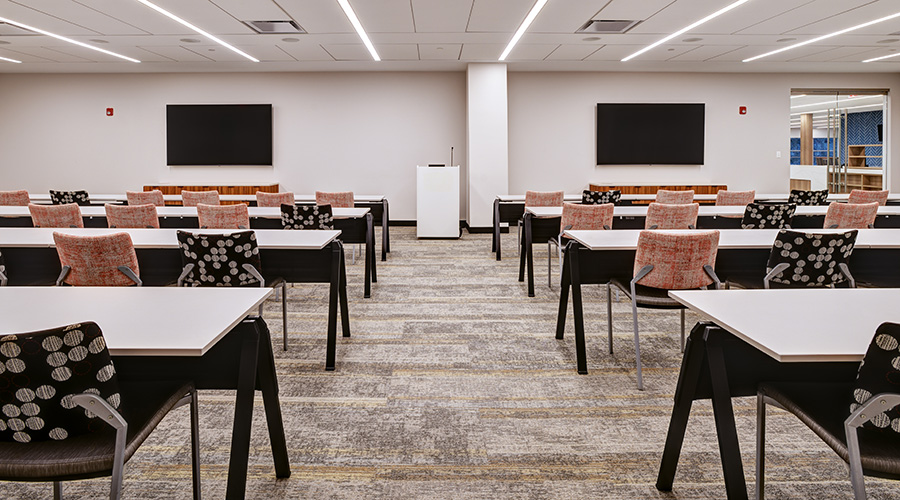
“In shared areas, flexibility was a key driver,” Wells says. “The multipurpose room utilizes modular furniture and operable walls, allowing the space to transform easily to support meetings, training sessions, or larger events. In the central work cafe, lightweight, easily movable furniture empowers employees to rearrange or clear the space as needed, reinforcing user choice and adaptability.”
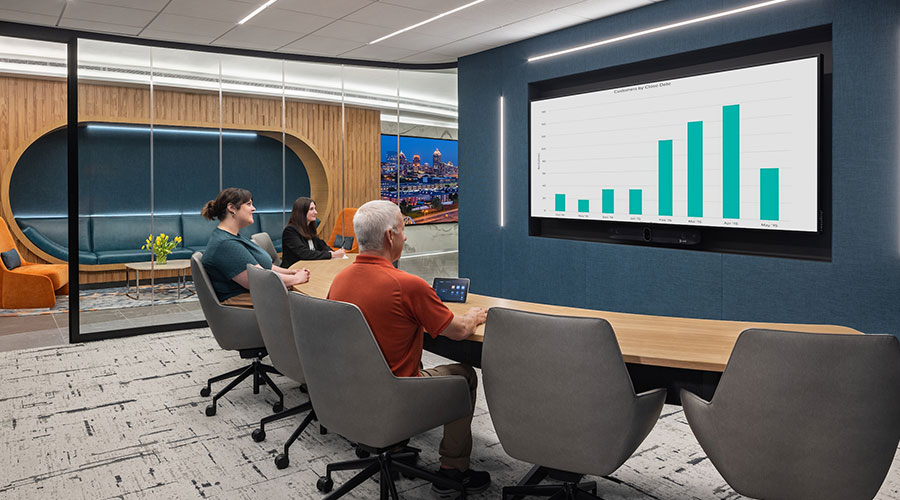
The project included a range of open and enclosed meeting environments that feature different furniture solutions and postures. Some spaces offer a more casual, lounge-like setting, while others use traditional tables and chairs to support more formal meetings. This variety ensures employees can select the environment that best supports their task, collaboration style or level of formality.
“Together, these furnishing strategies create a workplace that is flexible, efficient and resilient, supporting OneDigital’s evolving needs while maximizing long-term value for the organization,” Wells says.
Howard Riell is a freelance writer based in Henderson, Nevada.
Related Topics: