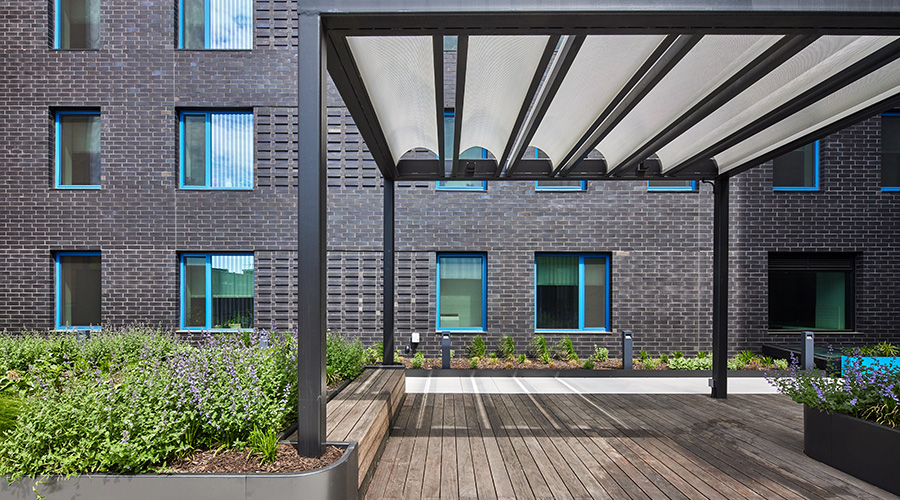
 Image credit: Richard Barnes 2026
 Building Resilience from the Outside In
High-performance building principles can reduce energy use, improve occupant comfort and strengthen building resilience.
By Ronnie Wendt, Contributing Writer
Key Takeaways:
- Passive House principles such as airtight construction, insulation, high-performance windows and heat-recovery ventilation can improve energy efficiency, occupant comfort and building resilience.
- Facility managers can use routine replacement and upgrade projects as opportunities to gradually improve building performance rather than waiting for a major renovation.
- High-performance buildings still depend on engaged operations teams that understand design intent, maintain the building envelope and monitor conditions such as temperature, humidity and CO2.
Extreme heat, wildfire smoke, power outages and increasingly unpredictable weather change what facility managers need from their buildings.
Keeping occupants comfortable on an ordinary day is no longer the only goal. Facility operations also need to maintain safe indoor conditions when outdoor conditions deteriorate or critical systems fail.
Darren Macri, board president of the Passive House Network and co-CEO of Wythe Windows, says adopting high-performance building principles can help facility managers address energy efficiency, occupant health and resilience.
Passive House offers a roadmap to resilience in five core principles, which include
- Airtight construction,
- High levels of insulation,
- Thermal bridge free design,
- High-performance windows, and
- Mechanical ventilation with heat recovery.
He adds that it isn’t necessary to pursue full Passive House certification to put those principles to work. In existing commercial buildings, Macri says a more practical approach may be to incorporate them gradually as building components reach the end of their useful lives.
A window replacement, HVAC upgrade or envelope repair, for example, becomes an opportunity to improve building performance. Over time, those individual decisions can add up to a building that uses less energy and is better able to protect occupants during extreme conditions.
“Make the best choice you can, and then build on that for the next one, and take your baby steps,” Macri says.
Start With the Building Envelope
Macri puts airtightness at the top of the list for facilities seeking better building performance. He explains that uncontrolled air movement can undermine energy performance and occupant comfort while contributing to moisture problems.
A high-performance building envelope limits that movement with a continuous air barrier, climate-appropriate insulation and careful attention to thermal bridges. High-performance windows complete the envelope, helping reduce heat loss and gain and improve occupant comfort.
Mechanical ventilation then takes on a critical role. Instead of relying on uncontrolled leakage to bring outdoor air into a building, ventilation systems introduce fresh air and remove stale air. Heat- or energy-recovery ventilation can capture energy from outgoing air to precondition incoming air.
That combination, he says, can help facility managers reduce energy loss, control indoor conditions and support indoor air quality.
Macri stresses that the operations team also must pay attention to the work being done inside the building. He explains something as routine as penetrating a wall to run new electrical, plumbing or communications infrastructure can become a building-performance issue if the air barrier isn't properly restored afterward.
“The people maintaining the building have to understand, how the work they do impacts the air barrier. They also need to understand how components they put in tie into that air barrier,” he says.
Make Replacement an Opportunity
Most facility managers inherit facilities constructed years or decades ago, along with capital plans that dictate when roofs, windows and mechanical systems can be replaced.
Macri suggests using those replacement cycles as opportunities to gradually improve performance. If a roof needs replacement, for example, facility managers can add exterior insulation into the project.
The same thinking can apply to mechanical equipment, he adds.
Instead of automatically replacing a failed boiler or other major system with equipment of identical capacity, Macri recommends evaluating the building as a whole. Improving airtightness, installing energy-efficient windows and higher-rated insulation could reduce heating and cooling loads enough to reduce the size of replacement equipment.
“You might find that you can bring in a much smaller heating system, if you do some air sealing and insulating first,” he says.
Turn the Envelope into a Resilience Strategy
Those improvements show their value when conditions outside a building become extreme. For example, during a heat wave, a well-insulated, airtight building slows heat transfer between indoors and outdoors. Exterior shading can also reduce solar heat gain before it reaches the building interior.
Macri has seen firsthand the difference exterior shading can make.
“When I lower that exterior shade in my Passive House home, it feels like someone's turned on the air conditioning. It makes such a dramatic difference having those exterior shades,” he says.
Building orientation, overhangs and landscaping can contribute as well. Deciduous trees, for example, can shade southern exposures during the summer, then shed their leaves to allow more solar gain during the winter.
A tighter, better-insulated envelope can also buy time during a power outage because indoor temperatures shift more slowly.
Wildfire smoke creates another reason to pay attention to the building envelope. An airtight facility can prevent smoke from entering through any gaps or leaks.
Don't Forget the Operations Team
Macri warns that a well-designed building can fall short of its performance goals if operations staff is not involved.
He says a lack of involvement becomes clear during commissioning. High-performance buildings are modeled to predict how they should perform, making deviations from those expectations something to investigate rather than accept.
He recalls a certified Passive House project where commissioning found VRF reversing valves operating in the wrong direction. Correcting the problem dramatically improved building performance.
That experience underscores why facility managers should not view commissioning as the last hurdle to clear before construction hands over the keys.
These leaders, he says, must also understand the design intent, know where critical envelope components are located and understand how mechanical and ventilation systems are supposed to operate. They also need enough performance information to recognize when operation drifts from the design.
Measure Comfort, Not Just Temperature
Macri recommends monitoring relative humidity and carbon dioxide levels along with temperature. He notes that CO2 measurements can provide useful feedback on whether balanced ventilation is bringing in fresh air and removing stale air as intended.
Humidity also plays a key role in occupant comfort, he adds.
“We always think about temperature. But what you see on the thermostat is not a great measure of comfort because it really is that humidity level that tells you whether you feel cool or hot,” Macri says.
Tracking those conditions gives facility teams another way to identify problems before they turn into occupant complaints.
It also reinforces that energy efficiency, resilience and occupant health aren't competing priorities. A better-performing envelope can reduce loads while improving occupant comfort, and controlled ventilation can support indoor air quality while recovering energy that otherwise would be lost.
Take the Next Best Step
Facility managers already make daily decisions that determine how their buildings will perform years into the future. Applying Passive House principles helps them look at decisions through the lens of airtightness, insulation, ventilation and resilience to turn routine replacements into incremental improvements.
Over time, those baby steps can lead to a building that uses less energy, keeps occupants more comfortable and is better prepared for severe conditions outside.
Ronnie Wendt is the owner of In Good Company Communications and a freelance writer specializing in articles for the facilities management, aviation, RV and automotive, meetings and events, security, logistics and business technology industries.
Related Topics: