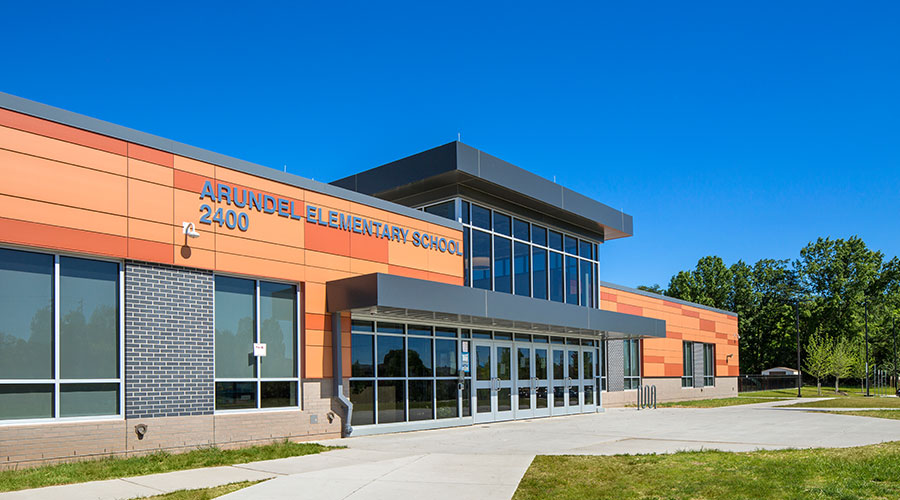
Baltimore Schools Tackle Challenge of Maximizing a CMMS
Baltimore City Public Schools tackle the daunting challenge of maximizing the performance and benefits of a CMMS.
By Dan Hounsell, Senior Editor
Computerized maintenance management systems (CMMS) offer institutional and commercial facilities a host of valuable benefits that can include reduced equipment downtime, improved technician productivity and greater cost controls.
Unfortunately, few maintenance and engineering departments are able to maximize the power of a CMMS. Technicians often resist implementing and using the software, departments fail to adequately manage the application, and managers do not take full advantage of the data technicians gather via work orders. As a result, facility conditions and performance suffer, and organizations struggle to fulfill their core missions.
In the case of Baltimore City Public Schools, Patrick McGough has made it a high priority to wring as much performance and as many benefits as possible from his department’s CMMS. His focus has been to help technicians, managers and executives alike understand that the software’s data is an essential resource that can support more effective decision making.
“A work order tells a story,” says McGough, the district’s CMMS manager, adding that this story plays a central role in an organization’s success.
Building the base
Baltimore City Public Schools is comprised of 145 buildings with about 16 million square feet of space, McGough says. Its oldest building dates to 1895, and the average age of the district’s buildings is 40 years. Its facilities maintenance and operations department oversees the facilities with a staff of 298.
The district’s original CMMS, purchased in 2016, was replaced with a customizable enterprise application in 2023, says McGough, who joined the department in 2019.
“I love data,” he says. “When I was hired, we had discussions about data and what we wanted to do with it, and I had an opportunity to sink my teeth into a single system.”
The discussions revolved around the district’s desire to use the CMMS and its data more effectively, and district executives were clear in their expectations of him in the role: “We want you to get your arms around the system. We need you to figure out what we have.”
As part of the data gathering process, McGough says the district conducted facility condition assessments to compile an accurate inventory of assets and their condition. That data is supplemented by technicians who perform regular walk-arounds to identify work orders.
McGough describes this process as “the front end of the need, adding, “We want them to tell the story of the need.”
To help him achieve the district’s goals related to CMMS performance and effectiveness, the district has expanded his staff from one CMMS analyst when he started to three, along with five work order administrators. Among the team’s priorities is ensuring that technicians not only gather data via work orders but that the data is accurate.
“The results are only as good as the data going in,” he says.
The efforts to improve CMMS performance also includes adapting it to meet the evolving needs of facility managers.
“We are constantly having departments come to us and say, ‘We want to do this additional thing with the CMMS,’” McGough says. As one example, he points to the issue of the CMMS not being able to track the impact of school closures that result from facility problems.
“We wanted to know how many days of school a problem has cost us,” he says, adding that the goal was to understand not only the asset implications of the problem but the education implications. In response, CMMS administrators created a new field to enable managers to track that data.
While the additional CMMS field has benefitted the department, McGough says it is just one of many potential changes to the software designed to gather more and better data.
“We’re only touching the tip of the iceberg,” he says.
Technician buy-in
Talk with most managers even for a short time about their CMMS challenges, and they will bring up the issue of buy-in from technicians, who in most cases are the primary users of the software. The issue can take a number of forms, from technicians’ stubbornness in moving on from an existing CMMS to their lack of belief in the benefits of the technology.
“We struggle with buy-in from technicians,” McGough says. “They’ll ask, ‘Do you want me sitting at a desk entering data, or do you want me out in the field fixing things?’”
McGough says the department has taken two critical steps to help create and sustain buy-in for the CMMS among technicians. The first is to spotlight the value and impact of data.
“We show them what their data is and what active work orders look like,” he says. “We show the impact of their data on facilities. We show them the story of the data.”
This kind of buy-in also is essential among the other users of the CMMS.
“We’re short-staffed, so we also rely on principals, assistant principals and custodians to identify problems and create work orders,” he says, adding that as a result, the application actually has about 2,700 users.
The second critical step to build technician buy-in involves training.
“You have to constantly train,” he says, adding that while initial training is important, ongoing training is just as important. “If they can’t find their work orders in the mobile app, we lose their buy-in.”
McGough also says if a technician asks for training on work orders and entry requests, “my staff has a policy that we’ll respond to that request within six hours. If we’ve got them on the hook, we’ve got to reel them in. We’ve got to make the most of that opportunity.”
A system’s evolution
Expanding the reach and impact of the Baltimore City Public Schools’ CMMS does not stop with technicians. McGough says ongoing efforts require the involvement of the district’s executives and their buy-in of emerging and expanding facilities technologies.
Involvement and support from an organization’s executive level can be an essential component in unlocking the full range of benefits a CMMS can deliver. One example of executive buy-in for the district comes in the form of requests by district administrators for more data on facilities via the CMMS.
“They say, ‘We need one more thing and one more thing and one more thing,’” McGough says, adding that the requests often involve budgeting and other financial data. “They tell us, ‘We need to pay the bills, so we need to understand project costs.’ Management is asking for data to make better decisions.”
McGough says such requests are confirmation that district executives see greater value in the CMMS and the data it contains.
“When directors understand the value of data that their teams are putting into the (CMMS) system, we can get them to see the value of that data,” he says. “When I can show it to management and they can see it, the impact is tremendous. I’ve got their buy-in.”
The department’s quest for even more facilities data to complement the information contained in a CMMS database is expanding to embrace the Internet of Things, AI and building automation systems
“We are starting to dip our toes into these areas, with more emphasis on the role of sensors and AI,” McGough says. “What can they tell us? We are understaffed, so we need a head start on addressing problems.”
The topic of AI often stirs hesitation among technicians already skittish about the impact of CMMS technology who now wonder if the rise of AI might further affect their jobs. McGough says an effective response to such questions is to demonstrate the benefits that AI can have for facilities and technicians.
“AI is not about taking people’s jobs,” he says. “It’s about helping people do their jobs better. What are our top five buildings with problems? What facility systems are underperforming and might need replacing?”
Ultimately, the success of the Baltimore City Public Schools’ CMMS will come down to the ability of McGough and his staff to achieve a critical goal — to gather, store and provide access to accurate data district officials can use to make more effective facilities-related decisions.
“The more information we can put into the work orders, the more puzzle pieces we can gather, the more people will find value in the system,” he says. “The value of the CMMS becomes more than just the work orders,” he says. “It’s the asset history. It’s the story of the system.”
Dan Hounsell is senior editor for the facilities market. He has more than 30 years of experience writing about facilities maintenance, engineering and management.
Related Topics: