Drones: Extending Reach, Maximizing Resources
Polk County, Florida, turns to drone technology to troubleshoot a roof’s condition and ensure cost-effective decisions.
By Dan Hounsell, Senior Editor
Few institutional and commercial facilities are built with future maintenance in mind. The issue might have been one of many considerations during a facility’s design phase, but if maintenance was on that list, it was near the bottom. For this reason, many facilities include areas and components that are difficult to access for front-line technicians looking to inspect, repair and replace failing equipment and materials.
Crews traditionally used ladders and scaffolding — and later lift equipment — to access exterior components such as windows above the first floor and interior areas, including lighting components in gymnasium and auditorium ceilings. But the setup, relocation and takedown of these products took several workers to complete, were time-consuming and required a range of safety precautions.
The last decade has seen the rise of technology that finally has given maintenance and engineering managers what they need to ensure front-line technicians have safe, efficient and effective access to and inspection of hard-to-access areas of facilities — drones. Today, departments are increasingly deploying drones to inspect every inch of hard-to-access building facades and interior spaces, as well as vast roofs and even sprawling landscapes.
Options and answers
Polk County covers over 2,000 square miles in Central Florida, and it includes about 1,300 structures. The county’s size and number of facilities that require inspection and maintenance can create challenges when it comes to inspection and repair.
“We have to be very efficient in what we’re doing on our repairs to make sure we’re doing our best to be good stewards,” says Keith Tate, the county’s facilities management director. That goal can be especially difficult to achieve when the issue in question is the condition of an aging roof on a large facility.
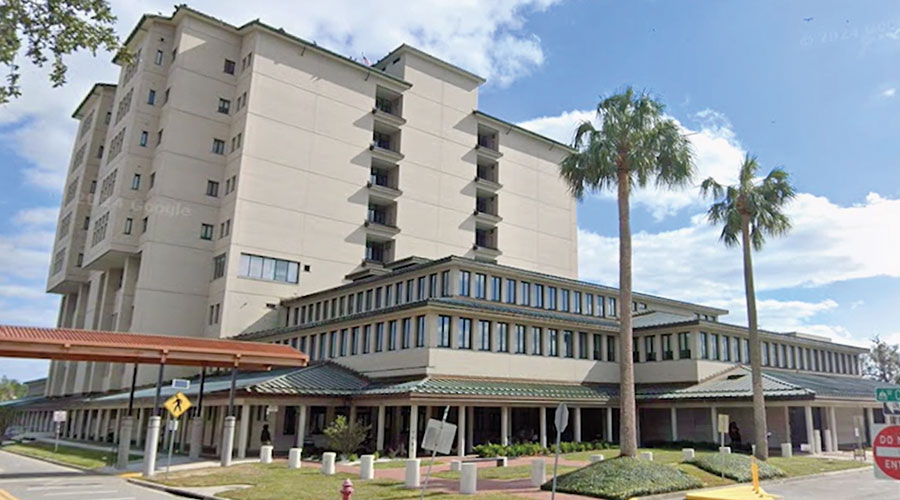
The facility in question is the 11-story courthouse for the10th Judicial Circuit Court in Bartow, Florida. The 515,000-square-foot courthouse was built in 1987.
“It is a very important building in the judicial system in Polk County,” Tate says. “Like most of our facilities, it’s in good condition, but the copper roof has seemed to be deteriorating in certain locations, which is uncommon for this type of roofing system.”
Being good stewards of taxpayers’ money involves considering the full range of options in any situation to determine the most cost-effective options, especially in the case of a project that could cost taxpayers millions of dollars.
“When we were discussing this initially, it was all about needing to replace this roof,” Tate says. “But as we went on, our discussions turned to investigating the roof: ‘Let’s see what we can do to repair the roof versus spending the funds to completely replace this roof — to do a repair job versus the complete replacement.’ To replace a copper roof based upon the skill set of most companies anymore, we were looking at several million dollars to replace that roof.”
Given the sheer scope of the project, one option discussed was to use a drone equipped with an infrared camera to inspect the roof and determine its condition.
“Based on the size of the roof, the height of the building — there are several different levels to the roof — from the standpoint of timeliness and the ability to get accurate information on it, the drone was really the only way to do that,” Tate says. “If we weren’t able to use drone technology, we’re probably looking at replacing the entire roof instead of making repairs on it.”
Infrared technology has become a staple of roof inspections in recent years due to its ability to uncover moisture in roof systems that had been difficult to detect without penetrating roofing materials.
“If you use a drone with an infrared camera on it just after sunset, the moisture in that roofing system — whether it’s a metal roofing copper, standing seam metal roof or a low-slope roof — will stand out,” Tate says. “It will almost glow because of the heat signature. During the day, the roof is absorbing all that heat. When it gets to sunset, it shifts from absorbing that heat to giving it off. That water will stand out, and that’s why we used an infrared drone.”
The results of the drone inspection on the courthouse roof using infrared imaging changed the department’s discussions about how to proceed with the project.
“We’ve been able to see that all it needs right now is repairs versus spending several million dollars to replace a copper roof on a building of this size,” he says. “Knowing the expense that we were trying to avoid, the drone usage saved us. The (drone) bid came in at approximately $300,000.”
The project enabled Tate and his department to implement technology that had been under consideration for several years.
“My maintenance manager and myself had discussed this for the last couple of years, trying to figure out how we would incorporate it into our projects and our asset management and looking at the funding and how that would meet the needs of more than just this facility,” he says. “The bottom line is, we’re extending the useful life of the roof system by spending approximately $300,000 versus spending probably a couple of million to replace the roof.
“We’re being good stewards with the citizens of Polk County’s money and the resources they allow us to use. It saved the county a lot of money to extend the useful life of this roof to a point where it should be — a 40- to 50-year roof versus where it would have been if we had to replace it right now.”
Expanding applications
Drone technology offers managers, their department and their organizations a host of potential benefits, but incorporating it successfully into essential operations and activities means managers need to understand the technology, as well as the needs of their facilities.
“A drone is a tool,” Tate says. “It’s not the answer to everything. It’s no different than AI or CAD software or any other piece of technology we use. It’s a tool, and it’s a part of the process. In this instance, it played into that process. It was an effective tool in this situation. In another situation on another building, it may not have been the right tool to use.”
“In this case, it was the right tool because of the height of the building, because of the size of the building and because of the potential cost of having to replace the entire roof system versus making repairs to it and extending the useful life of that roof.”
Tate says the department’s maintenance manager also used drone technology in another project that proved successful.
“He used a drone coordinated with our communications division to document another roof project that was submitted for evidence that the roof had been completed and all the work was done for a grant project that we had been working on,” Tate says. “That was another component of a closeout project where we used a drone. There are many different uses where you can use a drone to help document and go through the maintenance process.”
The department’s use of drone technology to assess and troubleshoot problems with the courthouse roof demonstrates the advances drone technology has made in recent years, as well as the impact on the ability of technicians and departments to carry out maintenance more effectively.
“It justifies our approach to using technology when and where it needs to be used — in this particular instance, having the ability to use an infrared camera with a drone,” Tate says. “When I first started in this business, I’m not sure if that would have ever been possible. Now, not only can you fly a camera up into the sky, but you can also see the results and what you’re looking for while you are flying that camera versus taking pictures and then coming back and downloading images.
“The advancements have made a world of difference in what we’re able to do in an effective manner and an efficient manner. The more we use drones, the more it helps us be willing to expand what we do and be innovative in our approach to the maintenance and repair of our buildings.”
Dan Hounsell is senior editor for the facilities market. He has more than 30 years of experience writing about facilities maintenance, engineering and management.
Related Topics: