How One Wisconsin Park Overcame Flooding
Flash flooding in Wisconsin put one Milwaukee-area park at risk.
By Mackenna Moralez, Managing Editor
Dave Simpson, director of public works for the city of Wauwatosa, Wisconsin, was on vacation when he got the dreaded call: The city was flooding, and there was no sign of the rain stopping anytime soon.
In August 2025, Milwaukee and surrounding communities experienced flash floods in the middle of the night. In a matter of hours, a gauge maintained by the Milwaukee Metropolitan Sewerage District (MMSD) measured 14.55 inches of rain — equivalent to 5.14 billion gallons of water overflow, making it the largest rainfall event in the state’s history. The 1,000-year storm brought $34 million of damage to public infrastructure. Fire and emergency departments had to make over 60 water rescues across the area, hundreds of cars and homes were damaged, and the Wisconsin state fair had to end a day early.
West of Milwaukee, the suburb of Wauwatosa had deal with its own damage from the torrential rain. The community’s Hart Park flooded, damaging the stadium, bleachers, turf, playground, softball field and other amenities. The park sustained nearly $4 million in damages.
“The flooding in August 2025 really didn’t just impact Hart Park. It impacted whole city and the whole region,” Simpson says. “The flood event itself occurred due to one of the largest rain events we’ve had in decades. The significant amount of rain that came down in less than a 24-hour period caused the river to overflow the banks in quite a few areas throughout Wauwatosa and surrounding communities, and ultimately Hart Park did receive a substantial amount of water in and through it.
“With the amount of rain we had, I thought it would be worse, to be quite honest. It overtopped multiple bridges, but those bridges all held. The main infrastructure that we would want to hold up held up. We certainly had damage in some areas, but it was relatively minor compared to what could have happened.”
This was not the first time that the park had flooded. In fact, it was designed with these types of weather events in mind. Over the last 30 years, the MMSD designed and constructed $585 million in flood management projects, with a certain amount of funding allocated directly to Hart Park. A levee system at the park was completed in 2007, according to MMSD, while a small floodwall segment was completed in 2011. The project expanded the park from 20 to 50 acres in order to temporarily store floodwater. The flood levees also hold back high waters to protect against major flooding.
“At the time, the (common) council really directed us to move forward with planning for 100-year storm events, which is kind of unusual,” Simpson says. “Most cities don’t do that within their storm sewer systems. Most cities plan for anywhere from a 10- to 25-year storm even within their storm systems.
“Most of our arterials now are seeing 100-year storm event piping being put in, so areas of the city that would have likely had much more damage did not experience any at all due to the some of the projects that the city has put in. It was a good opportunity to view and see what the city’s hard work had done for our infrastructure and residents.”
The Federal Emergency Management Agency (FEMA) has paid residents of Milwaukee, Waukesha and Washington counties more than $195 million for damage caused by the floods, the Milwaukee Journal Sentinel reports. The payout makes it the nation’s second costliest natural disaster of 2025, just $3 million short of the amount FEMA paid for the wildfires in Southern California. Disaster payments have reportedly gone toward home and vehicle repairs, moving and storage costs, temporary housing, damaged furnaces and water heaters and other disaster-related expenses.
Wauwatosa pursued all available disaster aid but was denied FEMA funding at the federal level. The state of Wisconsin appealed the decision and is pursuing assistance through the state's Wisconsin Emergency Management, but a decision has yet to be made.
Fortunately, the city received a $1 million donation from the TOSA Foundation for recovery efforts immediately following the storms. The donation prevents the recovery efforts from being passed on to the taxpayer.
“Some people underestimate the value of park and rec spaces and how valuable they are in the community,” Simpson says. “People think about our village, and they think about the park, and those are valuable things that people want to live near and go to those things for their community recreation. It would be easy to just turn all this into grass, and we won’t have any expenses the next time it floods. But I think the community accepts the level of risk we’re taking here.”
Interest in parks was renewed during the COVID-19 pandemic as families searched for ways for kids to socialize while adhering to public health safety standards. As many people understand the need for outdoor public spaces, Simpson wants to keep improving and maintaining them effectively while also being responsible with taxpayer dollars.
Rebuilding
Restoration efforts started shortly after the 2025 floods occurred. The park has insurance for certain areas, including the Muellner Building, a garage and administrative offices. Wauwatosa received $450,000 in flood insurance to cover most repairs for the buildings, according to a press release. But features that are not buildings, such as the stadium, playground, turf and track, are not insurable.
The Muellner Building is the main recreational facility in the park, regularly putting on activities for the community. The building is historically designated, so it is allowed to remain in the floodplain. Since the floods, Simpson and his team have had several discussions surrounding insurance, measures to flood-proof buildings and when or if they should rebuild them.
“As we rehabilitated the building from this most recent flood, we made multiple changes to ensure that if and when it does flood again, we won’t have such significant costs,” Simpson says. “We moved the elevator controls, which had been in the basement of the building, to the second floor. So that means in the next flood, the elevator will be just fine. There’ll be no damage to elevator. Just that fix alone is $180,000 to $200,000 saved.”
During the floods, the Muellner Building’s main electric panel was damaged. Instead of replacing it where it was, Simpson says team moved all the panels and electrical equipment up 5 feet. The $70,000 repair ensures that during the next weather event, the panel will remain safe.
“Those things are done on top of all the things we did with a recent remodel of the building,” Simpson says. “So as things happen and floods will happen again, the cost to repair the building will just be less and less every time we’re able to make these types of improvements to the building.”
In March 2026, the city began cleaning the stadium’s storm sewer system. Turf damage in the park’s stadium goes beyond what is visible on the surface, and while replacing it seems like a straightforward process, engineering analysis found that the drainage system was compromised during the flood and could cause more issues in future extreme weather events. The city’s common council has already approved contracts for repairing turf, cleaning the stadium’s storm sewer system and repairing bleachers.
“The failure beneath the turf wasn’t really a failure caused by anything that could have been prevented,” Simpson says. “We’re wondering if we had a backflow preventer on the outlet of the pipe, would that have prevented from debris coming up into the pipe system. Perhaps, but we’re not really sure if it came up, back in or if it came down through. There’s really no way to determine which direction it (the debris) came from. It’s one thing we still haven’t landed on. We haven’t historically televised our drainage facilities underneath our athletic fields, but I think we’re going to add that to our rotation every so often.”
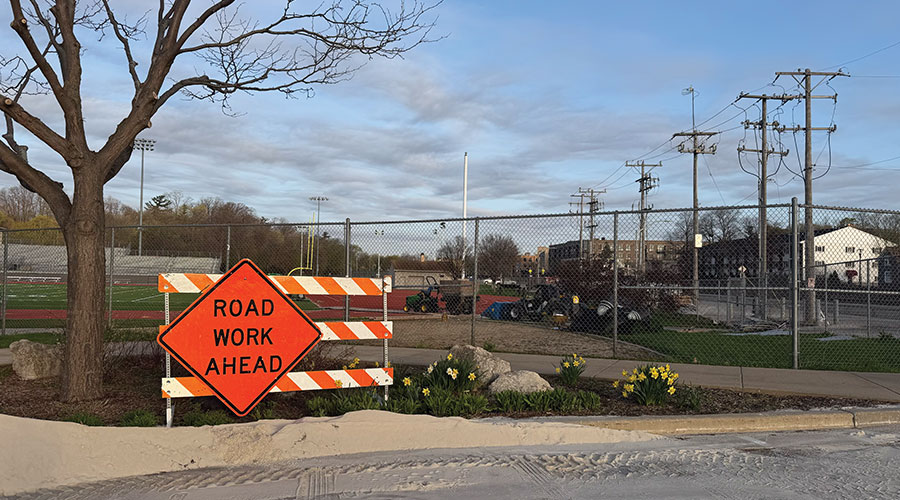
Hart Park has a target date of May 15 to complete repairs to its stadium. However, in April 2026, Milwaukee and the surrounding area experienced another round of flash floods, with certain neighborhoods getting over 7 inches of rain in one night. Fortunately, this time the park was spared.
“What you learn in the trade is that you can’t plan for weather. You just do the best you can with what you’ve got,” Simpson says. “I think the biggest thing is just understanding where your risks are. We obviously knew Hart Park was at risk of flooding, so we planned for that. If you can identify from your facility’s perspective any critical components that might in the floodway and move those out as replacements occur.”
Mackenna Moralez is the managing editor of the facilities market and the host of the Facilities in Focus podcast.
Related Topics: