How Modern Sensors Transform Building Lighting
As workers return to offices, schools and clinics, interest has surged in human-centric lighting.
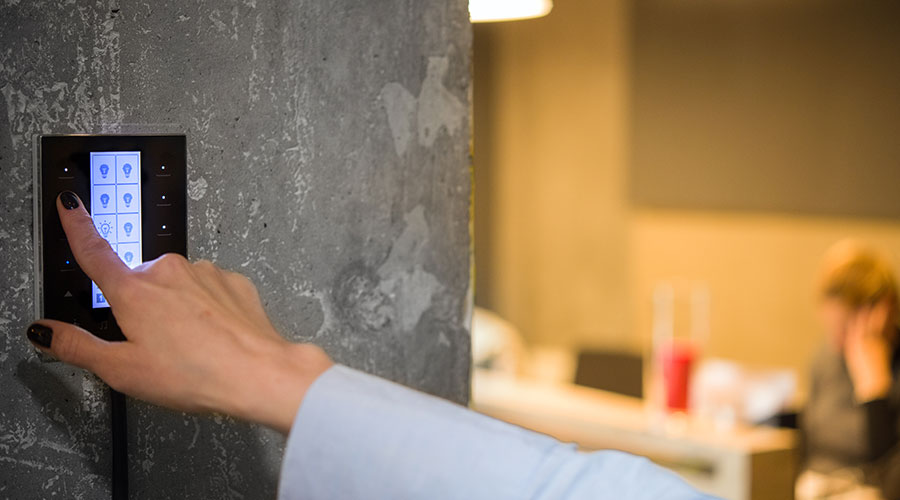
If lighting controls are the brain, sensors are the senses. Done right, they reduce waste without compromising experience. Done wrong, they frustrate occupants.
Two rules will keep managers out of trouble. First, pick the right sensing technology for the space. In enclosed rooms such as private offices, conference rooms and restrooms, dual-technology detection — for example, passive infrared lighting (PIR) paired with acoustic or ultrasonic — catches both gross and subtle motion, ensuring a quiet person does not end up in the dark. In open offices, per-fixture PIR embedded in an LLLC often works well because software grouping creates redundancy. Multiple sensors share responsibility for keeping an area alive, reducing nuisance shut offs.
Second, plan lighting coverage for the tasks people perform, not just for square footage. Desks move. Teaching positions shift. A sensor that looked perfect during the planning phase might miss the area where someone now spends hours. While most networked devices rely on low-power PIR, pairing with ultrasonic or microphonic sensing can improve reliability and prove invaluable for battery-constrained nodes.
Daylight, data and HVAC
Where daylight reaches the floor, daylight harvesting becomes the quiet workhorse, dimming electric light to maintain target illuminance. The new twist is data sharing. Modern NLC and LLLC systems can publish occupancy and light-level information to the building automation system (BAS), which in turn can shape HVAC responses in real time.
“We have been able to dial in air systems based on occupancy sensor data,” Terry says, describing projects where mechanical energy reductions rival the lighting savings. Once data flows across systems, the biggest energy winner can be HVAC.
The practical move for managers is to bring the BAS contractor into the lighting conversation early. Managers can help confirm that the lighting platform can export clean points — what, how often and in what format — and that the BAS can consume them securely without adding delay or fragility. This approach helps define responsibilities for point mapping, network security and fault handling before installation.
As workers return to offices, schools and clinics, interest has surged in human-centric lighting, which features tunable color and adaptive brightness that support alert days and restful evenings. The opportunity is genuine. With effective programming, tunable scenes can enhance comfort, task performance and perceived quality without inflating energy use. The discipline is to specify by physiology, not by marketing.
“The link between lighting spectrum and intensity versus measurable outcomes is complex and is not predicted well by correlated color temperature,” Nock says, adding that the practical fix is to specify by spectral power distribution and use melanopic or equivalent biological metrics via tools, such as the International Commission on Illumination alpha-opic toolbox or the Light and Health Research Center CS Calculator to shape day and evening scenes.
“Owners have taken advantage of the calming/energizing nature of color tuning or tracked daylight for interior spaces,” Terry says noting that improving efficacy allows these enhancements without breaking energy budgets.
Though innovation continues with circadian-optimized spectra, luminaires with more blue-rich content by day and less at night and even wearables that place light close to the eye, delivering biological stimulus with a fraction of the whole-space electric load. The through-line is to document intent, measure what is possible, and balance circadian aspirations with glare control, visual comfort and energy targets.
Lighting in a crisis
All roads lead back to life safety. Emergency egress lighting is not optional, and the wrong architecture can saddle facilities teams with unmanageable testing or single points of failure.
“Central generators or battery storage are costly and have a single point of failure,” Nock says, summarizing one end of the spectrum. “Distributed inverters mean more devices, but if one fails, the whole building won’t be in the dark.”
At the other end, unit equipment — fixture-level batteries — wins on first cost but can leave technicians tracking and testing hundreds of devices.
“Self-testing systems can help ensure that emergency lighting is operational and manage required test reports, provided they’re installed, programmed, and documented correctly,” Nock says.
For managers, field verification matters as much as the architecture.
“Ensuring the uniformity of the egress path is critical,” Terry says. Centralized inverters offer on-board screens or cloud notifications, which reduce the testing burden compared to scattered unit equipment. But commissioning still plays a crucial role in determining success. Technicians should verify that shunt relays are sensing the correct unswitched leg by walking the path under emergency power and checking for interactions with other life-safety systems, such as smoke doors, that could block illumination when it is needed most.
If the broad picture for managers is a lighting system that saves energy and enhances safety, the near-term specifics are about using the data managers already possess. Emerging NEMA/ANSI C137.9 configuration reports help facilities teams confirm that settings have not drifted. Many NLC platforms issue fault notifications, so when a node drops offline or a load signature changes, technicians can fix problems before they become complaints.
Data also grounds safety.
“We had a warehouse where light levels slipped so far staff wore headlamps,” Schetter says. The LED-plus-controls retrofit did not just cut kilowatt hours. It restored code-appropriate illuminance.
A pragmatic path forward
From trend to action, the playbook is straightforward. Managers should begin with a pilot where the odds favor them — long operating hours, daylight to harvest and cooperative occupants. They should use LLLC for fast, wireless zoning and robust sensing. They should write the sequence of operations like they mean it, commission scenes in the actual space, and train the people who will own the user interface.
By integrating lighting data with the BAS so variable occupancy can trim HVAC, managers can uncover the most significant savings. They can specify human-centric lighting by SPD and melanopic targets rather than color-temperature slogans and treat emergency lighting like the critical system it is. Then they can select architecture technicians who can maintain, document self-testing and reporting procedures and verify egress uniformity on backup power.
LEDs gave facilities a new engine. Controls, sensing and commissioning are the transmission, suspension and brakes that make that engine safe, comfortable and inexpensive to run for the long term.
Experience shows that the most reliable savings and safety outcomes are achieved when managers design and operate lighting as an integrated system rather than a collection of parts.
Joel Williams is a freelance writer based in Frankfort, Illinois.
Related Topics: