Fault Detection and Diagnostics Helps Buildings Catch HVAC Problems Early
Fault detection and diagnostics can cut HVAC maintenance costs, improve occupant comfort and support commercial asset value.
Key Takeaways:
- FDD continuously analyzes building automation data to identify emerging HVAC faults, enabling technicians to address small issues before they become costly equipment failures or occupant comfort complaints.
- Successful FDD programs depend on accurate, well-structured building data, since poor automation-system inputs limit the reliability and value of diagnostic results.
- Beyond operational savings, a documented FDD program can demonstrate that a property is well managed, lower risk and potentially more valuable during an asset transaction.
Fault detection and diagnostics (FDD) have arrived in institutional and commercial facilities. Are owners prepared to take advantage of the technology?
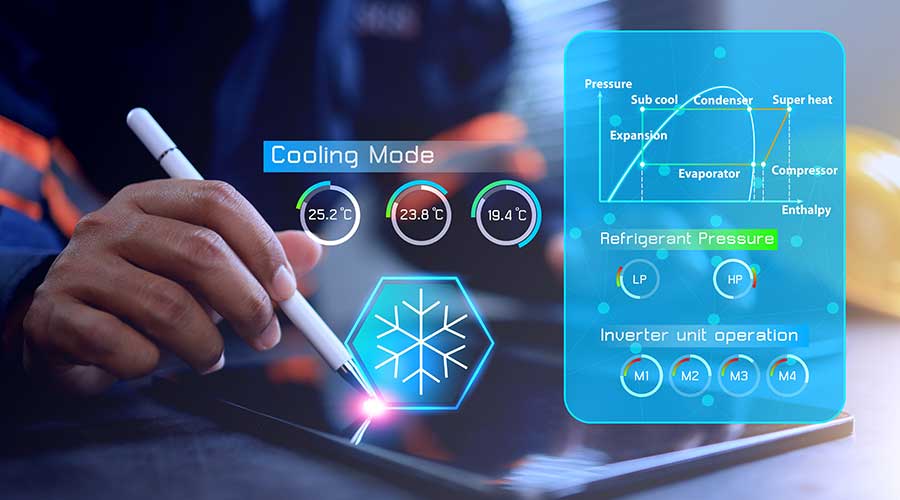
The goal of FDD is to optimize HVAC equipment maintenance costs while improving the reliability, availability, maintainability and safety of the equipment. FDD functions by continuously monitoring and analyzing condition monitoring data and detecting problems. Algorithms then process the data to produce failure alerts to technicians to enable a response before a small problems becomes large.
Building Operating Management discussed the status, benefits and challenges related to FDD with Christian Whitaker, global head of technical services and sustainability with JLL, to hear his insights on the potential of the technology for facilities.
BOM: In general, how aware are building owners of FDD?
Whitaker: Awareness (of FDD) is climbing and is relatively high. The concept of smart buildings or intelligent building operation has been around for a while. This is not a new concept. Fault detection and diagnostic work has been happening for probably close to 20 years — relatively soon after the adoption of DDC controls by most of the major vendors. That ultimately resulted in this being a capability.
I want to make sure we call out the distinct difference between fault detection as a system and as a tool versus fault detection and diagnostics. It’s the “and diagnostics” part that the industry has yet to wrap its head around fully. We haven’t really coalesced around a single model. In terms of adoption, that’s where there’s a lot of discrepancy.
Awareness is high, but the value proposition for these systems and tools is driving a highly varied amount of adoption, depending on the industry, the asset class (and) the type of facility that it is.
There are some guidelines that are helping (drive adoption). ASHRAE Guideline 36 (High-Performance Sequences of Operation for HVAC Systems) is definitely helping that, being able to have a standard sequence of operation as a standard approach to how you would do this in new and retrofitted buildings.
BOM: What is the biggest hurdle among building owners implementing FDD?
Whitaker: The biggest challenge the industry has is what I refer to all modeling problems — garbage in, garbage out. FDD is only as good as the underlying building automation points that you’re pointing your system at. The data quality you’re receiving is incredibly important to the analysis itself and the quality of the analysis you’re going to get out of these systems.
Most programs tend to underestimate how much time and budget is needed to go into fixing bad underlying structural data before you can really use these tools to accelerate and capture a lot of value. A good analytics layer isn’t going to help you much if the data layer is bad.
Problem two is that just having a fault detection system — even a good one with good diagnostics — won’t fix decades of deferred maintenance. It will tell you what that deferred maintenance is costing you in terms of dollars and in terms of equipment life. But that diagnosis is not a cure. Broken equipment is still going to need to be fixed before it can be optimized.
BOM: What are the benefits of FDD technology that align best with issues owners are most concerned about?
Whitaker: Putting aside some of the operational concerns, occupant satisfaction. The initial thought is, ‘I’ve got an FDD system. It’s going to help me fix the building. It’s going to perform better. I’m going to have happier occupants. Happier occupants lead to better rents. Better rents equals more asset value.’ That’s the sequence of logic that an owner might look at from the perspective of FDD.
But I would argue that things like comfort complaints are usually the last symptom, not the first. A good system will start to catch those problems before they become comfort problems. You’ll start to catch things like temperature drift, humidity drift (and) air quality concerns before they reach a point that a tenant calls a facilities manager. That improves the overall occupant experience because you’re solving that before it actually becomes a problem.
Now on the portfolio value impact, a documented, well-constructed FDD program is starting to function as evidence of a well-run, lower-risk asset when you’re starting due diligence on an asset transaction. An owner might look at it as further evidence ‘that I have a well-run asset that is worth more than an asset that does not have a system in place or does not have evidence to support that it is operating at a higher functional level.’ That’s a very easy one to translate into potential asset value.
Dan Hounsell is senior editor for the facilities market. He has more than 30 years of experience writing about facilities maintenance, engineering and management.
Related Topics: