Tree Canopies Help Cool Cities and Strengthen Climate Resilience
A nationwide study found that neighborhoods with abundant tree cover are significantly cooler than those with little vegetation.
By Ronnie Wendt, Contributing Writer
Key Takeaways:
- Greater tree canopy measurably reduces urban heat, with the greenest neighborhoods averaging nearly 1 degree Fahrenheit cooler than areas with the least tree cover and some cities seeing temperature differences of up to 4 degrees.
- Green infrastructure delivers benefits beyond cooling, helping reduce stormwater runoff, lower building energy costs, improve occupant well-being and strengthen climate resilience in parks, campuses and commercial properties.
- Researchers say trees should be treated as essential infrastructure, encouraging facility managers, building owners and municipal planners to incorporate tree canopies, bioswales and other climate-appropriate landscaping into long-term resilience strategies.
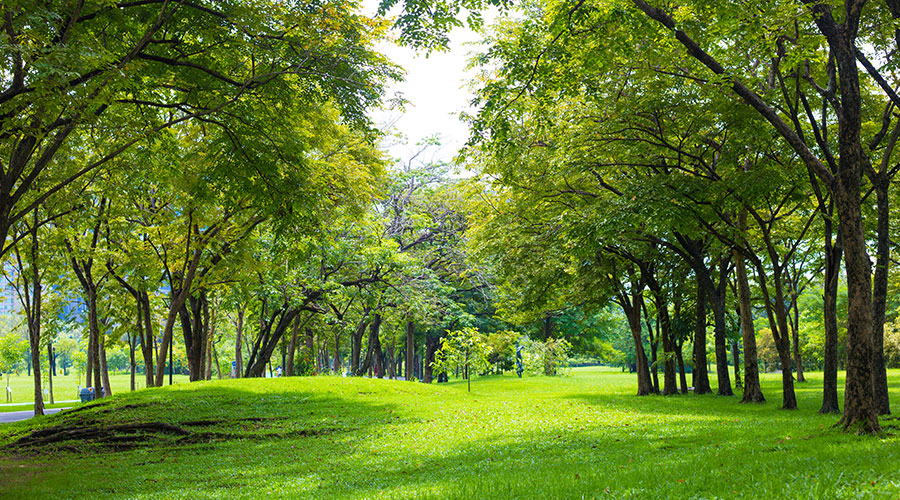
On a blistering summer afternoon, the difference between walking across a treeless parking lot and stepping beneath a canopy of mature trees feels dramatic.
According to new research from the Healthy Green Spaces Coalition, that temperature difference is more than just perception; it is measurable. The study, which analyzed over 36,000 census tracts across 65 U.S. cities, found a consistent relationship between tree canopy and lower urban heat island intensity.
The study found that neighborhoods in the greenest canopy quartile averaged nearly 1-degree Fahrenheit cooler than neighborhoods with the least tree cover. In some cities, the temperature differences reached between 2 and 4 degrees.
For municipal planners, park systems and facility managers, those numbers carry implications that extend beyond comfort
As cities contend with rising temperatures, more frequent heat waves and growing infrastructure demands, researchers say parks, tree canopies and green corridors will be essential components of urban resilience planning.
Heat at the Neighborhood Level
Concrete jungles, areas with 10 percent or less green cover in cities, are prone to heat islands. Urban heat islands occur when roads, rooftops, parking lots and buildings absorb and retain heat, raising temperatures in urban centers.
Steve Whitesell, executive editor of the Healthy Green Spaces Coalition report and CEO of climate technology firm Radian Developers, says the effects can even occur on a block-by-block basis. Trees planted in these locations can, however, counteract this effect.
“Every single location [we studied] showed that a tree canopy can help lower temperatures in the area,” he says.
These findings are relevant for public parks, athletic complexes, playgrounds and civic gathering spaces where people spend extended periods outdoors during peak summer temperatures. Whitesell points to metal bleachers and synthetic athletic fields as examples of areas where heat can have an extreme effect.
“What city planners can do is plant trees to the west of the bleachers and the field, so that during the hottest period of the day, from 1 p.m. to 4 p.m., spectators do not feel like they are in the frying pan,” he says.
Trees work synergistically with turf and vegetation to cool surrounding environments through evapotranspiration, a natural process in which plants release moisture into the air.
“The trees in a park shade the grass and lower the amount of water or irrigation the grass needs, but as the grass naturally evapotranspirates, it also cools off the trees,” Whitesell says. “It’s the cyclical effect that can dramatically add to a cooling effect in a park.”
More Than Shade
While urban greening centers on tree planting for cooling, research shows adding green spaces also enhances mental health, reduces stress and decreases violent crime.
“There’s less crime in these places,” he says. “People can concentrate better. The studies are pretty staggering.”
In fact, one study found that greener neighborhoods experience lower heat-related mortality rates. A UK-based study referenced in the report estimated that existing urban trees prevented approximately 153 heat-related deaths between 2015 and 2022.
In commercial buildings and office campuses, green infrastructure helps boost employee productivity while lowering operational costs. Those findings are increasingly important as facility managers seek ways to reduce cooling loads and manage rising energy costs during extreme summer heat.
“Study after study shows that having trees around a building lowers your energy costs and enhances worker productivity,” Whitesell says.
Green Infrastructure Beyond Trees
Urban cooling strategies have also evolved beyond traditional park spaces and street trees.
Whitesell points to bioswales, which are landscaped depressions designed to capture and slow stormwater runoff, as an example. He notes bioswales have emerged as another critical tool for managing heat and flooding.
“We are not just contending with heat in urban areas. We are also dealing with flooding,” he explains. “These landscaped slope depressions help capture stormwater runoff, so that water penetrates soil rather than rushing into storm drains during intense rainfall events, which researchers say are becoming more common as climate patterns shift.”
The report also emphasizes that green corridors, which are interconnected stretches of vegetation that can cool urban zones and improve walkability, can also help cities manage stormwater runoff.
These advantages are the reason Whitesell advocates that municipal leaders recognize trees and vegetation as vital infrastructure.
“Municipal planners, city managers, building owners and facility managers should think about trees as part of the core infrastructure,” he says. “Trees, turf and bioswales will reduce heat around the building, and ??reduce stormwater runoff and flooding.”
Climate Change and Water Concerns
The report arrives as many regions grapple with worsening drought conditions and growing concerns over long-term water availability.
Whitesell, who lives in Utah, described the western United States as being in what researchers call a “snow drought,” where precipitation falls as rain instead of accumulating as mountain snowpack, which traditionally replenishes reservoirs through gradual melting.
Those water concerns are becoming more complicated as expanding communities, agriculture and energy-intensive infrastructure such as data centers increase water demand. In fact, Whitesell notes a recent University of Texas study estimates that up to 9% of total water use in Texas alone could eventually go toward cooling data centers.
For that reason, researchers stress that urban greening efforts must be paired with climate-appropriate landscaping and smart irrigation technologies. Whitesell highlights drought-tolerant turf varieties and smart irrigation controllers that automatically adjust watering schedules based on rainfall and weather forecasts as beneficial solutions.
“There are a lot of new studies out on lower water use turf,” he adds. “We put in low water use turf ?in our yard ?because we live in a desert.”
Planning for the Future
There is no single solution to urban heat or climate resilience challenges. Instead, Whitesell believes long-term progress will come through thousands of incremental decisions made by municipalities, facility managers, planners, businesses and residents.
“It will not be one thing or one policy or one technology that’s going to fix the problems,” he says. “It’s going to take thousands of decisions that we all make every day.”
Still, the report makes one conclusion abundantly clear: greener neighborhoods are cooler neighborhoods. And as cities continue to warm, the shade from a tree may become one of the most valuable pieces of infrastructure city planners can invest in.
Download the report at https://greenspacescoalition.org/green-neighborhoods-are-cooler/ to learn more about how green spaces can help cities beat the heat.
Ronnie Wendt is the owner of In Good Company Communications and a freelance writer specializing in articles for the facilities management, aviation, RV and automotive, meetings and events, security, logistics and business technology industries.
Related Topics: