Coming Soon: Facilities That Also Happen to be Farms
Vertical farms offer new, unique option for building owners looking for ‘tenants’.
By Ken Sandler, Facility Influencer
What if your most important tenants were not people but, well, crops? The coming of a new “vertical farm” industry is turning that unusual vision into reality.
The idea behind what is also called “Controlled Environment Agriculture” (CEA) starts with the fact that fresh produce travels over 1,500 miles on average from farm to table before being consumed. While humans have been working the land for over 12,000 years, it’s a very different proposition in a complex global economy in which most people live in urban or suburban environments.
The multiple concerns with our global industrialized food system range from the existence of “food deserts” in which many people lack access to fresh, nutritious food to the increasing desire and market for food that is healthy, safe, high quality and free of harmful pesticides. The idea of bringing food production closer to its consumers is manifesting itself in the development of a new sector experimenting with how to turn buildings into indoor farms.
I had the pleasure of recently touring one such facility in Arlington, Virginia, called Area 2 Farms. This startup took over a warehouse in a light industrial area with some assistance from the Virginia Department of Agriculture and Forestry and the Arlington Industrial Development Authority and is now showing a profit based on subscriptions to its Consumer Shared Agriculture (CSA) program of local produce deliveries.
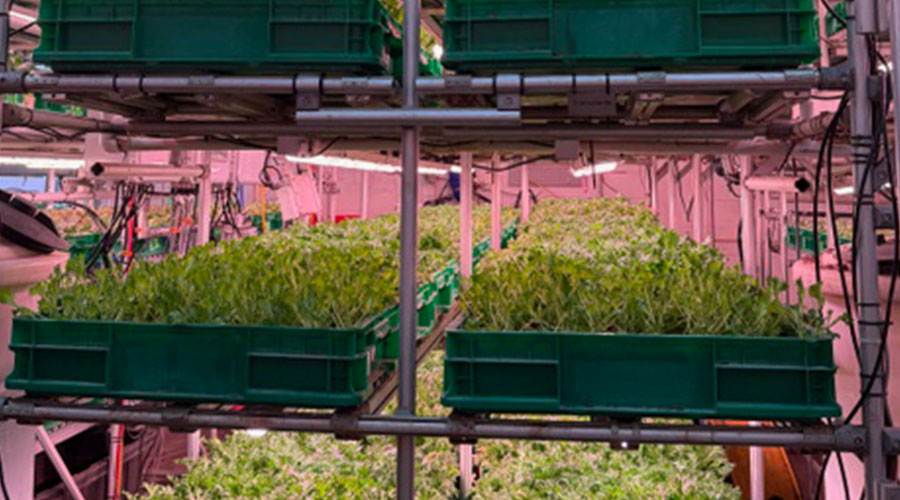
Area 2 Farms uses rows of stacks of its trays of vegetables – about 20 varieties of greens, plus such root vegetables as carrots and turnips – on a device they call “the Silo,” a system resembling a massive rotisserie with micro-robotic controls for rotating the time they spend directly under the LED lights vs. hidden underneath in the dark. By simulating night and day in this fashion, the system allows plants to undergo their daily respiration cycle, through which they absorb oxygen under the light and mostly expel carbon dioxide in the dark. This takes some burden off the ventilation system, so it doesn’t have to manage a building-wide influx of CO2 all at once.
Unlike some other vertical farms, Area 2 Farms grows its crops in soil – in their case, a nutrient rich compost mixture enriched by coconut shells, their own vegetable waste and homegrown worms. Other sometimes more high-tech vertical farming approaches include:
- Hydroponics: Growing crops in nutrient-enriched water;
- Aeroponics: Allowing plants’ roots to hang in the air, to be misted with nutrient solutions;
- Aquaponics: Combining fish farming with crop cultivation, with fish waste providing extra nutrients;
- Container Farms: Equipping large shipping containers with LED lighting for indoor plant cultivation.
Like humans, plants seek spaces with optimal levels of warmth, humidity and fresh air. They may not complain to their facility managers about poor conditions but will register protests by drooping and wilting.
Needless to say, keeping pests out is a big issue. Area 2 Farms is organic, an obvious selling point to its customers, and it applies a variety of integrated pest management (IPM) techniques, from sticky traps to deploying beneficial insects to, as a last resort, applying more natural solutions like neem oil to stop invaders.
Keeping a farm within the controlled environment of a carefully managed facility allows for many other opportunities to improve agricultural sustainability. The fertilizer used by Area 2 Farm is based not on petroleum, but on molasses. The facility also carefully controls and recycles the water it uses.
The problems of diesel farm equipment belching out smoke, local water supplies depleted and polluted by excessive irrigation and pesticide-laden runoff as well as wilderness lost to agriculture are not issues when the farming is done indoors. And, of course, when produce does not have to be transported across the country or world, the savings in vehicle emissions can be enormous.
To be sure, the different CEA technologies all require different levels of energy, water and nutrients to keep going. In some cases, the need for these inputs has proven excessive, leading to expenses that have helped sink some prominent vertical farming companies. As with any cutting-edge new technology, CEA has growing pains to overcome before it can become widespread.
Area 2 Farms wisely takes a community-oriented, open, transparent approach to guide it through those growing pains. The CSA subscription model makes this business and others like it partners with the community in the pursuit of healthy, local food rather than having to deal with the whims of large distributors like supermarket chains (though that alternative business model may hold promise for the future too).
Area 2 Farms is expanding through a franchising approach, starting with a new facility being constructed in the nearby suburb of Fairfax and plans to go nationwide. Other CEA ventures looking to expand include Washington, D.C.’s Our Farm and the high-tech Infinite Acres.
So be ready for a future in which some of your tenants may be of the edible, leafy variety. You may have the pleasure of serving them in more ways than one!
Ken Sandler, Ph.D., is a clean energy and sustainability analyst and thought leader who spent 35 years advancing green building and sustainability policies and programs across the federal government. In addition to being a FacilitiesNet sustainability columnist and Facility Influencer, he writes his own newsletter, Regenerative Futures, available on LinkedIn and Substack.
Related Topics: