Protecting Vulnerable Populations During Natural Disasters
Readiness requires a plan, effective training, and a preparedness-focused culture.
By Ronnie Wendt, Contributing Writer
It looked like a disaster from a “Grey’s Anatomy” episode, but it was a real-life event.
Brown floodwaters surged over a washed-out road and winds howled against the walls of Unicoi County Hospital, while staff at the rural Tennessee hospital moved patients to the roof for a daring helicopter rescue.
In another natural disaster many states away, wildfires pushed California caregivers to the brink.
As the Los Angeles fires intensified, evacuation orders came for several long-term care facilities. Again, staff and emergency teams raced against time to rescue at-risk residents.
Disasters like these expose the unique challenges faced by facility executives in healthcare facilities that care for vulnerable populations with diverse needs. Here, preparedness can make a difference.
“We don’t want to be alarmists,” says Glenn Thomas, director of Safety and Risk Management at Continuing Life, a group of continuing care retirement communities (CCRCs) where residents can age in place, which means residents range from fully independent retirees to those requiring skilled nursing or memory care. “But we want to be prepared. Because when the moment comes, preparation saves lives.”
The California Association of Health Facilities (CAHF), which represents skilled nursing and intermediate care facilities in California, has developed emergency response best practices for long-term care facilities.
“Most of the nursing homes in our state use templates and emergency operations plans and the incident command system (ICS) we developed for nursing homes,” says Jason Belden, CAHF director of emergency preparedness and physical plant services.
Events like fires and flooding show that emergency plans must account for a spectrum of different needs.
“There is no one-size-fits-all approach (to emergency response),” Thomas says. “Emergency preparedness must be built around each level of care, which is governed by different regulatory bodies with different standards.”
Start at the very beginning
The foundation of any effective response plan begins with a hazard vulnerability assessment (HVA). Whether running a school, managing a busy factory floor, or operating a complex healthcare facility, this critical first step sets the stage for everything that follows, Thomas says.
“The most important element of emergency planning is taking a hard look and being realistic about your hazards, then taking steps to build an emergency plan,” he says.
It sounds simple, but this process requires deep insight and open dialogue across the organization.
An HVA puts leadership and operational teams around the same table to examine actual risks and prioritize concerns specific to their environment. For a manufacturing plant, this might mean confronting the potential dangers of toxic chemicals. In a pediatric hospital, the possibility of infant abduction could rank high. In high-stress workplaces, the threat of workplace violence might top the list.
“Whatever hazards exist, you have to consider them,” Thomas says. “That becomes your starting point for building emergency plans. You do your hazard vulnerability assessment. Rank your top five to 10 hazards, then build your plans based on that list.”
Check every box
Once an organization has an HVA, the next step is transforming those risks into a real-world response plan. This is where bringing in experts can make a difference, Thomas says.
“Local emergency responders — whether it’s police, fire, or EMS — are almost always willing to partner with businesses and healthcare facilities to develop an emergency plan,” Thomas says. “Such collaboration helps first responders understand what we feel the biggest hazards are, what they may need to respond to, and what hazards they may encounter when they respond.”
But Thomas is quick to point out that while expert input is essential, so is originality.
“There are a lot of great templates for disaster or emergency plans already available,” he explains. While templates can be a helpful starting point, he warns against falling into the “paper compliance” trap — the practice of downloading a generic plan, putting it in a binder, and calling it done.
“That binder might check a regulatory box,” Thomas warns, “but it will not help you when the power goes out, the roads close, a fire is approaching, and you’re trying to move 800 people to safety.”
The solution? Customization and training.
“You need to develop the plan, consulting with people that can help you fine-tune it,” Thomas says. “Then you need to learn the plan, educate employees on it, and train to the plan.”
Train to the plan
Preparedness starts and ends with frequent and proper training.
“Training is the most important element of emergency planning,” Thomas says. “It helps everyone understand what their roles are, what their capabilities are, and what they need to do during an emergency.”
While regulatory standards require organizations to review emergency plans and train employees annually, Thomas is quick to note that’s just the floor — not the ceiling.
“That’s the bare minimum,” he says.
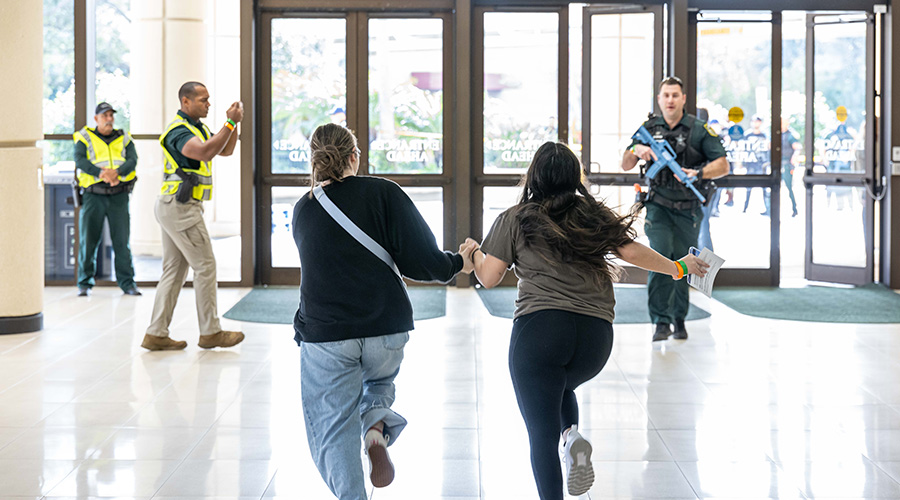
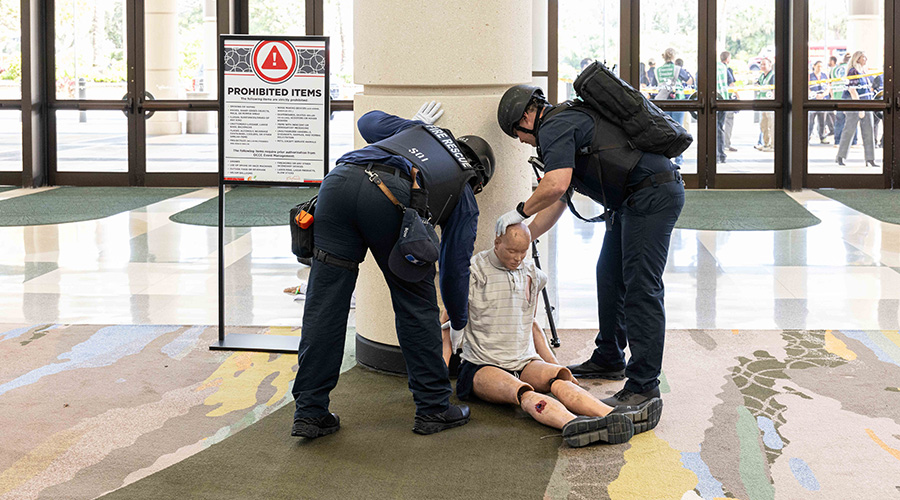
Most healthcare facilities conduct semi-annual training that ranges from tabletop discussions to full-scale emergency drills. These exercises simulate real-world scenarios designed to test and fine-tune response efforts.
Drills engage all employees, simulating their roles in crisis response.
“We might have people performing first aid, people setting up triage areas, and people isolating utilities and shutting off gas and power,” he says. “We customize the scenario, then have people in the field exercising and doing these things.”
Belden likens frequent training to an athlete practicing a sport.
“The more you practice, even just through conversations or mini scenarios at shift changes, the more second nature your response becomes,” he says.
But training isn’t just about muscle memory. It also includes making sure the plan is up to date. Thomas recommends a thorough review annually, starting with the HVA. Changes in the surrounding environment, he says, can dramatically shift a facility’s risk profile and must be accounted for.
“Maybe a new lithium battery facility has been constructed next door, and it changes your top hazards,” he says. “You need to sit down, revisit your HVA, and update your plan accordingly.”
The review must also update emergency contacts and phone numbers. “You do not want to discover during an emergency that your emergency contact or phone numbers are incorrect,” Thomas says. “You need to be prepared to respond at a moment’s notice.”
Being prepared means planning not just for the likely, but for the worst-case scenario — a large-scale disaster where emergency services may be delayed or unable to respond at all.
“Don’t assume first responders will come,” Thomas says. “You must build a plan as if you are on your own.”
For Continuing Life, that mindset has led to the development of on-site emergency trailers stocked with essential supplies, from food and water to lighting and medical equipment. Each Continuing Life community maintains its own trailer, ready to support shelter-in-place operations or evacuations without outside help.
Account for special needs
The challenges of evacuating nursing homes, skilled nursing facilities and hospitals are immense. Many residents and patients have significant mobility limitations and rely on complex medical equipment, Belden says.
“You must consider things like glasses, dentures, hearing aids, medications — and make sure nothing is left behind,” he says. “You can't be printing medical records while you're evacuating.”
Belden shares facilities need a phased evacuation approach for rapid-onset emergencies. It begins with monitoring local alerts like red flag warnings, starting ICS protocols early, and having go-bags and documentation ready before an evacuation order.
“We have a special section in our emergency management plan that addresses evacuations and sheltering in place,” Thomas says. “It considers evacuations and how we would do it. The first step is our Special Needs List.”
This real-time, dynamic registry of residents lists the individuals who will require additional support in an emergency. Does the resident have a hearing or vision impairment? Need a walker or wheelchair? Do they have CPAP machines? Are they on oxygen or in hospice? This list helps staff, and first responders, prioritize care during evacuations.
“We give this list to first responders,” he says. “We can say, ‘We’re actively evacuating. Here is our plan and what we are doing. Here are the residents who require additional assistance and what their considerations are.’ Having that list helps us address the most vulnerable populations here.”
Resident care is a core focus that should begin long before an emergency, according to Thomas. He says hosting town halls and presentations with residents can encourage personal readiness, including maintaining a “grab and go” bag filled with essentials, such as medications, flashlights and important documents.
“Prepared residents make an enormous difference in an emergency,” he says. “They’re not waiting to be told what to do. They are ready to act.”
For skilled nursing facilities, residents must be transported to another skilled nursing facility. This is where things can get tricky, requiring preplanning.
“You need to think about how you are going to get them there. How many buses do you have? Can you get ambulances?” Thomas asks. “The best-case scenario is an emergency that only affects the facility, where you can call 911 and get a large response. The worst-case scenario is like what we saw in LA, where the emergency affected the entire county and resources were stretched. How do you take care of things when you cannot get the level of response you need?”
Consider communication channels
Communication during an emergency is essential. Build communication channels before they are needed, Thomas says.
“A key component of emergency management is effective communication. You need a communication plan,” he says.
Continuing Life enacted the first part of its communication plan during the wildfires, monitoring the situation on the news and various apps including the Watch Duty app, which uses a network of maps and cameras to offer real-time data on natural disasters.
Staff used this information to stay alert and prepared and shared it with residents to keep them up to date.
“During an emergency, you want to gather crucial information and disseminate that information to whomever needs it,” Thomas says. “That requires proactive monitoring of the situation to help you make decisions.”
Real-time information enabled Continuing Life staff to prepare equipment and supplies, stage equipment for potential evacuations, and offer vehicles to aid other communities.
“We were also monitoring and in communication with local healthcare coalitions and other communities to see how we could help them,” Thomas says. “We asked them what supplies, equipment or assistance we could send.”
He states that while the fires didn’t directly impact Continuing Life facilities, they tested their readiness. “We offered bed space, vehicles, equipment and even staff to support facilities that had to evacuate,” he says.
Communication also includes knowing who is in charge. Incident command should never be ad hoc, says Belden. Everyone should know who the incident commander is on every shift and those commanders must be trained accordingly.
CAHF offers free training in the Nursing Home Incident Command Systems, a simplified version of the Hospital ICS. CAHF also encourages facilities to use ICS in non-emergency scenarios to build familiarity and confidence in the structure.
Emergency preparedness in healthcare and long-term care facilities requires tailored planning, constant training, and collaboration to protect the most vulnerable. When seconds count, preparation isn’t just practical — it’s lifesaving.
Ronnie Wendt is a freelance writer based in Minocqua, Wisconsin.
Related Topics: